



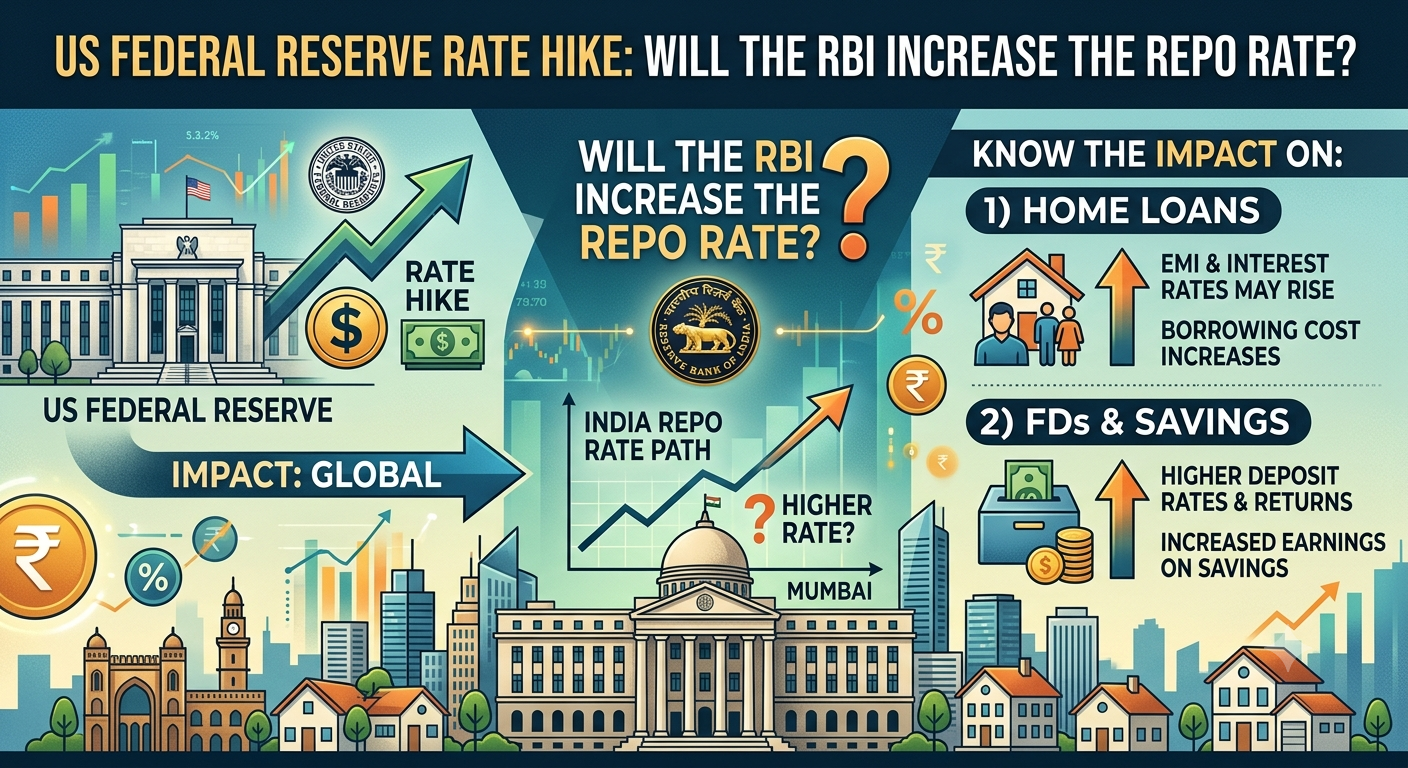
The US Federal Reserve has increased its benchmark interest rate by 25 basis points, pushing the federal funds target range to 3.75%-4%. This US Fed Rate Hike comes as the US central bank announced the decision on September 16, 2026, amid continued concerns over elevated inflation.
The US Fed rate hike has once again put the RBI repo rate in focus. Indian borrowers and fixed deposit investors are now watching whether the Reserve Bank of India (RBI) could follow with a rate increase and how such a move might affect home loan interest rates and FD interest rates.
At its August 2026 monetary policy meeting, the RBI kept the repo rate unchanged at 5.25%.
So, could the RBI raise the repo rate following the US Fed rate hike? Here is what Indian borrowers and FD investors should know.
What Happened After the US Fed Rate Hike?
The US Federal Reserve raised its benchmark interest rate by 25 basis points, increasing the federal funds target range from 3.50%-3.75% to 3.75%-4%.
In its September 16 statement, the Federal Reserve said that US economic activity continues to grow at a steady pace, while inflation remains high. The rate increase is intended to help bring inflation closer to the Fed’s 2% target.
The US Fed rate hike can affect global financial markets because changes in US interest rates can influence capital flows, currencies, bond yields, and borrowing conditions in other countries.
However, the US Fed rate hike does not mean that the RBI will automatically raise the repo rate. The RBI will consider India’s own inflation, economic growth, and other domestic factors before making a decision.
Will RBI Increase Repo Rate After US Fed Rate Hike?
1. The RBI repo rate is decided by the Monetary Policy Committee (MPC) based on India’s economic conditions.
2. The US Fed rate hike can affect global financial conditions and may be considered by the RBI, but it is not the only factor that influences the RBI’s rate decisions.
3. In its August 2026 policy review, the RBI kept the repo rate unchanged at 5.25%.
4. The RBI also looks at factors such as inflation, economic growth, liquidity, and financial stability before deciding whether to change the repo rate.
5. Some analysts expect the RBI could consider rate increases later in 2026. SBI Research has suggested two 25-basis-point hikes in October and December, citing inflationary pressures, crude oil prices, and external shocks.
6. These rate-hike suggestions are analyst views and not official announcements from the RBI.
Therefore, the US Fed rate hike does not automatically mean that the RBI will increase the repo rate. The RBI’s next decision will depend mainly on India’s domestic economic conditions and the MPC’s assessment.
Why Does the US Federal Reserve Rate Matter to India?
A rise in US interest rates can influence global investment flows as investors compare returns across countries.
When US rates stay high, some investors may move money towards US dollar-based assets. This can put pressure on emerging-market currencies and financial markets, including India.
For India, changes in global financial conditions can affect:
- Indian rupee: Changes in global fund flows can influence the rupee’s value.
- Foreign investment flows: Higher US rates may affect how global investors allocate money across markets.
- Bond yields: Changes in global interest rates can influence Indian bond yields.
- Imported inflation: Changes in commodity prices and the rupee can affect the cost of imports.
- Domestic borrowing costs: Global rate movements can influence borrowing conditions in India.
- Financial liquidity: Changes in capital flows can affect liquidity in financial markets.
However, the RBI considers these global factors along with India’s inflation, economic growth, and other domestic conditions before making a decision on the repo rate.
What Could a Repo Rate Hike Mean for Home Loans and FDs?
A repo rate hike can make borrowing more expensive for people with floating-rate loans, especially home loans linked to external benchmarks.
According to Adhil Shetty, CEO of BankBazaar, if the repo rate rises to 5.75%, floating-rate loans such as home loans could be affected, as their rates are linked to external benchmarks.
- For home-loan borrowers, a higher interest rate could result in:
- Higher EMIs
- A longer loan repayment period
- Or both, depending on how the bank resets the loan rate.
- Borrowers would generally see these changes when their loan reaches its next reset date.
- For fixed deposits (FDs), a repo rate hike does not necessarily mean banks will increase FD interest rates by the same amount.
- Banks decide their FD interest rates based on factors such as:
- Their liquidity needs
- Funding requirements
- Asset-liability management
- Competition with other banks
- The maturity period of the FD
Therefore, banks may revise FD interest rates selectively, depending on their individual financial and business requirements.
Understand this with an Example
Suppose a borrower’s home loan is linked to the RBI repo rate. If the RBI raises the repo rate, the lending rate could also rise depending on the bank’s benchmark and spread.
A higher interest rate can result in:
- A higher EMI, if the loan tenure remains unchanged; or
- A longer repayment period, if the borrower keeps the EMI broadly unchanged.
The actual impact depends on the loan amount, outstanding principal, remaining tenure, interest rate, and the bank’s reset mechanism.
RBI data also show that monetary-policy changes can transmit to housing loan rates. The central bank has previously noted that external benchmark-linked lending improved the transmission of policy-rate changes to borrowers.
What Should Existing Home Loan Borrowers Check?
Existing home loan borrowers should first check which benchmark their loan is linked to.
- If the loan is linked to an external benchmark such as the RBI repo rate, changes in the benchmark can affect the loan interest rate more quickly.
- RBI rules require external benchmark-linked loans to be reset periodically, but the exact impact can vary from one loan to another.
- Borrowers should check their loan agreement for:
- Benchmark used for the loan
- Interest-rate spread charged by the lender
- Reset frequency
- Whether the change affects the EMI, loan tenure, or both.
- Any charges for changing the loan benchmark.
What Could an RBI Repo Rate Hike Mean for FD Investors?
A change in the RBI repo rate can affect FD interest rates, but banks do not necessarily increase deposit rates immediately after a repo rate hike.
- Banks consider factors such as funding needs, deposit growth, liquidity, competition, and overall market conditions when setting fixed deposit interest rates.
- If the RBI raises the repo rate, banks could face higher funding costs and may revise their FD interest rates. However, a repo rate hike does not guarantee an immediate increase in FD rates.
- The timing and extent of any change can differ from one bank to another.
- As of August 2026, RBI-published rate information showed term deposit rates above one year in the 6%-6.75% range. Banks can revise these rates over time.
- For investors planning to open a new FD, a higher interest-rate environment could provide an opportunity to lock in a higher rate.
- For example, if a bank raises its FD rate after a repo rate hike, a new FD booked at the revised rate could offer a higher return than an FD booked earlier.
However, an existing fixed-rate FD generally continues to earn the rate applicable when it was booked until maturity, subject to the terms of the deposit. Therefore, investors should compare available FD interest rates before investing, especially when planning to lock in their money for a longer period.
Home Loans vs FDs: Possible Impact of a Repo Rate Hike
| Area | Possible impact if RBI raises the repo rate |
| Floating-rate home loans | Interest rates could increase, depending on the loan’s benchmark. |
| Home loan EMI | EMI may rise if the loan tenure remains unchanged. |
| Home loan tenure | The repayment period may increase if the borrower keeps the EMI unchanged. |
| New FDs | Banks may offer higher deposit rates, depending on their funding needs and pricing decisions. |
| Existing FDs | Usually continue to earn the agreed interest rate until maturity, as per the deposit terms. |
| Home loan borrowers | Could face higher borrowing costs if their loan rate increases. |
| FD investors | Could benefit from higher rates on new FDs if banks raise their deposit rates. |
US Fed Rate Hike and RBI Repo Rate: Key Differences
| Point | US Federal Reserve | RBI |
| Main focus | US economic conditions | Indian economic conditions |
| Key factors considered | Inflation, employment and overall economic activity | Inflation, economic growth, liquidity, financial conditions and external risks |
| Purpose of rate decisions | To support its monetary-policy goals and bring inflation towards its target | To achieve its monetary-policy objectives while considering domestic economic conditions |
| Impact of the latest US Fed rate hike | The rate hike reflects the Fed’s assessment of the US economy | The US rate hike does not mean the RBI must immediately raise the repo rate |
| Next policy decision | Based on developments in the US economy | Based on India’s economic data and the Monetary Policy Committee’s assessment |
In simple terms, the US Fed and RBI make interest-rate decisions based mainly on their respective economies. Therefore, the latest US Fed rate hike does not automatically mean that the RBI will increase the repo rate.
FAQs
Q1. What is the RBI repo rate currently?
Ans. The RBI repo rate stands at 5.25%, following the central bank’s August 2026 monetary policy review.
Q2. Will FD Interest Rates Rise If the RBI Raises the Repo Rate?
Ans. FD interest rates could increase if banks decide to raise their deposit rates. However, an RBI repo rate hike does not necessarily mean that FD rates will rise immediately or by the same amount
Sources: msn