



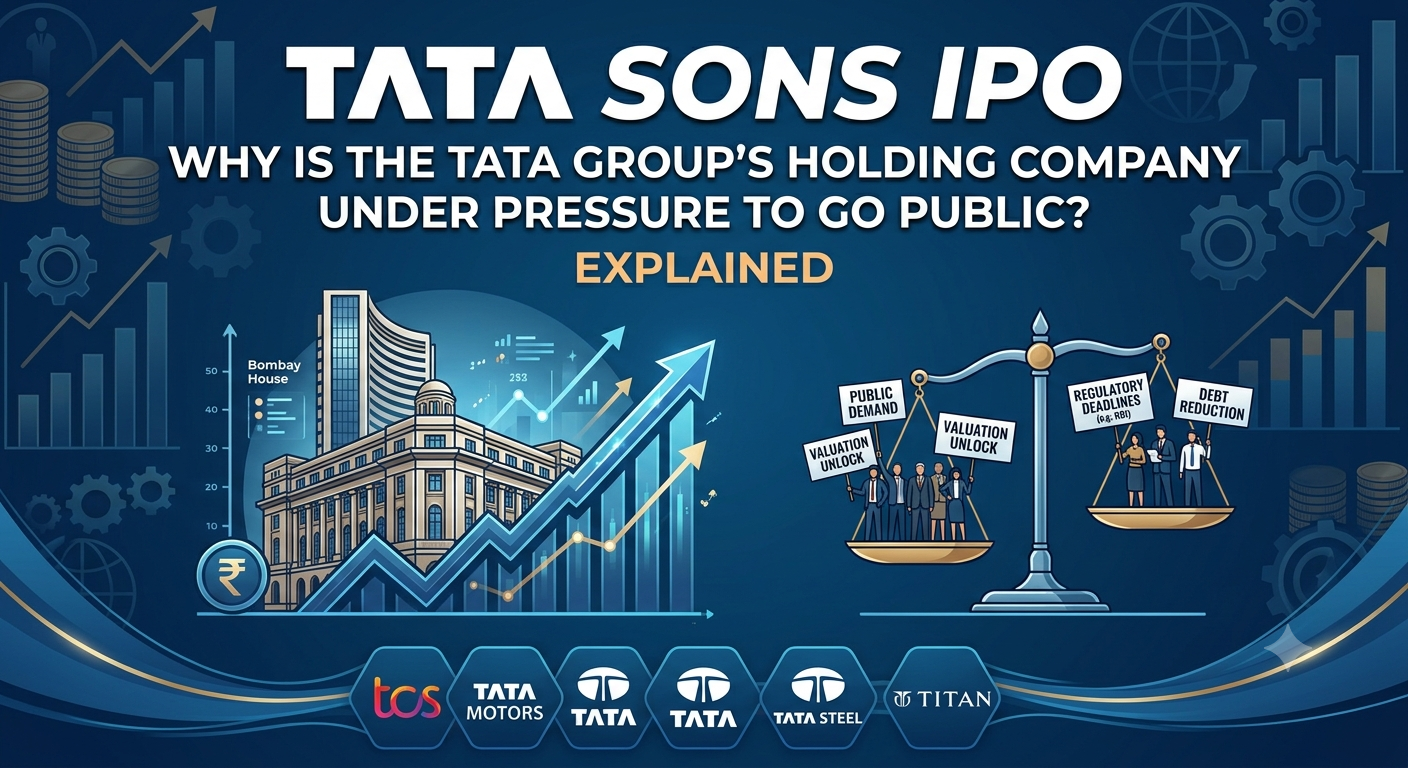
The Tata Sons IPO has once again come into focus after the Reserve Bank of India (RBI) rejected Tata Sons’ request to give up its registration as a Core Investment Company (CIC). This decision has put greater pressure on the holding company to meet the regulatory requirement of listing on the stock exchanges.
Tata Sons has been a privately held company for several decades. However, its classification under the RBI’s rules for large non-banking financial companies has made a stock market listing a key issue.
This development matters for investors because Tata Sons is the holding company at the top of the Tata Group and owns stakes in several major businesses, including Tata Consultancy Services (TCS), Tata Motors, Tata Steel, and other Tata Group companies.
This development raises an important question: Why is Tata Sons under pressure to go public, and what could the Tata Sons IPO mean for investors? Let’s understand the reasons behind the possible listing and what investors need to know.
What are Tata Sons and Why is its IPO Important?
Tata Sons is the main holding company of the Tata Group. It owns stakes in several Tata Group businesses and plays an important role in the group’s overall structure.
According to the group’s official website, the Tata Group has 26 publicly listed companies. However, Tata Sons itself continues to remain an unlisted private company. This makes the Tata Sons IPO different from a typical IPO of an operating company. If Tata Sons goes public, investors would get an opportunity to own shares in the holding company, which has stakes in several businesses across the Tata Group.
Why is Tata Sons Under Pressure to List?
- Tata Sons is a Core Investment Company (CIC): Tata Sons is registered with the Reserve Bank of India (RBI) as a Core Investment Company. CICs are regulated as part of the RBI’s framework for non-banking financial companies (NBFCs).
- Tata Sons is classified as an NBFC-Upper Layer: The RBI placed Tata Sons in the NBFC-Upper Layer (NBFC-UL) category. The RBI’s framework requires NBFCs classified in the Upper Layer to comply with stricter regulatory requirements, including mandatory stock market listing within the prescribed period.
- Listing requirement for NBFC-UL companies: Under the RBI’s Scale Based Regulation framework, an NBFC classified in the Upper Layer must be listed within three years of its identification as an NBFC-UL. The framework also requires such companies to follow listed-company-style disclosure requirements even before the actual listing.
- Tata Sons has a large asset base: Tata Sons had standalone assets of around ₹1.75 lakh crore as of March 2025, according to Reuters. This is significantly higher than the ₹1 lakh crore threshold relevant to the listing requirement for certain large NBFCs.
- RBI rejected Tata Sons’ request to deregister: Tata Sons had sought to surrender its registration as a Core Investment Company, which could have helped it avoid the mandatory listing requirement. However, the RBI rejected the request in September 2026, bringing the potential Tata Sons IPO back into focus.
Why Did Tata Sons Seek the RBI’s Approval and What Did the RBI Decide?
Tata Sons had approached the Reserve Bank of India (RBI) to surrender its registration as a Core Investment Company (CIC). The move could have helped the company exit the relevant regulatory framework and potentially avoid the mandatory listing requirement.
However, in September 2026, the RBI rejected Tata Sons’ request, meaning the company continues to remain under the RBI’s regulatory framework and its applicable listing obligations remain in focus. The RBI has also filed a caveat in the Bombay High Court in connection with the matter, allowing it to present its position if legal proceedings are initiated against the decision. However, this development does not mean that the Tata Sons IPO has been officially announced. There is currently no confirmed IPO date, price band, or issue size.
Why Does Tata Sons Want to Remain Private?
Tata Sons has traditionally operated as a closely held company, with most of its ownership concentrated among a few shareholders. Around 66% of its equity is held by Tata charitable trusts, while the Shapoorji Pallonji family owns about 18.37%. Tata Group companies hold around 13%, with the remaining shares owned by individuals.
Going public could improve transparency and give the market an opportunity to determine the company’s valuation. At the same time, a stock market listing would bring additional disclosure, governance, and shareholder-related requirements.
Therefore, the Tata Sons IPO is not just about raising money from public investors. It would also involve changes in how the holding company operates, reports information, and engages with shareholders.
Who Owns Tata Sons?
The ownership structure of Tata Sons is an important factor to understand when looking at the potential Tata Sons IPO. Tata charitable trusts primarily own the company, along with the Shapoorji Pallonji family and Tata Group companies.
| Shareholder | Approximate Stake |
| Tata charitable trusts | 66% |
| Shapoorji Pallonji family | 18.37% |
| Tata Group companies | Around 13% |
| Other shareholders | Balance |
The Tata charitable trusts hold the majority stake in Tata Sons. If the company lists and the trusts retain majority ownership, they would continue to have significant influence over the company even after a potential Tata Sons IPO.
What Could the Tata Sons IPO Mean for Shareholders and How Large Could It Be?
The potential Tata Sons IPO could have implications for both existing shareholders and public investors. However, the final structure and size of the issue are not yet known.
- Market-based price discovery: Tata Sons is currently an unlisted company, so its shares do not have a publicly traded market price. A stock market listing could allow the market to determine the value of its shares through trading.
- Potential value unlocking: A listing could make the value of Tata Sons’ holdings more visible to the market. This could also have an impact on Tata Group companies and other existing shareholders that own shares in Tata Sons.
- Greater liquidity: If Tata Sons shares are listed, eligible shareholders could get a publicly traded market for their holdings, subject to the final IPO structure and applicable regulations.
- Interest in IPO size: The potential Tata Sons IPO has attracted attention because the company owns stakes in several major Tata Group businesses. This has led to speculation about how large the IPO could be.
- No confirmed IPO size yet: Tata Sons has not officially announced the IPO size, valuation, price band or issue price. Therefore, figures being discussed in the market should be considered estimates and not confirmed details.
- Final size will depend on several factors: The eventual issue size could depend on the IPO structure, regulatory requirements, decisions by existing shareholders, and the valuation of Tata Sons at the time of the listing.
Tata Sons IPO vs Listed Tata Group Companies
| Factor | Tata Sons IPO | Listed Tata Group Companies |
| Current status | Tata Sons is currently an unlisted company | These companies are already listed on stock exchanges |
| Type of business | Tata Sons is the holding company of the Tata Group | These are individual operating businesses |
| Share price | No publicly traded share price at present | Share prices are available on stock exchanges |
| Investment exposure | Provides exposure to Tata Sons’ holdings across multiple Tata businesses | Provides exposure to a specific Tata company |
| IPO status | No official IPO date, price band or issue size has been announced | No IPO is required as these companies are already publicly listed |
| Valuation | Its market valuation could be determined through a future listing | Valuations are already reflected through their stock market prices |
What Would a Tata Sons IPO Mean for Tata Group and Its Shareholders?
A possible Tata Sons IPO could change how the Tata Group’s main holding company operates and how investors assess its business and investments.
- Investment in the holding company: Investors would not be buying shares of a single Tata operating business. Instead, they would invest in Tata Sons, the group’s principal holding company, which owns stakes in multiple Tata businesses.
- Public shareholders could become part of the ownership structure: Tata charitable trusts currently hold around two-thirds of Tata Sons’ equity, while Tata Group companies and other shareholders own the remaining shares. A listing could bring public investors into this ownership structure.
- Higher level of transparency: A listed Tata Sons would have to follow applicable stock market disclosure and reporting requirements. This could provide investors with more information about its financial performance, investments and use of capital.
- Closer monitoring of decisions: Public shareholders could pay greater attention to how Tata Sons allocates funds across its different businesses, investments and new ventures.
- Possible effect on listed Tata companies: A Tata Sons listing could also draw greater investor attention to other listed Tata companies because of the holding company’s stakes across the group.
- Greater focus on capital allocation: If Tata Sons invests heavily in newer businesses or strategic initiatives, public shareholders could seek more information about these investments and their potential impact on the wider Tata Group.
The Tata Sons IPO has once again gained attention after theRBI rejected the company’s request to surrender its Core Investment Company registration. The decision means Tata Sons remains subject to the applicable regulatory framework and listing requirements. However, Tata Sons has not officially announced an IPO date, price band, or issue size. Investors should therefore differentiate between a regulatory requirement to list and a formally launched IPO.
Sources: msn