



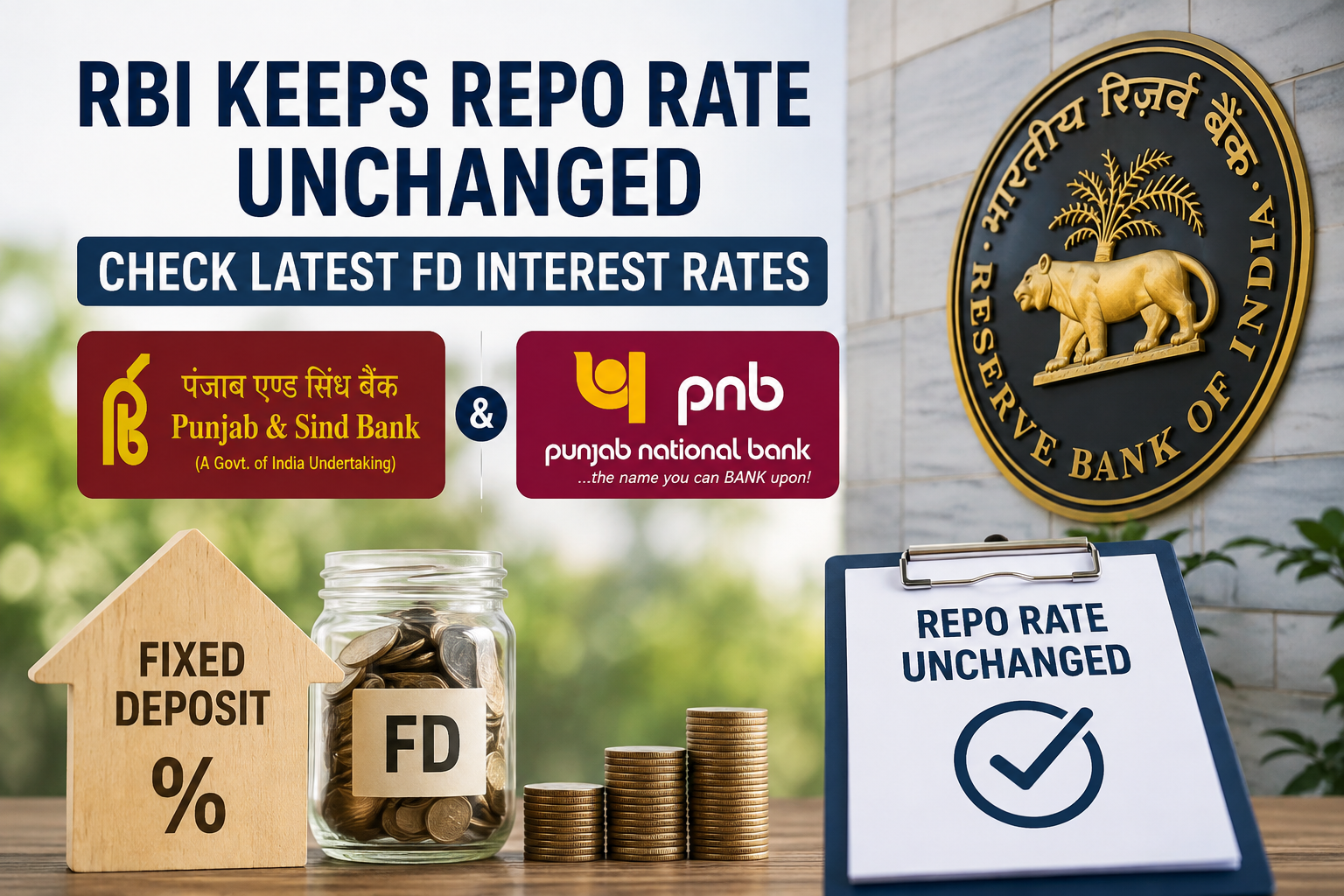
The RBI repo rate is unchanged at 5.25% by the Reserve Bank of India (RBI). At its Monetary Policy Committee (MPC) meeting held from August 3 to 5, 2026, the central bank decided to keep the benchmark policy rate unchanged. This decision provides stability to the prevailing interest-rate environment.
The RBI’s decision is relevant for fixed deposit (FD) investors as changes in the policy rate can affect the overall interest-rate scenario and influence how banks price their deposits. However, FD interest rates do not have a direct link with the repo rate. Banks may change their deposit rates based on factors such as funding needs, liquidity conditions, and competition in the banking sector.
Individuals who are craving stable returns would find themselves benefited by comparing the latest FD interest rates provided by public sector banks such as Punjab & Sind Bank and Punjab National Bank (PNB) before booking a fixed deposit. Here’s a look at the FD interest rates 2026 offered by both banks.
RBI Keeps Repo Rate Unchanged at 5.25%
The RBI has kept the policy repo rate unchanged at 5.25%, maintaining the benchmark rate at its current level. The decision means there is no immediate change in the central bank’s key policy rate.
For FD investors, the repo rate pause may offer some stability in the overall interest-rate environment. On the other hand, banks aren’t obligated to keep their FD interest rates unchanged. They can revise deposit rates based on their individual funding needs, liquidity conditions, and market competition.
Investors should therefore check the latest FD rates with their respective banks before booking a fixed deposit.
Punjab & Sind Bank FD Interest Rates 2026
As per the official Punjab & Sind Bank website, the bank revised its domestic term deposit rates for deposits below ₹3 crore with effect from June 16, 2026.
At present, the bank offers FD interest rates ranging from 2.85% to 6.95% per annum. The applicable rate varies based on the deposit tenure and whether the fixed deposit is callable or non-callable.
Punjab & Sind Bank FD Rates for Deposits Below ₹3 Crore
Punjab & Sind Bank offers different FD rates based on the investment tenure. The applicable rate also varies for certain tenures depending on whether the deposit is callable or non-callable.
| FD Tenure | Interest Rate |
| 7–45 days | 2.85% |
| 46–150 days | 3.35% |
| 151–364 days | 4.85% |
| 1 year | 5.85% |
| Above 1 year–374 days | 5.60% |
| 375 days – Callable | 6.40% |
| 375 days – Non-callable | 6.50% |
| 376–443 days | 5.60% |
| 444 days – Callable | 6.80% |
| 444 days – Non-callable | 6.90% |
| 445–665 days | 5.85% |
| 666 days – Callable | 6.85% |
| 666 days – Non-callable | 6.95% |
| 777 days | 6.10% |
| 999 days – Callable | 6.00% |
| 999 days – Non-callable | 6.05% |
| 5 years | 5.95% |
| Above 5 years to 10 years | 5.85% |
Among the latest Punjab & Sind Bank FD rates, the 666-day non-callable FD provides the highest interest rate of 6.95% per annum. For the same tenure, the bank offers an interest rate of 6.85% on the callable FD.
Investors should keep in mind that non-callable deposits come with restrictions on premature withdrawals. Therefore, it is important to assess liquidity needs before opting for this FD.
PNB FD Interest Rates
As per Punjab National Bank’s official interest-rate page, the bank revised its domestic term deposit rates for deposits below ₹3 crore, effective June 1, 2026.
The latest PNB FD interest rates for general customers range from 3% to 6.60% per annum, depending on the deposit tenure. Eligible senior citizens and super senior citizens can also receive an additional interest rate on applicable fixed deposits.
| FD Tenure | General Citizens | Senior Citizens | Super Senior Citizens |
| 7–14 days | 3.00% | 3.50% | 3.80% |
| 15–45 days | 3.00% | 3.50% | 3.80% |
| 46–90 days | 4.50% | 5.00% | 5.30% |
| 91–154 days | 4.90% | 5.40% | 5.70% |
| 155 days | 5.55% | 6.05% | 6.35% |
| 180–270 days | 5.60% | 6.10% | 6.40% |
| 1 year | 6.25% | 6.75% | 7.05% |
| Above 1 year–389 days | 6.30% | 6.80% | 7.10% |
| 390 days | 6.30% | 6.80% | 7.10% |
| 391–443 days | 6.30% | 6.80% | 7.10% |
| 444 days | 6.60% | 7.10% | 7.40% |
| 445–665 days | 6.30% | 6.80% | 7.10% |
| 666 days | 6.50% | 7.00% | 7.30% |
| 667 days–2 years | 6.30% | 6.80% | 7.10% |
| 2–3 years | 6.30% | 6.80% | 7.10% |
| 3 years–1203 days | 6.35% | 6.85% | 7.15% |
| 1204 days | 6.30% | 6.80% | 7.10% |
| 1205 days–5 years | 6.35% | 6.85% | 7.15% |
| 5–10 years | 6.00% | 6.80% | 6.80% |
Among the listed PNB FD rates for general depositors, the 444-day fixed deposit offers the highest interest rate of 6.60% per annum. For the same tenure, senior citizens can earn 7.10%, while super senior citizens are eligible for a higher rate of 7.40%.
Punjab & Sind Bank vs PNB FD Interest Rates 2026
| Bank | Tenure Offering the Highest Rate | Maximum Rate for General Depositors |
| Punjab & Sind Bank | 666 days, non-callable | 6.95% |
| PNB | 444 days | 6.60% |
Punjab & Sind Bank offers a higher maximum rate in this comparison. However, investors should consider more than just the interest rate when selecting an FD. The deposit tenure, premature withdrawal rules, liquidity needs, and minimum deposit requirements should also be evaluated before making a decision.
What Does the RBI Repo Rate Pause Mean for FD Investors?
The RBI repo rate unchanged offers some stability to the overall interest-rate environment. However, it does not necessarily mean that banks will keep their FD interest rates unchanged.
Banks consider several factors while deciding or revising their deposit rates, including:
- Deposit and credit demand: Banks may adjust FD rates depending on the demand for deposits and loans in the market.
- Liquidity conditions: The availability of funds with a bank can influence the interest rates it offers on fixed deposits.
- Competition among banks: Banks may revise their FD rates to remain competitive and attract more deposits from customers.
- Funding requirements: A bank’s need to raise funds can affect the rates offered on different deposit tenures.
- Future interest-rate expectations: Banks may consider the expected direction of interest rates when setting their deposit rates.
- Overall monetary policy environment: RBI’s broader monetary policy stance can influence banks’ approach to deposit pricing.
Investors should therefore check the latest FD interest rates on the respective bank websites before booking a fixed deposit, as rates can change independently of the repo rate.
Should You Book an FD After the RBI Repo Rate Pause?
Investors with short- or medium-term financial goals can consider booking an FD if the interest rate offered aligns with their return expectations and investment horizon. This may suit conservative investors who value stable and predictable returns over market-linked options.
However, choosing an FD solely because it offers the highest interest rate may not always be the right approach. A higher rate could be linked to a longer lock-in period or restrictions on premature withdrawal, which may affect liquidity.
What Should Investors Consider Before Opening an FD?
Before investing in a fixed deposit, investors should compare the latest FD interest rates and evaluate other important factors instead of focusing only on the advertised return.
- Interest rate: Compare the rates offered by different banks across various tenures. Focus on the rate applicable to your chosen tenure rather than selecting an FD simply because it offers the highest return.
- Investment Period: Choose a maturity period that matches your money goals and cash requirements. FD interest rates 2026 can differ significantly depending on the deposit tenure.
- Premature withdrawal: Find out whether the bank permits early withdrawal and check if any penalty or reduction in interest applies when you close the FD before maturity.
- Callable vs non-callable FD: Non-callable deposits may offer better FD interest rates, but they generally come with restrictions on premature withdrawal. Understand these terms before investing.
- Tax implications: Interest earned from an FD is taxable under the applicable tax rules. Therefore, investors should compare post-tax returns rather than consider only the advertised interest rate.
- Deposit insurance: Investors placing a substantial amount in an FD should understand the applicable deposit insurance rules and coverage limits before investing.
FAQs
Q1. What happens to FD rates when the RBI reduces the repo rate?
Ans. FD rates may change when the RBI cuts the repo rate, as banks and NBFCs often adjust their deposit rates in response to changes in the broader interest-rate environment. A reduction in the repo rate can therefore lead financial institutions to lower FD rates as they adjust their funding costs.
Q2. Will FD rates increase in 2026?
Ans. FD rates could see selective and gradual increases in 2026 as banks face tighter liquidity, higher credit demand and persistent inflation. However, the RBI’s decision to keep the repo rate at 5.25% may limit broad-based rate increases.
Sources: businesstoday