



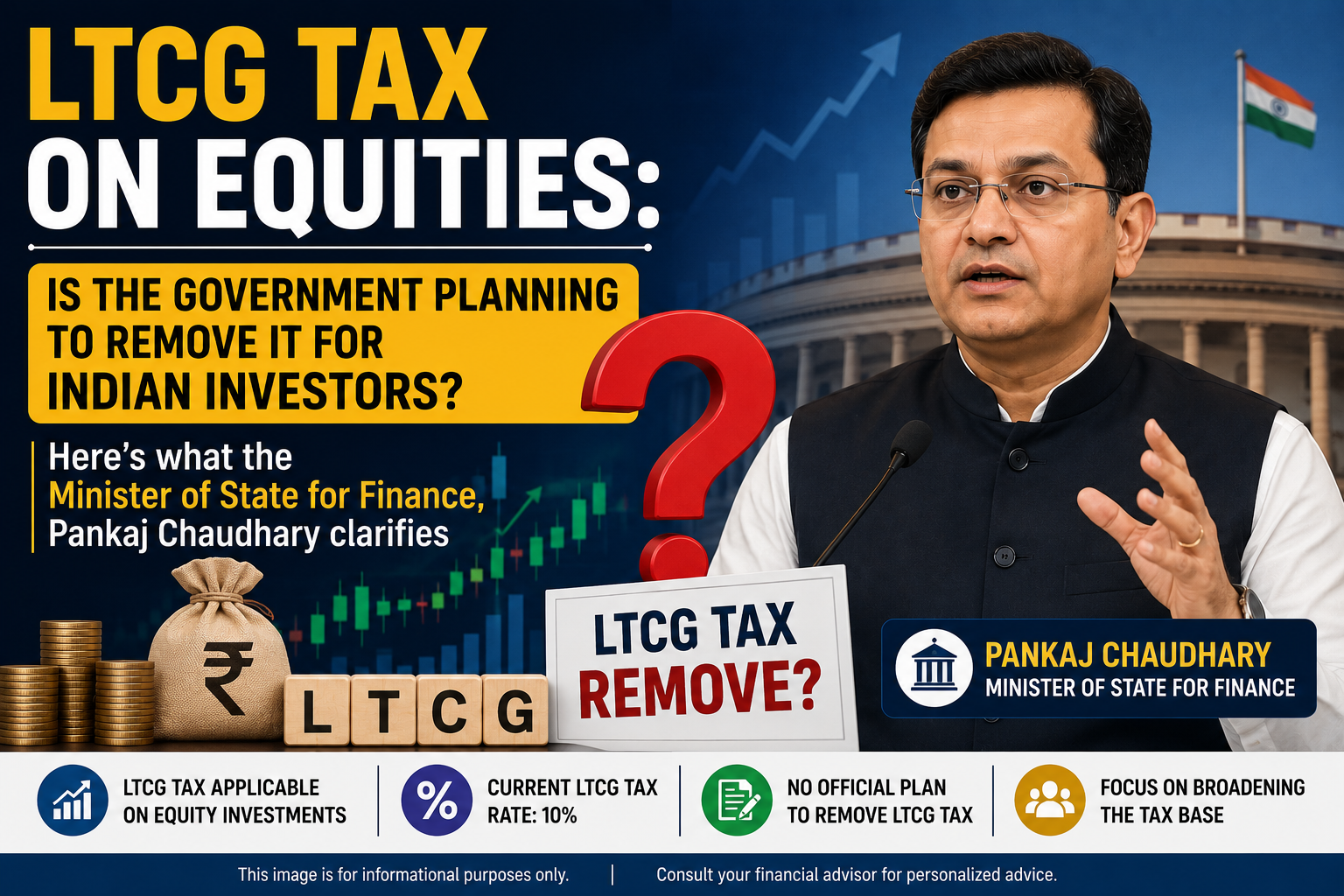
The Indian government has clarified that it is not considering any proposal to remove the Long-Term Capital Gains (LTCG) tax on equity investments for domestic institutional investors and retail investors during FY 2026-27. This clarification comes after speculation that the Centre might offer similar tax relief to Indian investors. Previously, certain tax benefits were provided to foreign investors investing in government securities.
Currently, domestic institutional and retail investors who invest in equities are required to pay Short-Term Capital Gains (STCG) or Long-Term Capital Gains (LTCG) tax, depending on how long they hold their investments before selling.
Neeraj Shekhar raised the issue in a question submitted to the Finance Ministry on July 28, 2026. He asked whether the government was planning to scrap the LTCG tax on equities for domestic investors during the current financial year to improve market sentiment. In addition, he asked if the removal would encourage investment and support India’s Gross Domestic Product (GDP). He also sought clarification on whether the government had recently removed the LTCG tax for foreign investors. Finally, he questioned if a similar benefit was being considered for domestic investors.
What is the meaning of LTCG and STCG?
- LTCG (Long-Term Capital Gains): The gain earned from selling a capital asset after holding it for the specified long-term period. It is subject to the applicable LTCG tax rate.
- STCG (Short-Term Capital Gains): The gain earned from selling a capital asset before the required holding period is completed. It is taxed at the applicable STCG tax rate.
Why Did the Confusion Arise?
The confusion began after the government announced tax relief for Foreign Portfolio Investors (FPIs) investing in Government Securities (G-Secs) through the Income-tax (Amendment) Ordinance, 2026. Following this move, some market participants speculated that the government might also introduce similar tax benefits for Indian investors in equity investments. This includes relief from Long-Term Capital Gains (LTCG) tax.
However, the Finance Ministry has clarified that the tax relief applies only to specified investments in Government Securities (G-Secs) and does not extend to equity investments. As a result, the LTCG tax on listed shares continues to remain unchanged for both Indian investors. The same rule applies to FPIs investing in equities.
What Did the Finance Ministry Say?
Replying to a question in the Lok Sabha, Minister of State for Finance Pankaj Chaudhary clarified that:
- There is no proposal to abolish the LTCG tax on equity investments.
- The 12.5% LTCG tax rate on listed equity shares and equity-oriented mutual funds will continue to remain in force.
- The same LTCG tax rate is applicable to both Indian investors and Foreign Portfolio Investors (FPIs) on equity investments.
- The government evaluate capital gains tax and other tax rules during each Union Budget after considering the country’s economic conditions.
Current LTCG Tax Rules on Equities
| Particulars | Current Rule |
| Asset | Listed equity shares and equity-oriented mutual funds |
| Minimum Holding Period | More than 12 months |
| LTCG Tax Rate | 12.5% |
| Tax-Free Exemption | Long-term capital gains up to ₹1.25 lakh in a financial year |
| Applicable To | Indian retail investors, domestic investors, and Foreign Portfolio Investors (FPIs) investing in equities |
Note: These LTCG tax rules were introduced through changes announced in recent Union Budgets and continue to remain in force.
Why Isn’t the Government Removing LTCG Tax?
While several industry bodies and market experts have urged the government to abolish the LTCG tax to promote long-term investing and improve market participation, the government has indicated that the tax remains a significant source of revenue.
According to official data shared in Parliament:
- The government collected around ₹1.29 lakh crore through LTCG tax on equities in the assessment year corresponding to FY 2024-25.
- The combined LTCG tax collections from the previous two assessment years crossed ₹2 lakh crore, underscoring the tax’s important contribution to government revenues.
Will the Government Review LTCG Tax in the Future?
Although the government has clarified that there is no proposal to abolish the LTCG tax at present, the Finance Ministry has reiterated that tax policies are reviewed periodically during the annual Union Budget exercise. These reviews include capital gains taxation and take into account economic conditions and fiscal requirements.
Earlier this year, Nirmala Sitharaman also said that the government is open to considering feedback from investors on issues related to Long-Term Capital Gains (LTCG) and Short-Term Capital Gains (STCG) taxation. However, she did not announce any changes to the existing tax policy.
What Does This Mean for Investors?
For the time being, Indian investors should plan their investments on the assumption that the current LTCG tax regime will continue without any changes. To manage their tax liability effectively, investors should:
- Take advantage of the ₹1.25 lakh annual exemption when planning Long-Term Capital Gains (LTCG).
- Include the 12.5% LTCG tax while estimating long-term investment returns.
- Keep an eye on announcements made during the Union Budget, as any changes to the LTCG tax or capital gains tax are usually announced in the Union Budget.
Is the Section 87A Tax Rebate Available on Capital Gains Income?
No. Section 87A tax rebate is not available on Long-Term Capital Gains (LTCG), Short-Term Capital Gains (STCG), or any other income taxed at special rates from FY 2025-26 (AY 2026-27) onwards.
Here are the key points:
- Section 112A(6) provides that the Section 87A rebate is calculated only after excluding LTCG taxable under Section 112A from the total income. This restriction applies to LTCG exceeding ₹1.25 lakh.
- Budget 2025 clarified that the Section 87A tax rebate is not available on LTCG, STCG, or any other income that is taxable at special rates, including capital gains under Sections 111A and 112.
- From AY 2026-27, resident individuals opting for the new tax regime under Section 115BAC(1A) can claim a Section 87A rebate only on income taxed at the normal slab rates.
- Budget 2025 also increased the Section 87A rebate under the new tax regime by:
- Raising the eligible total income limit from ₹7 lakh to ₹12 lakh.
- Increasing the maximum rebate from ₹25,000 to ₹60,000.
- However, the rebate is restricted to the income tax payable under the normal tax slabs and cannot be claimed against tax payable on capital gains or any other special rate income.
Conclusion
The government has put an end to speculation by confirming that there is no proposal to abolish the LTCG tax on equity investments for Indian investors at present. According to the Finance Ministry, the existing LTCG tax framework will remain in force. Any future changes to capital gains taxation will be reviewed through the Union Budget process.
For now, investors should base their long-term investment strategies on the current LTCG tax rules instead of expecting an immediate tax exemption.
FAQs
Q1. How Can You Reduce Your Long-Term Capital Gains (LTCG) Tax?
Ans. You can reduce your Long-Term Capital Gains (LTCG) tax in several ways. Claim the annual ₹1.25 lakh exemption on eligible equity gains, if applicable. You can also reinvest your capital gains in eligible residential property or specified bonds under Sections 54, 54F, and 54EC.
Q2. Can You Reinvest Capital Gains to Save on Taxes?
Ans. Yes. You can reduce or defer your capital gains tax by reinvesting the gains in eligible government-approved assets. These include purchasing a qualifying residential house or investing in specified bonds, subject to the conditions laid down under the Income Tax Act.
Q3. How Can You Reduce Capital Gains Tax on Shares Held for 20 Years?
Ans. You can reduce capital gains tax by claiming the applicable tax-free exemption, transferring eligible assets to a spouse, or donating them to an eligible charitable organisation, subject to the provisions of the Income Tax Act.