



Zerodha Fund House has launched the Zerodha Life Cycle Fund 2031 NFO, expanding its target-date fund series to cater to investors with financial goals around 2031. The New Fund Offer (NFO) opened for subscription on August 27, 2026, and will remain open until September 10, 2026, with a minimum investment of ₹100. The launch follows the debut of the Zerodha Life Cycle Fund 2036 and Zerodha Life Cycle Fund 2041 in June 2026, which marked Zerodha Fund House’s entry into target-date investing in India.
The new fund further expands Zerodha Fund House’s Life Cycle Fund series, adding a shorter five-year investment horizon for investors with financial goals around 2031. In this blog, we will provide a complete overview of the Zerodha Life Cycle Fund 2031 NFO, including its key details, investment objective, subscription dates, minimum investment, and other important factors investors should know.
Zerodha Life Cycle Fund 2031 NFO: Key Details
| Particulars | Details |
| Fund Name | Zerodha Life Cycle Fund 2031 |
| NFO Opening Date | August 27, 2026 |
| NFO Closing Date | September 10, 2026 |
| Allotment Date | September 11, 2026 |
| Minimum Investment | ₹100 |
| Risk Level | High |
| Lock-in Period | No lock-in |
| Exit Load | 3%/2%/1% based on the holding period; Nil after 3 years |
| Target Year | 2031 |
| Fund Manager | Kedarnath Mirajkar |
What Is Zerodha Life Cycle Fund 2031 and How Does It Work?
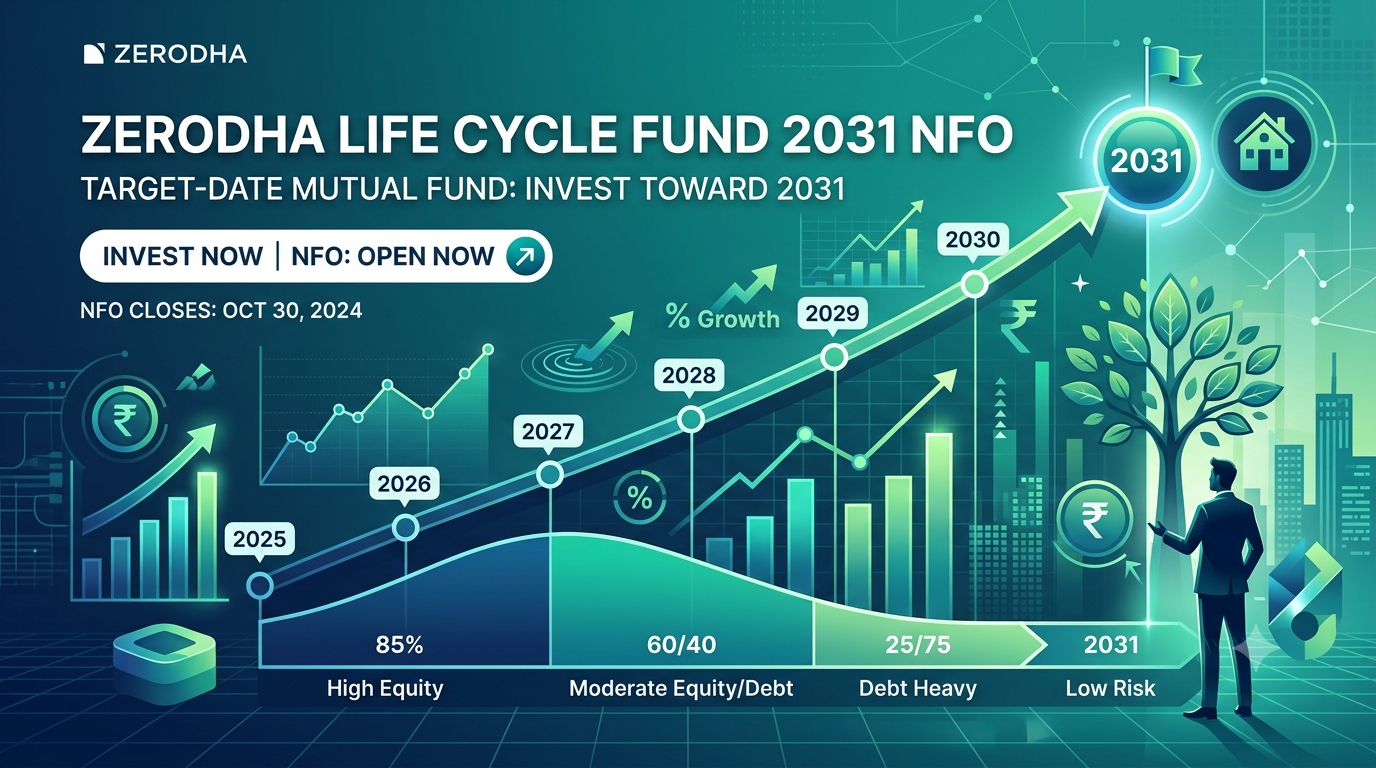
The Zerodha Life Cycle Fund 2031 is an open-ended mutual fund built around a specific target year. It follows a predetermined asset-allocation strategy, known as a glide path, which changes the portfolio mix as the target date gets closer.
In simple terms, the fund initially maintains a higher exposure to growth-oriented investments such as equity. As 2031 approaches, it gradually reduces the allocation to relatively higher-risk assets and moves towards more conservative investments. This process takes place automatically, meaning investors do not need to rebalance their portfolios themselves.
The scheme is designed for investors with financial goals around 2031, such as purchasing a car, funding a vacation, or meeting another significant expense, who have a defined investment horizon.
Zerodha Life Cycle Fund 2031: Where and How the Fund Will Invest
The Zerodha Life Cycle Fund 2031 will diversify its portfolio across different asset classes, including equities, government securities, commodities, and arbitrage opportunities.
For its equity allocation, the fund will seek to track the Nifty LargeMidcap 250 Index. The debt portion will include Indian government securities with varying maturities, while the commodity allocation will provide exposure to gold and silver.
Zerodha Life Cycle Fund 2031 Asset Allocation and Investment Mix Over Time
The Zerodha Life Cycle Fund 2031 will gradually adjust its portfolio allocation as it approaches the target year. The indicative asset allocation across different stages is as follows:Top of Form
| Investment Period | Equity | Gold & Silver ETFs | Debt | Arbitrage |
| 2026–2028 | 35%–50% | 0%–10% | 25%–50% | Up to 50% |
| 2028–2030 | 20%–35% | 0%–10% | 25%–65% | Up to 50% |
| Maturity Year | 5%–20% | 0%–10% | 25%–65% | Up to 50% |
These figures represent indicative allocation ranges and may change based on the fund’s glide-path strategy. The Scheme Information Document (SID) remains the final reference for the scheme’s investment framework. According to the fund house, the allocation to gold ETFs will be capped at 5% of the fund’s AUM.
How Does the Zerodha Life Cycle Fund 2031 Target-Date Strategy Work?
- Automatic portfolio adjustment: The key feature of the Zerodha Life Cycle Fund 2031 NFO is its predefined strategy that automatically changes the asset mix over time
- Higher equity exposure initially: When the 2031 goal is still several years away, the fund can allocate a larger portion of its portfolio to equity to target long-term capital growth
- Gradual shift towards conservative assets: As the target year approaches, the fund is expected to reduce its equity allocation and increase exposure to relatively more conservative asset classes
- Less need for manual rebalancing: Since the asset allocation changes automatically, investors do not need to regularly adjust their portfolio as their financial goal gets closer
- Risk and returns: The scheme is categorised as High Risk, and the fund does not guarantee any specific returns.
Zerodha Life Cycle Fund 2031 Minimum Investment and Withdrawal Charges
1. Minimum investment: Investors can start investing in the Zerodha Life Cycle Fund 2031 NFO with as little as ₹100
2. Investment options: The fund is available through both lump-sum and Systematic Investment Plan (SIP) routes, giving investors flexibility in how they invest
3. No lock-in period: Investors can redeem their units at any time, as the scheme does not have a mandatory lock-in
4. Exit load: Early redemption will attract an exit load based on the holding period:
- 3% if redeemed within 1 year
- 2% if redeemed after 1 year but within 2 years
- 1% if redeemed after 2 years but within 3 years
- Nil if redeemed after 3 years
5. Long-term investment approach: The exit-load structure is designed to encourage investors to stay invested for the longer term and align their investments with their financial goals around 2031.
How Is Zerodha Life Cycle Fund 2031 Taxed?
The Zerodha Life Cycle Fund 2031 will be considered an equity-oriented mutual fund for taxation purposes throughout its lifecycle. If the investment is held for one year or less, the gains will be treated as short-term capital gains and taxed at 20%, along with applicable cess and surcharge.
For investments held for more than one year, the gains will qualify as long-term capital gains. Long-term gains exceeding the applicable ₹1.25 lakh annual exemption limit will be taxed at 12.5%, plus applicable cess and surcharge.
Investors should keep in mind that their final tax liability may vary depending on their individual financial and tax circumstances. Seeking advice from a qualified tax professional can help investors understand the applicable tax treatment.
Who Should Consider Zerodha Life Cycle Fund 2031?
The Zerodha Life Cycle Fund 2031 may be suitable for investors who:
- Have a financial goal planned around 2031
- Prefer a structured approach to goal-based investing
- Want their portfolio to be rebalanced automatically
- Do not want to manage their equity and debt allocation on their own
- Are comfortable with the fund’s High Risk rating
- Can stay invested for the intended investment period
However, investors should not select a fund only because its target year matches their financial goal. It is important to consider factors such as risk appetite, investment horizon, financial objectives, and existing portfolio before making an investment decision.
What is there for Investors in Zerodha Life Cycle Fund 2031 NFO?
The Zerodha Life Cycle Fund 2031 NFO differs from a traditional fixed-maturity debt fund. It follows a target-date, multi-asset investment strategy, with the portfolio allocation changing gradually over the investment period.
One of its key features is the automatic glide path, which aims to gradually lower the portfolio’s risk as the 2031 target date gets closer. However, investors should remember that market movements affect the scheme and it carries a High Risk rating. The fund cannot guarantee returns or the achievement of its investment objective.
FAQs
Q1. What is the difference between Zerodha Life Cycle Fund 2031, 2036 and 2041?
Ans. The key difference is the target year and investment horizon. Zerodha Fund House designed the Life Cycle Fund 2031 for goals around five years away, the 2036 fund for goals about 10 years away, and the 2041 fund for goals roughly 15 years away.
Q2. Which fund is suitable for a shorter investment horizon?
Ans. The Zerodha Life Cycle Fund 2031 targets financial goals around 2031 and offers a shorter investment horizon than the 2036 and 2041 funds.
Source: Zerodha