



Many taxpayers think they don’t have to file an Income Tax Return (ITR) if their annual income is below the basic tax exemption limit. While this is true in many cases, voluntarily filing an ITR can still offer several financial, legal, and practical benefits.
However, income is not the only factor that determines whether you must file an ITR. The Income Tax Department also considers certain high-value transactions, spending patterns, foreign assets, and other financial activities, which can make ITR filing mandatory even if you have little or no tax liability. As the filing season for Assessment Year (AY) 2026-27 begins, taxpayers should understand these lesser-known rules to avoid penalties or future tax notices. Whether you are a salaried employee, student, freelancer, retiree, or first-time taxpayer, your ITR filing in 2026 can also help you claim tax refunds, build financial credibility, and stay compliant with tax laws.
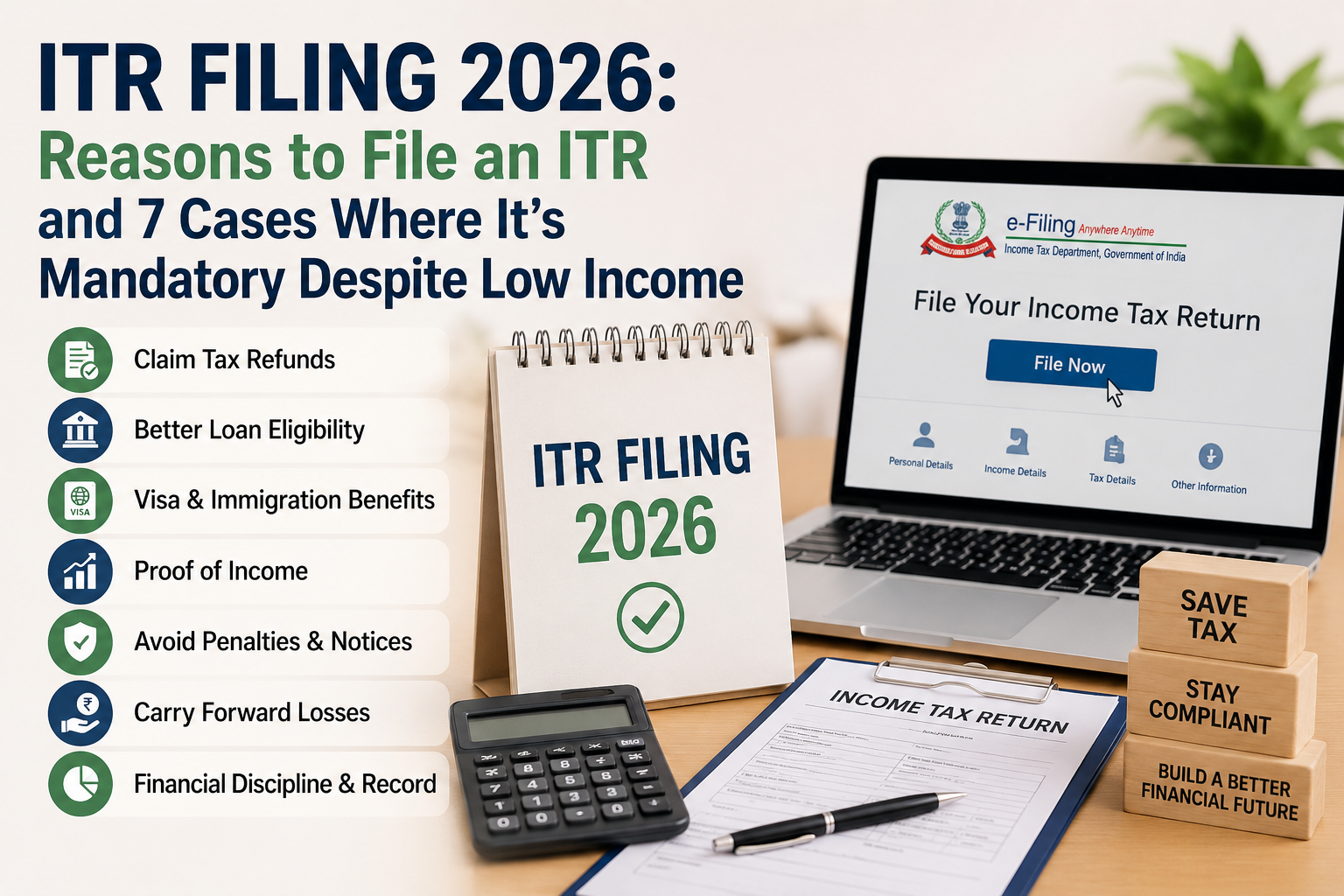
What are the Reasons to opt for ITR filing in 2026 despite low Income?
1. Claim a TDS Refund
Filing an ITR allows you to claim a refund if excess Tax Deducted at Source (TDS) has been deducted from your salary, fixed deposit interest, or other income. Even if your total income is below the tax exemption limit, filing an ITR is the only way to recover the excess tax deducted.
2. Incurred Capital or Business Losses
If you have incurred losses from stocks, mutual funds, property sales, or a business/profession, filing your ITR before the due date allows you to carry forward eligible losses to future years. These losses can be adjusted against future gains, helping reduce your tax liability.
3. Makes Loan Approvals Easier
Banks and financial institutions often require the last two or three years’ Income Tax Returns (ITRs) when processing applications for:
- Home loans
- Personal loans
- Vehicle loans
- Education loans
Even if your income is below the tax exemption limit, regularly filing ITRs helps create a documented income record and strengthens your financial credibility, making it easier to obtain loans.
4. Acts as Proof of Income
An acknowledged Income Tax Return (ITR) is a widely accepted document for verifying income in India. It can be useful for:
- Renting a house
- Applying for government schemes
- Seeking scholarships
- Buying high-value insurance policies
- Completing financial verification or documentation processes
5. Supports Visa Applications
Many countries, including the United States, Canada, the United Kingdom, Australia, and Schengen countries, may ask applicants to submit ITR acknowledgements from the past few years as part of the visa application process.
While the exact requirements vary by country and visa type, ITRs are widely accepted as proof of financial stability and a consistent source of income.
6. Builds a Strong Financial Record
Students, freelancers, consultants, self-employed professionals, and first-time earners often have incomes below the tax exemption limit. Even so, filing an ITR regularly helps build a reliable financial record.
A consistent ITR history can be beneficial when:
- Applying for loans
- Seeking business funding
- Applying for credit cards
- Entering into business partnerships
Regular tax filing also demonstrates financial discipline and enhances your overall financial credibility.
7 Cases When You Must File an ITR Despite Low Income
1. Large Deposits in Savings Accounts
If you deposit more than ₹50 lakh in one or more savings bank accounts during a financial year, filing an Income Tax Return (ITR) becomes mandatory, even if your taxable income is below the basic exemption limit. The Income Tax Department tracks such high-value cash transactions to ensure they are consistent with your reported income and financial profile.
This requirement is part of the government’s efforts to improve transparency, curb tax evasion, and monitor significant financial transactions. If such deposits are not properly disclosed, they may attract scrutiny or notices from the tax authorities.
2. Ownership of Foreign Assets
Resident individuals who own assets outside India are required to file an Income Tax Return (ITR), regardless of whether their income is below the basic tax exemption limit. This requirement applies to a wide range of foreign assets, including overseas bank accounts, foreign shares, financial interests in foreign companies, signing authority over foreign accounts, or being a beneficiary of any asset located outside India.
As more Indians invest in US stocks, global mutual funds, and other international assets, this rule has become increasingly important. The disclosure requirement helps the Income Tax Department track foreign holdings, improve transparency, and ensure compliance with tax laws. Failure to report such assets may lead to penalties or scrutiny by the tax authorities.
3. Deposits Over ₹1 Crore in Current Accounts
If you deposit more than ₹1 crore across one or more current accounts during a financial year, you are required to file an Income Tax Return (ITR). This rule applies regardless of whether your income is below the basic tax exemption limit or you have no tax payable.
The Income Tax Department monitors such high-value transactions to ensure they are in line with your reported income and financial activities. Filing an ITR in these cases helps maintain transparency and reduces the risk of receiving notices or inquiries from the tax authorities.
4. Foreign Travel Expenses
If you spend more than ₹2 lakh on foreign travel for yourself or any other person during a financial year, you are required to file an Income Tax Return (ITR). This requirement applies even if your income is below the basic tax exemption limit or you have no tax liability.
The Income Tax Department treats high-value overseas travel expenses as a reportable financial transaction. The rule is aimed at improving transparency and ensuring that significant spending is consistent with a taxpayer’s declared income. Failing to file an ITR in such cases could result in notices or scrutiny from the tax authorities.
5. Professional Receipts Above ₹10 Lakh
Self-employed professionals, including doctors, lawyers, architects, consultants, chartered accountants, and freelancers, must file an Income Tax Return (ITR) if their gross professional receipts exceed ₹10 lakh during a financial year. This requirement applies irrespective of the actual profit earned from the profession.
It is important to note that the threshold is based on total receipts or revenue, not the income left after deducting business or professional expenses. Filing an ITR in such cases ensures compliance with tax laws and helps avoid penalties or notices from the Income Tax Department.
6. Higher TDS or TCS
If the total Tax Deducted at Source (TDS) and Tax Collected at Source (TCS) during a financial year exceeds ₹25,000, filing an Income Tax Return (ITR) becomes mandatory. For senior citizens, this threshold is higher at ₹50,000.
Many taxpayers are unaware that higher TDS or TCS can trigger an ITR filing requirement, even if their taxable income is below the basic exemption limit. This rule commonly applies to fixed deposit holders, consultants, freelancers, professionals, and others whose income is subject to tax deduction or collection at source. Filing an ITR also helps taxpayers claim refunds if excess tax has been deducted.
7. Electricity Bills Above ₹1 Lakh
If your total electricity bill exceeds ₹1 lakh during a financial year, you are required to file an Income Tax Return (ITR), irrespective of whether your income is below the basic tax exemption limit.
This is one of the lesser-known conditions that can make ITR filing mandatory. The rule forms part of the government’s framework for monitoring specified high-value transactions and promoting greater financial transparency. Ignoring this requirement could lead to scrutiny or notices from the Income Tax Department.
Why Do These Reasons to File for an ITR Matter?
The Income Tax Department now uses data from banks, financial institutions, and other reporting agencies to keep track of high-value financial transactions. As a result, ITR filing is no longer based only on your annual income. Here are a few reasons why these rules are important:
- Income is not the only factor: High-value transactions, investments, and spending patterns can also determine whether you need to file an ITR.
- Financial activities are closely monitored: Large bank deposits, foreign assets, overseas travel expenses, and other specified transactions are reported to the Income Tax Department.
- ITR filing may be mandatory even without tax liability: You may still be legally required to file an ITR even if you have little or no tax to pay.
- Avoid notices and penalties: Filing your ITR on time helps you stay compliant and reduces the chances of receiving tax notices or facing penalties.
- Review your financial transactions carefully: Before deciding not to file an ITR, check whether any high-value transactions during the financial year fall under the mandatory filing rules.
FAQs
Q1. What is the deadline for ITR filing in 2026?
Ans. The last date to file your Income Tax Return (ITR) for the Assessment Year (AY) 2026–27 is July 31, 2026.
Q2. Which ITR forms can taxpayers use for AY 2026–27?
Ans. For Assessment Year 2026–27, the Income Tax Department has notified the ITR-1 to ITR-5 forms. It has also released Excel utilities for ITR-1, ITR-2, ITR-3, and ITR-4, allowing taxpayers to prepare their returns offline before uploading them to the e-filing portal.
Q3. Is the Section 87A tax rebate different from a tax deduction?
Ans. Yes. A tax rebate under Section 87A reduces the amount of tax you have to pay, while a tax deduction reduces your taxable income before your tax liability is calculated.
Q4. Is the Section 87A rebate applied before or after the 4% cess?
Ans. The Section 87A rebate is applied before the 4% Health and Education Cess is added to your total tax liability.
Q5. What is the maximum rebate available under Section 87A in the new tax regime?
Ans. Under the new tax regime, resident individuals with a taxable income of up to ₹12 lakh can claim a Section 87A rebate of up to ₹60,000.
Q6. Can I claim a TDS refund if my income is below the taxable limit?
Ans. Yes. If tax has been deducted at source (TDS) but your final tax liability is zero, you can claim the refund by filing your Income Tax Return (ITR).
Q7. Who can claim the Section 87A rebate under the old tax regime?
Ans. Taxpayers who choose the old tax regime and have a taxable income of up to ₹5 lakh are eligible to claim a Section 87A rebate of up to ₹12,500.