



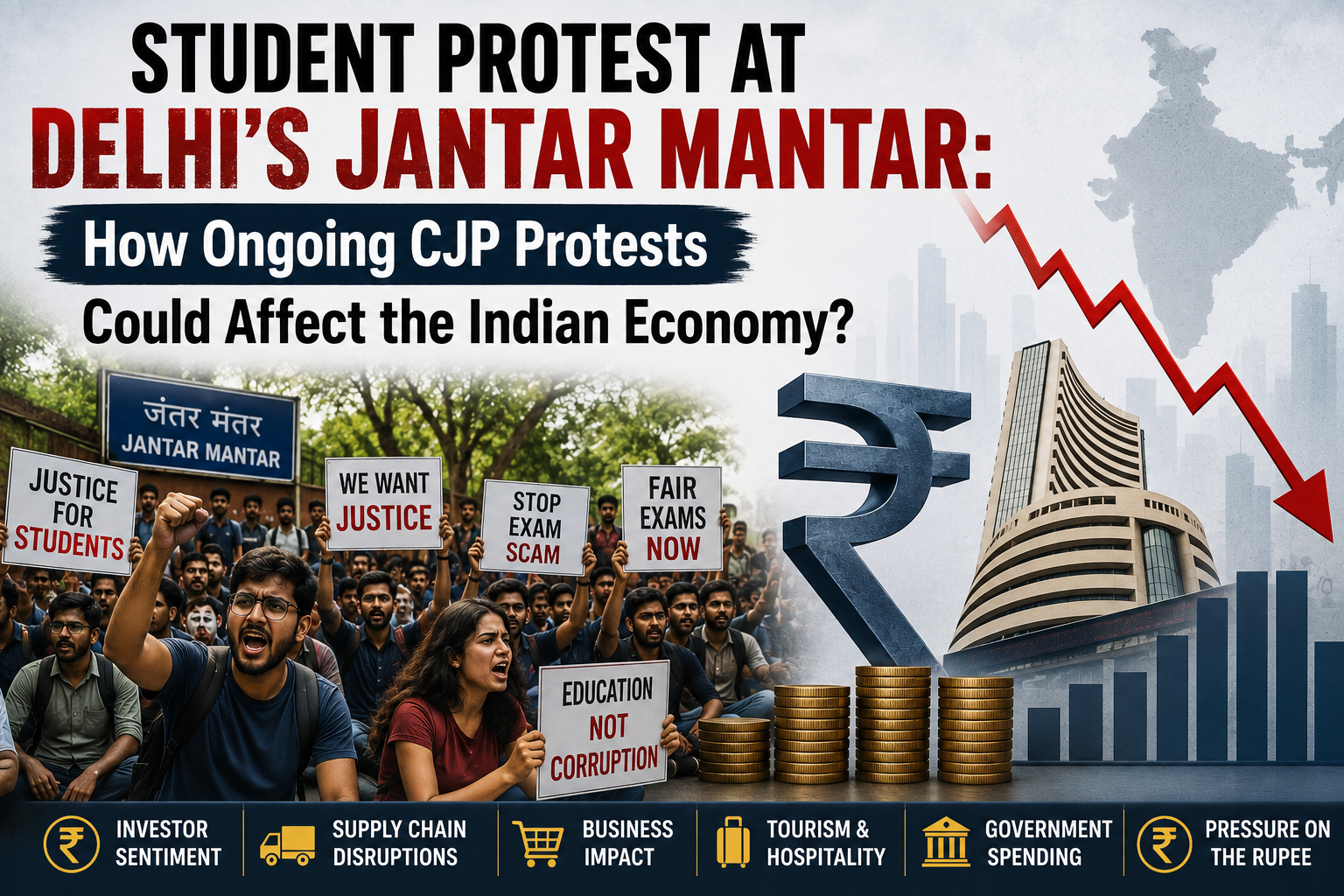
The student protest at Delhi’s Jantar Mantar over the NEET-UG 2026 controversy has entered a crucial phase as political tensions continue to rise. The situation intensified after leaders of the principal opposition party staged a sit-in outside Prime Minister Narendra Modi’s residence to protest the alleged irregularities in the examination and the police action against student protesters. During the demonstration, Rahul Gandhi, Priyanka Gandhi Vadra, and several other opposition leaders were detained by the police before being released later. The protesters have also demanded the resignation of Union Education Minister Dharmendra Pradhan over the handling of the NEET-UG issue.
Although the ongoing CJP protest is still in its early stages, the participation of senior opposition leaders has turned it into a major political issue. This has sparked discussions over whether the movement could gain momentum similar to past mass protests, such as the Anna Hazare movement or the JP Movement, which significantly influenced India’s political landscape. The future course of the protest will largely depend on how long it continues and how the Central Government responds. At the same time, economists and market experts believe that its economic impact will depend more on the scale and duration of the agitation than on the protest itself.
Student protests are an important part of India’s democratic framework, giving citizens a platform to express concerns about education, employment, and public policy. A peaceful demonstration at Jantar Mantar is unlikely to have any significant effect on the economy. However, if the protests continue for a prolonged period, spread to multiple cities, or disrupt transportation, businesses, and public services, they could create short-term economic challenges for certain sectors.
Can an Ongoing CJP Protest Impact India’s Economy?
The ongoing CJP protest in Delhi has not significantly affected the Indian economy or financial markets so far. However, experts say the risks could increase if the demonstrations continue for a prolonged period and disrupt transport, businesses, or policymaking.
Abhinav Tiwari, Research Analyst at Bonanza Portfolio Limited, said the CJP protest at Delhi’s Jantar Mantar is currently more of a social and governance issue than a macroeconomic concern. He added that investors expect the situation to be resolved soon, while the recent weakness in Indian markets and the rupee has largely been driven by global factors such as rising crude oil prices, geopolitical tensions, US interest-rate expectations, and shifts in foreign capital flows.
Echoing a similar view, Ponmudi R of Enrich Money said a prolonged disruption could weaken foreign investment inflows, increase market volatility, put pressure on the rupee, and raise import costs—especially for crude oil—potentially adding to inflation. He noted that sustained capital outflows could also affect investor confidence as India competes with other emerging markets for global investments.
Which Sectors Are Most Likely to Be Affected if the Ongoing CJP Protests Continue?
1. Business Activity Could Slow Down
If protests continue for several days and disrupt the normal flow of traffic and commerce, businesses in the affected areas may experience temporary setbacks. Industries that depend on regular customer visits and smooth transportation networks are likely to feel the impact first.
- Fewer customers: Road blockades, traffic diversions, and restricted access to commercial areas may reduce the number of people visiting markets, shopping centres, and local stores.
- Decrease in sales: Fewer customers could lead to lower daily sales for retail stores, restaurants, cafés, and neighbourhood shops.
- Supply and delivery disruptions: Delays in the transportation of goods may interrupt inventory restocking and slow deliveries to both businesses and consumers.
- Rising logistics expenses: Businesses may have to bear higher transportation costs due to longer travel routes, fuel expenses, and delays caused by traffic congestion.
Retail outlets, restaurants, supermarkets, street vendors, and other small businesses are generally among the first to face short-term operational and financial pressure if disruptions continue over an extended period.
2. Ongoing Protests Could Disrupt Supply Chains
If protests continue for an extended period and affect highways, major roads, or transport hubs, the movement of goods across regions could slow down. Businesses that rely on timely deliveries and efficient logistics may face operational challenges until normal transportation resumes.
- Slower deliveries: Road blockades and traffic diversions may delay the transportation of goods, resulting in longer delivery times for businesses and customers.
- Higher logistics costs: Transporters may have to use alternative routes or spend more time on the road, increasing fuel consumption, labour costs, and overall logistics expenses.
- Manufacturing delays: Factories that depend on the timely arrival of raw materials could experience production slowdowns if essential supplies are delayed.
- Increase in freight charges: Longer travel distances, higher operating costs, and limited transport availability may lead to a temporary rise in freight and shipping charges.
If disruptions persist, industries that depend on just-in-time supply chains may experience operational difficulties.
3. Tourism and Hospitality Could Face Short-Term Challenges
If protests continue and result in traffic disruptions or heightened security concerns in popular tourist destinations, some travellers may choose to postpone or cancel their trips. Businesses that depend on tourism and visitor spending could experience temporary setbacks until normal conditions are restored.
- Lower hotel occupancy: Hotels, resorts, and guest houses may witness fewer bookings as domestic and international tourists delay their travel plans.
- Reduced demand for local transport: Taxi operators, cab aggregators, tour buses, and other transport providers may see a decline in passenger demand due to fewer visitors and restricted movement.
- Impact on restaurants and cafés: Restaurants, cafés, and other food outlets in tourist areas may experience lower customer footfall, leading to a temporary dip in sales.
- Fewer visitors to tourist attractions: Museums, monuments, amusement parks, and other attractions could receive fewer visitors if tourists avoid affected locations.
- Challenges for event organizers: Organizers of exhibitions, cultural events, conferences, and festivals may face lower attendance, postponements, or cancellations if travel disruptions continue.
However, the impact is likely to remain limited to the affected regions unless the protests spread to multiple cities or major tourist destinations nationwide.
4. Continued Protests Could Increase Government Expenditure
If demonstrations continue for an extended period, authorities may need to allocate additional resources to maintain public order, ensure safety, and minimize disruptions. While such costs are usually manageable within existing budgets, they could increase if the situation persists for longer.
- Increased police deployment: Authorities may need to deploy additional police personnel to maintain law and order, manage crowds, and ensure public safety in affected areas.
- Enhanced security arrangements: Governments may incur extra costs for surveillance, barricading, monitoring systems, and other security measures to prevent disruptions and protect public property.
- Traffic management efforts: Managing road closures, diversions, and congestion may require additional manpower, equipment, and coordination among various agencies.
- Greater demand for emergency services: Ambulance services, medical teams, fire departments, and disaster response units may need to remain on higher alert, increasing operational expenses.
- Maintenance of public infrastructure: Roads, public facilities, and civic infrastructure may require repairs, cleaning, or restoration if they are affected during prolonged demonstrations.
Although these expenditures are generally within the government’s capacity to handle, the overall cost could rise if protests continue for an extended period or spread across multiple locations.
5. Investor Confidence could weaken
Investors generally prefer a stable political and economic environment when making investment decisions. If protests continue for an extended period or spread to multiple regions, they could create short-term uncertainty, prompting investors and businesses to adopt a more cautious approach.
- Short-term stock market volatility: Uncertainty surrounding prolonged disruptions may trigger fluctuations in stock prices as investors react to changing market sentiment and news developments.
- Delayed investment decisions: Companies and investors may postpone expansion plans, capital expenditure, or new investments until there is greater clarity about the situation.
Greater caution among foreign investors: Foreign Institutional Investors (FIIs) may adopt a wait-and-watch approach, which could temporarily reduce investment inflows if uncertainty persists.
- Temporary decline in business confidence: Businesses may become more cautious about hiring, expansion, or launching new projects until normal economic activity resumes.
In most cases, localized and peaceful demonstrations do not significantly affect financial markets over the long term.
How Could Ongoing CJP Protests Put Pressure on the Indian Rupee?
If protests continue for an extended period and create uncertainty around the country’s business environment, they could influence investor sentiment. While domestic protests alone are unlikely to weaken the rupee, they may become an additional concern if they affect foreign investment flows or economic stability.
- Reduced foreign investment: Foreign investors generally prefer stable political and economic conditions. If uncertainty persists, some may delay fresh investments or temporarily reduce exposure to Indian assets.
- Pressure on capital inflows: Slower foreign capital inflows could reduce demand for the rupee in global currency markets, creating downward pressure on the currency.
- Impact on market sentiment: Prolonged disruptions may encourage investors to adopt a cautious approach, particularly if they coincide with other domestic or global economic challenges.
- Higher import costs: If the rupee weakens, imports—especially crude oil and other essential commodities—could become more expensive, increasing costs for businesses and consumers.
However, experts note that the rupee’s movement depends on multiple factors, including crude oil prices, global interest rates, geopolitical developments, the RBI’s policy actions, and foreign investment trends. Therefore, any impact from prolonged protests would likely be limited unless they become widespread and significantly affect economic activity or investor confidence.
Conclusion
The economic impact of the ongoing protests will largely depend on their duration and scale. While prolonged disruptions could temporarily affect businesses, supply chains, investor sentiment, and certain sectors, experts believe global factors remain the primary drivers of market movements. If the protests remain localized and are resolved quickly, their overall impact on the broader economy is likely to be limited.
Sources: msn.com