



Filing an Income Tax Return (ITR) is a key financial obligation for taxpayers in India. However, one of the most common difficulties during the tax filing season is identifying the right ITR form. Choosing an incorrect form may lead to delays in processing, notices from the Income Tax Department, or even rejection of the return.
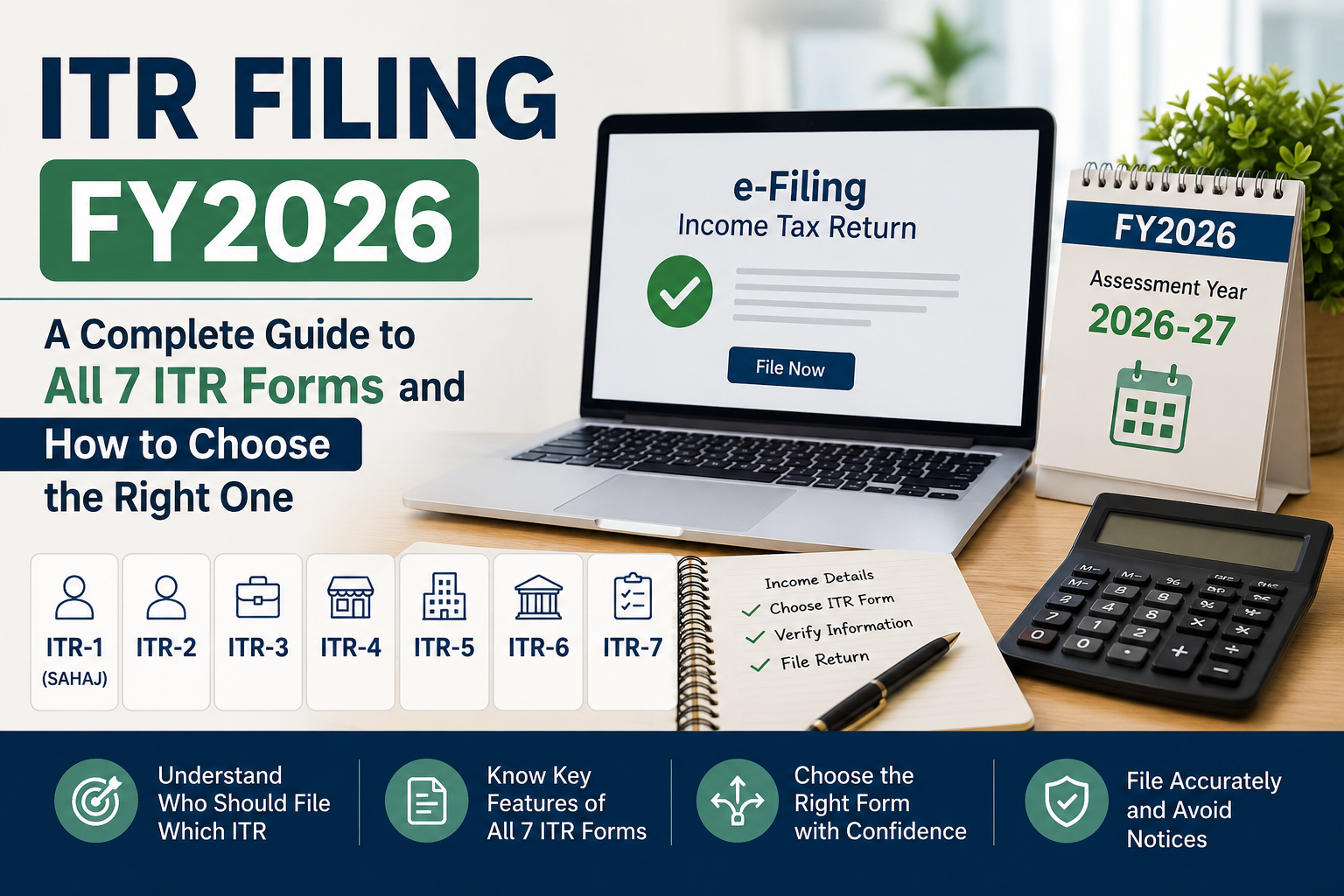
For Financial Year 2025–26 (Assessment Year 2026–27), the Income Tax Department has notified seven different ITR forms, each designed for specific taxpayer categories, income sources, and earning patterns. Whether you are a salaried individual, freelancer, business owner, investor, or company, selecting the appropriate form is crucial for hassle-free tax filing.
There are seven different ITR forms available for tax filing in India. Here’s a detailed look at each form and who should use it based on their income source and earnings.
What is ITR Filing?
ITR (Income Tax Return) filing refers to the process of submitting details of income, tax payments, deductions, and investments to the Income Tax Department for a specific financial year. Through ITR filing, individuals, businesses, and other taxpayers disclose their total earnings and determine whether they have any tax liability or are eligible for a refund.
For ITR Filing FY2026 (Financial Year 2025–26), taxpayers are required to provide information about income earned from salary, business or profession, capital gains, house property, and other income sources while claiming applicable deductions and exemptions. Filing an ITR by the due date ensures tax compliance, helps avoid penalties, and is often necessary for purposes such as securing loans, applying for visas, and claiming refunds.
Why is it important to choose the appropriate ITR Form?
Every ITR form is created for a particular category of taxpayer and type of income. Selecting the wrong form can create several issues, such as:
- Delays in receiving tax refunds
- Invalid return notices from the IT Department
- Extra compliance obligations
- Difficulties in revising or re-filing returns
Therefore, it is essential to check the eligibility conditions of each ITR form carefully before beginning the tax filing process.
List of All 7 ITR Forms for Filing in 2026
1. ITR-1 (Sahaj)
Who can file ITR-1?
ITR-1, popularly known as Sahaj, is designed for resident individuals with straightforward income sources.
You are eligible to file ITR-1 if:
- Your total yearly income is within the ₹50 lakh limit
- You earn income from salary or pension
- You have income from one house property
- Your agricultural income is up to ₹5,000
- You receive income from other sources, such as bank interest
Who cannot file ITR-1?
You are not eligible to file ITR-1 (Sahaj) if:
- Your total income exceeds ₹50 lakh
- You earn capital gains from shares, mutual funds, or property transactions
- You own assets or earn income outside India
- You are a director in a company
- You have income from business or profession
Best suited for: Salaried individuals and pensioners with simple income sources and basic tax filing requirements.
2. ITR-2
Who should file ITR-2?
It applies to people and Hindu Undivided Familieswho do not earn income from a business or profession.
You can file ITR-2 if you have:
- Salary or pension income exceeding ₹50 lakh
- Capital gains from shares, mutual funds, or the sale of property
- Income from multiple house properties
- Foreign assets or income earned abroad
- Agricultural income above ₹5,000
Best suited for: High-income salaried taxpayers, investors, and NRIs with non-business income sources.
3. ITR-3
Who can file ITR-3?
ITR-3 is for Persons and Hindu Undivided Familieswho are earning prominent income from a business or profession.
You should opt for ITR-3 if:
- You own or operate a business
- You work as a freelancer or professional, such as a consultant, doctor, lawyer, or architect
- You earn money from daily stock trading or F&O trading
- You are a partner in a partnership firm
Best suited for: Business owners, self-employed professionals, freelancers, and active traders.
4. ITR-4 (Sugam)
Who can file ITR-4?
ITR-4, popularly known as Sugam, is for taxpayers who opt for the presumptive taxation scheme under Sections 44AD, 44ADA, or 44AE of the Income-tax Act.
Eligibility to file ITR-4:
- Your total income is up to ₹50 lakh, subject to prescribed conditions
- You earn income from business or profession under the presumptive taxation scheme
- You receive salary or pension income along with eligible business income
Who cannot file ITR-4?
You are not eligible to file ITR-4 (Sugam) if:
- You own any assets out of India, or you have accumulated foreign income
- You earn income from capital gains
- Your business turnover exceeds the prescribed threshold limits
Best suited for: Small business owners and professionals opting for the presumptive taxation scheme.
5. ITR-5
Who should file ITR-5?
ITR-5 is meant for specific entities and business structures, including:
- Partnership firms, including Limited Liability Partnerships (LLPs)
- Association of Persons (AOPs)
- Body of Individuals (BOIs)
- Cooperative societies
Best suited for: Firms with partners and certain organisations that need to file income tax returns.
6. ITR-6
Who can file ITR-6?
ITR-6 is applicable to companies that are not eligible for exemption under Section 11 of the Income Tax Act.
This form is generally used by:
- Private limited companies
- Public limited companies
Best suited for: Registered companies required to file corporate income tax returns.
7. ITR-7
Who should file ITR-7?
ITR-7 is intended for entities required to file returns under specific provisions of the Income-tax Act.
This category includes:
- Trusts
- Political parties
- Religious institutions
- Charitable organisations
- Educational institutions claiming tax exemptions
Best suited for: Tax-exempt organisations, trusts, and institutions
Comparison of All 7 ITR Forms for ITR Filing FY2026
| ITR-1 (Sahaj) | Salaried individuals and pensioners | Income from salary, pension, and one house property |
| ITR-2 | Investors and high-income individuals | Capital gains, income from multiple house properties |
| ITR-3 | Business owners and self-employed professionals | Income from business or profession |
| ITR-4 (Sugam) | Small businesses and professionals | Income under the presumptive taxation scheme |
| ITR-5 | Partnership firms and LLPs | Partnership and firm-related income |
| ITR-6 | Registered companies | Corporate or company income |
| ITR-7 | Trusts, charitable bodies, and institutions | Exempt income under specific provisions |
How to Download Your Filed ITR?
1. Visit the Income Tax Department portal and log in using your PAN (User ID) and password.
2. Click on the e-File tab available in the main menu.
3. Navigate to Income Tax Returns and select View Filed Returns.
4. Choose the relevant Assessment Year (AY) for which you want to access the return.
5. Click Download Form to download a copy of your filed ITR or select Download Receipt to get the ITR-V acknowledgement.
FAQs
Q1. Which ITR form should you choose: ITR-1 or ITR-2?
Ans – ITR-1 is ideal for taxpayers with straightforward income sources, making the filing process simpler and faster. On the other hand, ITR-2 is better suited for individuals with more complex financial profiles, such as those earning capital gains, owning multiple properties, or having foreign income or assets.
Q2. Is it possible to file an ITR without a Chartered Accountant (CA)?
Ans – Yes, you can file your Income Tax Return (ITR) without the help of a Chartered Accountant (CA). For individuals with simple income sources, the process is generally easy, free, and largely automated, making self-filing a convenient option.
Q3. How do you choose the right ITR form?
Answer – The selection of the correct Income Tax Return (ITR) form depends on factors such as your income sources, residential status, and total annual earnings. Choosing an incorrect form may lead to a defective return notice from the Income Tax Department.
Q4. How can you check or identify your ITR details?
Answer – To check the details of your Income Tax Return (ITR) in India, you can simply Login to the Income Tax e-filing portal. After signing in, go to e-File > Income Tax Returns > View Filed Returns to track your filing status or download a copy of your submitted ITR in PDF format.