



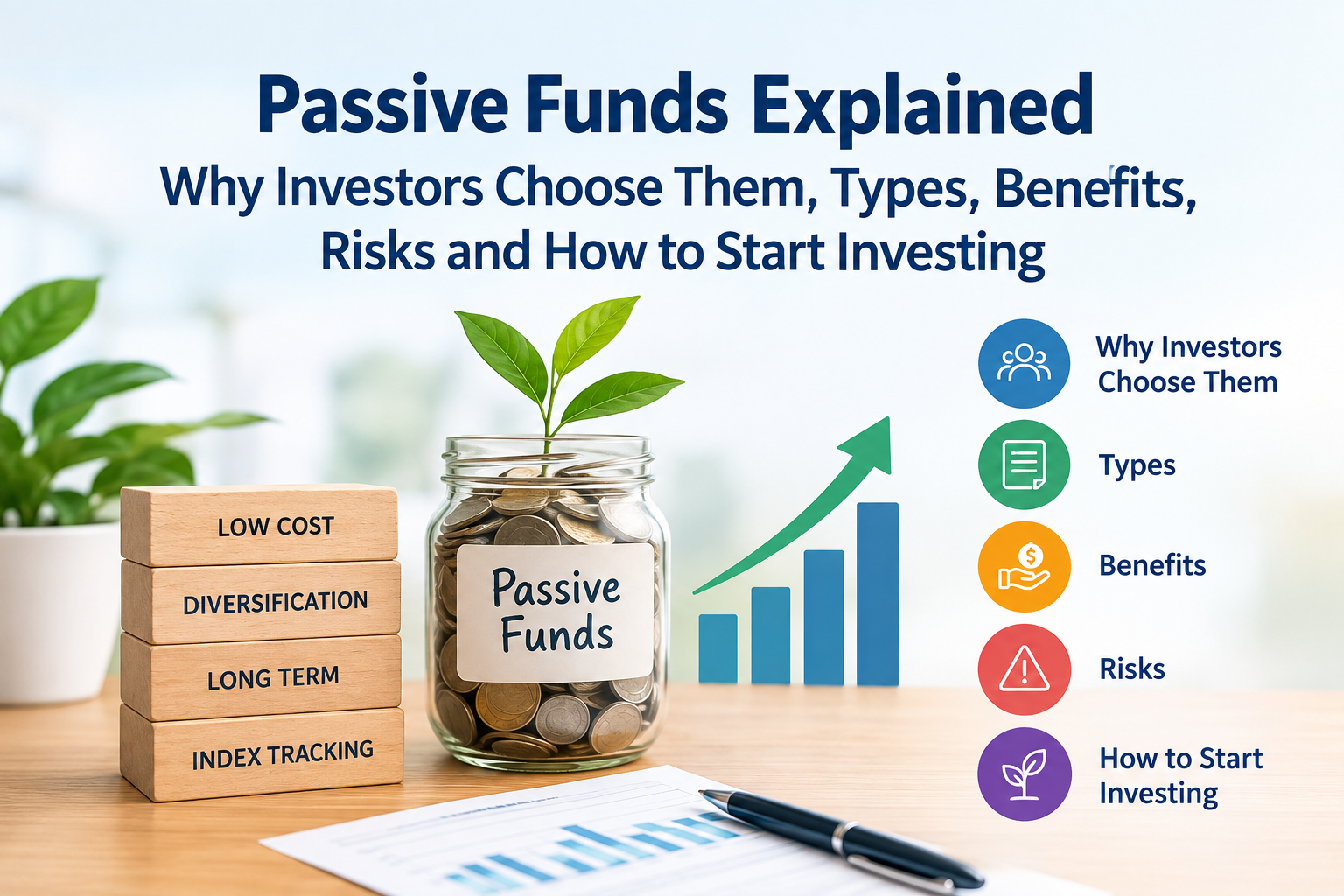
Investors like to invest in passive funds in order to gain exposure to the investment market through a predefined investment strategy. These Passive funds are curated to track the performance of a specific market index, for instance, the Nifty 50 or Sensex, instead of depending on a fund manager to select investments to outperform the benchmark actively.
With their simple investment approach, potential cost benefits, and diversified market exposure, passive funds are worth exploring, particularly for beginners who want to understand how market-linked investments work.
But what exactly are passive funds, how do they function, and what risks should investors be aware of before investing? This blog explains the types of passive funds, their benefits and risks, and how to start investing, using simple and easy-to-understand language.
What Are Passive Funds?
Passive funds are basically investment funds that aim to match the performance of a specific market index. Rather than actively selecting stocks to outperform the benchmark, these funds typically invest in the securities included in the index, following its composition and weight allocation.
For instance, a mutual fund that tracks the Nifty 50 Index aims to generate returns that broadly reflect the index’s performance, before considering expenses, tracking errors, and other factors.
Passive funds are mainly available in two forms:
- Index Mutual Funds: Index Mutual funds are a kind of fund that intend to mirror the performance of a particular market index.
- Exchange-Traded Funds (ETFs): ETFs are investment funds that mainly trade on stock exchanges, equivalent to individual stocks.
As a result, these funds do not guarantee returns and remain exposed to market fluctuations, including potential losses during market downturns.
Why Are Investors Choosing Passive Funds?
Passive funds have become a popular topic among investors because they provide an opportunity to participate in market performance without relying on a fund manager to make frequent stock-selection decisions.
Investors may explore passive funds for several reasons, including potentially lower costs, diversification, and a straightforward investment strategy. Here are some key passive fund benefits to understand.
1. Potentially Lower Investment Costs
The major advantage of passive funds is that they might have lower expenses compared to active funds.
Passive funds usually follow a fixed index, so they need less research and fewer changes to their portfolio. This aids in reducing certain management-based costs. However, the expense ratio varies from one fund to another, so investors should compare individual schemes before investing.
The Securities and Exchange Board of India (SEBI) provides information on index funds and passive investment strategies, including their cost-related features.
Why it matters: Even a small difference in annual expenses can influence long-term returns because of the compounding effect.
2. Diversification Through a Single Fund
Passive funds that track broad market indices allow investors to gain exposure to multiple companies through a single investment.
For example, an index fund tracking a broad equity index may invest in companies from different sectors. This helps investors participate in a basket of securities without having to select and purchase each stock individually.
However, diversification does not remove market risk. Funds that follow a specific sector or a small group of stocks may offer less diversification than funds that track a broad market index.
Why it matters: This investment can give you access to several companies, but diversification depends on the index the fund follows.
3. A Simple Investment Strategy
Passive investing follows a predefined benchmark, which can make its approach easier to understand than strategies that involve frequent stock selection.
Before investing, individuals can review the fund’s underlying index, investment objective, expense ratio, and tracking performance.
This clear approach probably appeals to beginners who want to emphasize long-term investing rather than predicting which stocks will perform best in the market.
Why it matters: Knowing the benchmark helps investors understand what they are investing in and how the fund is expected to perform.
4. Greater Transparency in Portfolio Construction
Investors can examine the benchmark to understand the types of securities and sectors the fund aims to track.
However, the fund’s actual portfolio may not exactly match the index at all times. Differences can arise because of expenses, cash holdings, corporate actions, portfolio rebalancing, and other operational factors.
Why it matters: Understanding the index methodology and the fund’s tracking performance can help investors assess how closely the fund follows its benchmark.
Types of Passive Funds?
1. Index Mutual Funds
These funds are curated to follow the performance of a market index. Index mutual funds generally invest in the securities covered in their underlying index, as per the fund’s investment strategy and proper regulations.
Some examples of indices that index funds track are:
- Nifty
- Sensex
- Nifty Next 50
- Broad-market, sectoral, and thematic indices
The returns of an index fund can differ from those of its underlying index because of expenses, tracking differences, and other factors. SEBI’s investor education resources explain how index mutual funds aim to follow the composition of their selected benchmarks.
2. Exchange-Traded Funds (ETFs)
ETFs are mainly listed on stock exchanges as investment funds and, depending on the scheme, an ETF may track an equity index, bond index, commodity, or another basket of assets. ETFs are bought and sold on stock exchanges during trading hours, and their prices may change during the day.
Key features of ETFs include:
- These are traded on stock exchanges just like individual shares.
- Generally require a demat account to hold ETF units.
- The market price may be higher or lower than the fund’s NAV.
- Bid-ask spreads and trading liquidity can affect buying and selling costs.
- Returns depend on the performance of the underlying assets, expenses, and other tracking-related factors.
AMFI explains that ETFs trade on stock exchanges in a manner similar to stocks. Investors should also consider the fund’s trading volume and associated costs before investing.
3. Debt Index Funds and Bond ETFs
Passive investing is not restricted to equity markets. Debt index funds and bond ETFs are designed to track predefined indices made up of fixed-income securities.
These funds can provide exposure to a selected basket of bonds or other debt instruments. Before investing, individuals should examine factors such as:
- Types of bonds held by the fund
- Maturity period of the securities
- Credit quality
- Sensitivity to interest rate changes
- Risk disclosures and investment strategy
Important: Debt index funds and bond ETFs are not completely risk-free. Interest rate changes can affect bond prices, and credit-related risks may also arise depending on the securities held in the portfolio.
4. Sectoral and Thematic Index Funds
Some passive funds track specific sectors or investment themes, such as banking, information technology, and healthcare.
These funds allow investors to gain targeted exposure to a particular market area. However, they may offer less diversification than broad-market index funds.
For example, a banking sector index fund may be significantly affected by developments in the banking industry. If the selected sector or theme performs poorly, the fund may experience considerable fluctuations.
Difference Between Passive Funds and Active Funds
| Feature | Passive Funds | Active Funds |
| Investment approach | Follows a specific market index or benchmark. | Fund manager selects investments based on the fund’s strategy. |
| Main objective | Aims to replicate the performance of the chosen benchmark. | Generally seeks to outperform a benchmark through investment decisions. |
| Portfolio decisions | Primarily guided by the index’s composition and methodology. | Based on the fund manager’s research, strategy, and market assessment. |
| Trading activity | Usually involves less active trading, depending on the index and fund strategy. | May involve more frequent buying and selling of investments. |
| Investment costs | Often have lower expenses, although costs vary between schemes. | Expenses vary and may be higher depending on the fund and management approach. |
| Performance | Aims to follow the benchmark’s returns after considering expenses and tracking differences. | Depends on investment decisions, market conditions and the fund’s ability to achieve its objective. |
| Key consideration | Index exposure, expense ratio and tracking difference. | Fund manager’s strategy, investment performance and expenses. |
Benefits of Passive Funds
1. Potentially Lower Expenses
Passive funds may have relatively lower operating costs because they follow an index instead of requiring extensive research and frequent stock selection. However, expense ratios vary across schemes, so investors should compare the costs before investing.
2. Portfolio Diversification
Broad-based index funds can provide exposure to multiple securities through a single investment. This can help investors spread their exposure across different companies and, in some cases, sectors.
3. Benchmark-Based Investing
Passive funds follow a predefined market index or benchmark, allowing investors to participate in its performance without depending on frequent individual stock-selection decisions by a fund manager.
4. Greater Transparency
The fund’s underlying benchmark and investment objective can help investors understand what the fund aims to track and how its portfolio is structured.
5. Long-Term Investment Discipline
A passive investment strategy follows a predefined approach, which may help investors avoid making frequent investment decisions based on short-term market movements.
Risks of Passive Funds
1. Market Risk: A passive fund generally follows its underlying index, which means if the index decreases, the value of the fund may also decline. Equity passive funds, for instance, are affected by movements in the stock market.
2. Tracking Error and Tracking Difference: A passive fund may not exactly match the performance of its benchmark. Tracking error measures the variation between the fund’s returns and those of the benchmark, while tracking difference refers to the difference in returns over a period. Expenses and other portfolio factors can contribute to these differences.
3. Concentration Risk: Some sectoral, thematic, or narrowly focused indices may have high exposure to a few companies or a specific industry. Therefore, not all passive funds provide broad diversification.
4. ETF Liquidity Risk: ETFs are traded on stock exchanges, so liquidity is an important consideration. ETFs with low trading volumes may have a wider gap between their buying and selling prices.
5. Index Risk: Passive funds’ performance depends on the index it tracks. If the underlying index performs poorly, the fund is likely to be affected as well. Investors should therefore assess the index and its composition before investing.
How to Start Investing in Passive Funds
- Set your investment goal: Identify whether you are investing for long-term wealth creation, retirement, or exposure to a specific market segment.
- Choose the type of passive fund: Decide between an index fund and an ETF, and understand the index or asset the fund tracks.
- Understand the benchmark: Check the index’s composition, diversification, sector exposure, and rebalancing method before investing.
- Compare costs: Look at the expense ratio when comparing similar passive funds, as costs can affect long-term returns.
- Check tracking performance: Review tracking error and tracking difference to see how closely the fund has followed its benchmark.
- Review the portfolio: Check the fund’s holdings, asset allocation, and concentration. For ETFs, also consider trading volume and liquidity.
- Complete KYC and invest: Complete the required KYC process and invest through an AMC portal, mutual fund platform, or other permitted channel. ETFs are traded on stock exchanges and generally require a demat account.
FAQs
Q1. Can I invest in passive funds through SIP?
Ans. Yes. SIPs are available for many eligible mutual fund schemes, including index funds. ETFs are traded on stock exchanges, so they follow the usual exchange-trading process.
Q2. What should I consider when selecting a passive fund?
Ans. Check the benchmark, expense ratio, tracking error, tracking difference, portfolio, liquidity, and whether the fund matches your investment goals and risk tolerance.
Q3.Are passive funds free from risk?
Ans. No. Passive funds carry the risks of the assets they track. For example, equity passive funds can lose value when the underlying market falls.
Sources: msn.com