



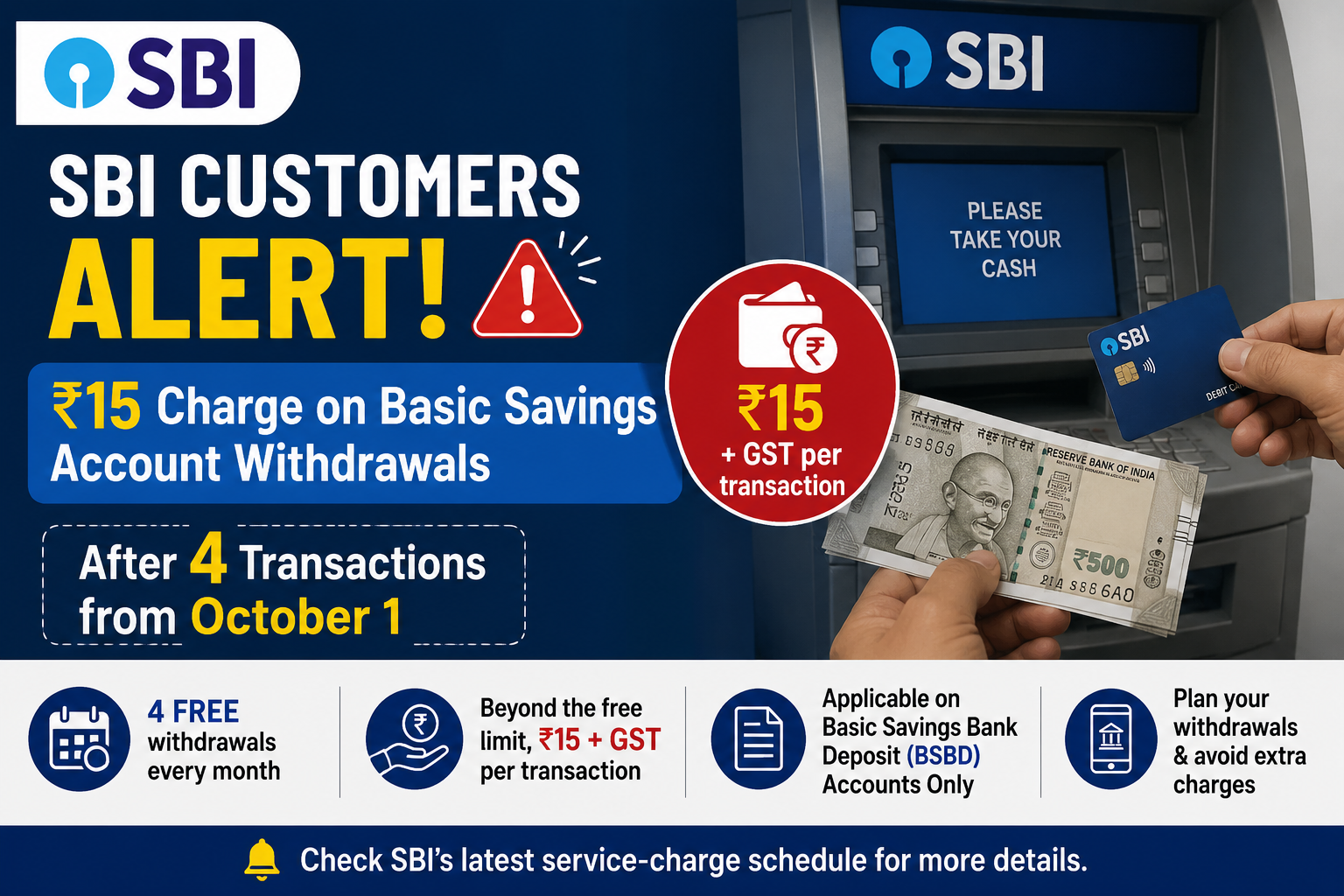
If you have a Basic Savings Bank Deposit (BDSD) in State Bank of India, then there is an important update for you. SBI has revised the service charges applicable to customers with a Basic Savings Bank Deposit (BSBD) account. Starting October 1, 2026, SBI customers will get four free cash withdrawals each month. Any withdrawal beyond this limit will incur a fee of ₹15 plus applicable GST per transaction. The revised charges have been published on SBI’s official website under its service charges section.
The update is particularly relevant for customers who regularly withdraw cash from their SBI basic savings account. Here’s a look at the new SBI withdrawal rule and what it means for BSBD account holders.
What Is an SBI Basic Savings Bank Deposit Account?
The Basic Savings Bank Deposit (BSBD) Account is a savings account that provides essential banking services without requiring customers to maintain a minimum balance. According to SBI, the account comes with certain basic facilities at no additional cost.
The account can be a suitable option for customers looking for essential banking services without the burden of meeting a regular minimum-balance requirement.
Main Features of SBI BSBD Account
The SBI BSBD account does not require customers to maintain a minimum balance. However, cheque book facility is not available with this account. Customers can withdraw money either by submitting a withdrawal form at an SBI branch or by using an ATM.
Account holders are also provided with a basic RuPay ATM-cum-debit card for making ATM transactions.
SBI Basic Savings Account Withdrawal Rule from October 1
Under the revised SBI cash withdrawal charges, BSBD account holders will be allowed four free cash withdrawals each month. Once the free limit is exceeded, SBI will levy a ₹15 fee plus applicable GST on every additional chargeable withdrawal.
For instance, if a customer makes five eligible cash withdrawals in a month, the first four withdrawals are free. The fifth withdrawal will incur a ₹15 charge plus GST. The same fee will apply to every subsequent withdrawal that falls beyond the free limit.
SBI’s official service-charge page states that the revised charges for the Basic Savings Deposit Account – Branch Channel will take effect from October 1, 2026.
What Is Changing for SBI Customers?
- Four free withdrawals per month: SBI BSBD account holders will continue to get four free withdrawals each month.
- Charges after the free limit: Withdrawals beyond the four free transactions will attract a ₹15 fee plus applicable GST per transaction.
- Earlier rule: SBI’s earlier service-charge schedule stated that four withdrawals were free, while transactions beyond the first four, excluding digital transactions, were charged ₹15 plus GST.
- New rule from October 1: The revised charges will come into effect from October 1, 2026, making it important for customers to track their monthly transactions.
- Digital transactions: Reports on the revised charges indicate that digital transactions may also be counted within the four-transaction monthly limit, which could affect customers who use multiple banking channels.
- Keep track of withdrawals: Customers who frequently use ATMs, branches, or other transaction channels should monitor their monthly activity to avoid unexpected charges.
SBI Cash Withdrawal Charges that Every Customer Should Know
| Particular | Rule Applicable from October 1, 2026 |
| Account type | Basic Savings Bank Deposit (BSBD) Account |
| Free cash withdrawals | Up to 4 withdrawals every month |
| Fee beyond the free limit | ₹15 per additional withdrawal |
| GST | Applicable separately on the withdrawal charge |
| Effective from | October 1, 2026 |
| Customers affected | BSBD account holders who make frequent cash withdrawals |
Why SBI Customers Should Keep Track of Their Withdrawals
- Small fees can add up over time: A ₹15 charge may seem insignificant for one transaction, but repeated withdrawals beyond the monthly free limit can gradually increase the customer’s banking expenses.
- Charges apply to additional withdrawals: After using the four free withdrawals, customers may have to pay ₹15 plus applicable GST for every subsequent eligible transaction.
- Frequent cash withdrawals may cost more: Customers who regularly rely on cash should monitor their withdrawal frequency to minimise avoidable service charges.
- Combine withdrawals when possible: Instead of making several small withdrawals, customers can plan their cash needs and make fewer, consolidated withdrawals wherever convenient.
- Keep a monthly record: Tracking the number of withdrawals made during the month can help customers stay aware of their free transaction limit and avoid unexpected fees.
- Review applicable transaction channels: Customers should check SBI’s updated service-charge schedule to determine which transaction types and banking channels fall under the revised rules.
- Transaction rules may vary: Customers should not assume that every transaction is subject to the same treatment. The applicable charges may depend on the type and channel of the transaction.
- Plan cash requirements carefully: Customers who frequently use cash can estimate their monthly needs in advance and organise their withdrawals accordingly to reduce the chances of paying additional charges.
Does the New Rule Apply to All Savings Accounts?
No. The revised rule applies specifically to Basic Savings Bank Deposit (BSBD) accounts. SBI has separately mentioned the updated charges for the Basic Savings Deposit Account – Branch Channel in its service-charge schedule.
Customers holding regular SBI savings accounts should therefore not assume that the ₹15 charge applies to them. The applicable charges may differ based on the type of savings account and transaction channel.
How Can SBI Customers Avoid Extra Charges?
BSBD account holders can follow a few simple steps to minimise additional withdrawal charges:
- Track monthly withdrawals: Keep a record of the number of cash withdrawals made each month.
- Limit unnecessary withdrawals: Try to avoid extra cash withdrawals once the four free transactions have been used.
- Plan cash needs: Combine multiple cash requirements into fewer withdrawals whenever possible.
- Use digital payments: Opt for digital payment methods for regular purchases when convenient.
- Check updated charges: Review SBI’s latest service-charge schedule to understand the applicable rules before making transactions.
The aim is not to completely avoid cash withdrawals but to understand the SBI cash withdrawal limit and plan transactions accordingly.
Conclusion
The SBI withdrawal charges from October 1, 2026, are important for BSBD account holders, as the revised service charges will come into effect from October 1. Customers will continue to get four free withdrawals every month, while withdrawals beyond the free limit may attract ₹15 plus GST per transaction. Those who frequently withdraw cash should keep track of their monthly transactions and plan their withdrawals carefully to avoid extra SBI cash withdrawal charges. It is also advisable to check SBI’s latest service-charge schedule for the applicable rules.
Sources: economic times