



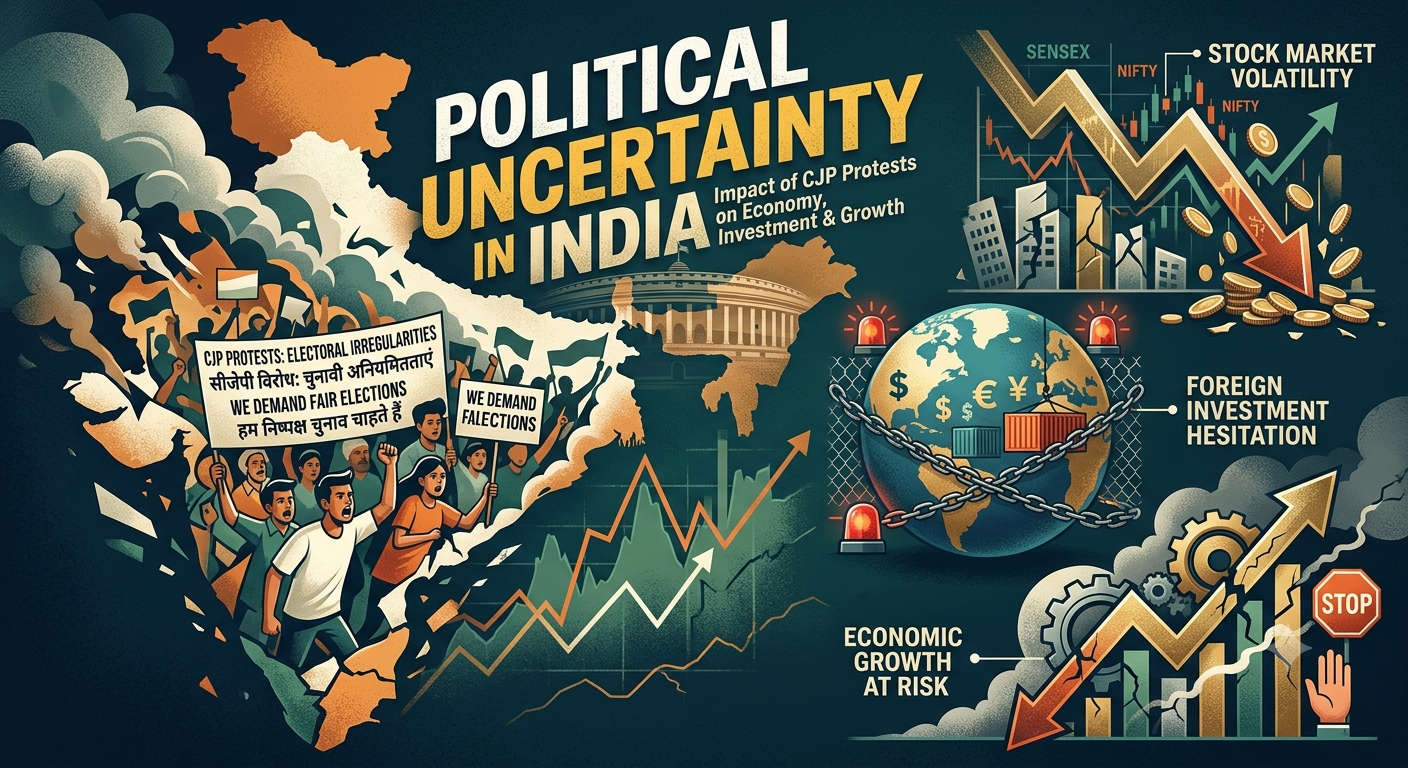
Political uncertainty in India has increased amid the current CJP protests by the Cockroach Janata Party (CJP) and other groups over alleged errors in updating voter lists. These protests have raised concerns about fair elections, government accountability, and how prolonged political disputes could affect the Indian economy.
On October 13, 2026, Reuters reported on demonstrations over changes to voter lists and the controversy surrounding the Election Commission’s Special Intensive Revision (SIR) exercise. The Election Commission has stated that the process is intended to remove deceased voters, duplicate entries, and ineligible names from electoral rolls. However, critics have expressed concerns that eligible voters could also be excluded. These opposing views remain at the heart of the controversy.
While political protests do not necessarily lead to stock market declines, prolonged uncertainty can affect investor confidence, business planning, and expectations about future government policies. In this blog, we will examine the potential economic impact of political uncertainty, how foreign investors may respond, and which key indicators investors should watch.
What is happening with the current CJP Protests in India?
The Cockroach Janata Party (CJP) has been protesting against alleged irregularities in the Special Intensive Revision (SIR) of voter lists. The party has also demanded answers and accountability from the Election Commission.
According to The Indian Express, critics have raised concerns about how voter-list data is managed, the use of centralised software, and reported disagreements within the Election Commission. However, the Commission has denied any wrongdoing. These claims remain allegations and should not be treated as legally proven facts.
On October 14, 2026, Telangana Today, citing IANS, reported that three CJP leaders were arrested after entering Jantar Mantar during a protest. The report also mentioned allegations made by the party regarding the police action. These events have brought attention to issues such as fair elections, accountability of institutions, and the way public protests are handled.
However, the economic impact will depend on how the situation develops. Short-term protests may have little effect on the economy, but prolonged political uncertainty could affect investor confidence, business decisions, and government policymaking.
Can political uncertainty affect the Indian Stock Market?
Political uncertainty in India can affect stock market sentiment, but the impact may vary across sectors and is not always immediate.
Stock prices depend on several factors, including company earnings, economic growth, interest rates, government policies, and future risks. When political developments create uncertainty around these factors, investors may review their investments and adjust their portfolios.
Here are some ways political uncertainty could affect the Indian stock market.
1. Short-Term Volatility in the Sensex and Nifty
The BSE Sensex and NSE Nifty 50 may see price fluctuations when investors react to major political developments. If the CJP protests grow or the controversy raises concerns about future government policies, some investors may become cautious and reduce their exposure to riskier investments until the situation becomes clearer.
However, any rise or fall in the Sensex or Nifty should not be directly linked to these protests without supporting market data. Several other factors, such as global interest rates, crude oil prices, company earnings, inflation, currency movements, and foreign investor activity, can also affect Indian stocks.
What investors should watch: Daily Sensex and Nifty movements, trading volumes, India VIX, sector-wise performance, and official announcements related to economic policies.
2. Impact on Investor Confidence
Investor confidence partly depends on a stable and predictable economic and regulatory environment. Businesses and investors need clear rules, consistent policies, and reliable institutions to make long-term investment decisions.
If political disputes create prolonged uncertainty about governance or future policies, investors may become more cautious. In contrast, transparent investigations, clear communication and predictable institutional processes can help reduce uncertainty.
Therefore, the impact of the CJP protests will depend not just on the protests themselves but also on whether the developments change investor expectations about India’s economic and policy environment.
3. Impact on Different Sectors of the Stock Market
Political developments can affect industries in different ways, depending on their exposure to government policies, consumer demand, and economic conditions.
- Infrastructure and capital goods: Companies in these sectors may face challenges if government projects, public spending, or approvals are delayed.
- Banking and financial services: These sectors may respond to changes in economic growth expectations, demand for loans, and overall market sentiment.
- Real estate: Political uncertainty may affect business confidence, financing conditions, and property-buying decisions.
- Consumer goods: Prolonged uncertainty could influence consumer confidence and spending on non-essential products.
- Information technology and export-oriented businesses: These companies may be more affected by global demand, currency movements, and overseas technology spending.
These are potential ways political uncertainty could affect different sectors. They do not confirm that the CJP protests have already affected any particular industry.
How Could the CJP Protests Affect Foreign Investment in India?
Foreign investment plays an important role in India’s economy by bringing in capital, creating jobs, supporting technology development, and helping businesses grow. Political uncertainty can influence how foreign investors assess the risks of investing in the country.
To understand the possible impact, it is important to know the difference between two types of foreign investment.
1. Foreign Portfolio Investment (FPI)
Foreign portfolio investors put their money into financial assets such as shares and bonds. They can change their investments relatively quickly when market conditions or risk expectations change.
If political uncertainty increases, some FPIs may sell Indian shares or bonds. Depending on the amount sold and the overall market situation, this could increase selling pressure in the financial markets.
However, FPI investment decisions depend on several factors, including:
- US interest rates and global liquidity: Changes in overseas interest rates can influence where foreign investors choose to invest.
- Market valuations: Investors compare the prices of Indian stocks with those in other markets.
- Corporate earnings and economic growth: Strong business performance and growth prospects can attract foreign investment.
- Rupee movements: Changes in the value of the Indian rupee can affect returns for overseas investors.
- Crude oil prices and inflation: Higher oil prices and rising inflation can create economic challenges for India.
- Global risks: International conflicts and changes in investor confidence can also influence investment decisions.
Research published in the Reserve Bank of India’s Bulletin explains how geopolitical risks can affect trade and capital flows through wider economic channels. Although global geopolitical risks differ from domestic political uncertainty, the research helps explain how uncertainty can influence an economy.
2. Foreign Direct Investment (FDI)
Foreign direct investment usually involves a long-term business commitment, such as setting up a factory, expanding operations, or investing in an Indian company.
Unlike portfolio investors, direct investors generally consider several factors before making investment decisions. These include India’s market size, infrastructure, skilled workforce, supply chains, tax rules, regulatory clarity, and long-term business opportunities.
If political uncertainty continues for an extended period and raises concerns about future policies or the functioning of institutions, some foreign companies may delay or review their investment plans. However, protests alone do not mean that foreign companies will withdraw their investments or stop expanding their businesses in India.
Can Political Uncertainty Slow India’s Economic Growth?
Political uncertainty might affect India’s economic growth in several ways:
1. Delays in Business and Investment Plans
Businesses need some certainty before investing in factories, offices, technology, and other long-term projects. When uncertainty increases, companies may delay their investment plans until the situation becomes clearer. This could slow business expansion, hiring, and other economic activities.
However, investment delays are not always inevitable. Companies may continue to invest if demand remains strong and they expect good growth opportunities.
2. Impact on Consumer Spending
Consumer spending is an important part of India’s economic growth, and prolonged uncertainty affects people’s confidence about their jobs, income, or financial future; they may postpone spending on non-essential items or major purchases.
This could affect sectors such as automobiles, retail, travel, hospitality, and consumer durables if spending remains weak for an extended period. However, political protests alone do not mean that consumer spending has declined. Actual economic data is needed to understand whether spending has been affected.
3. Government Spending and Policy Decisions
Political disputes can sometimes take attention away from administrative work or make discussions about government priorities more difficult. If economic decisions, public infrastructure projects, or regulatory changes are delayed, businesses and investment activity could be affected.
However, if government institutions continue to function smoothly and economic policies remain predictable, the impact of political disputes may be limited.
4. Impact on Jobs and Private Investment
If companies postpone expansion plans, they may also delay hiring or reduce their planned spending. If this happens across several industries, it could affect job creation and household incomes.
However, employment also depends on factors such as domestic demand, exports, technological developments, productivity, and the availability of skilled workers.
How Should Stock Market Investors Deal with Political Uncertainty?
1. Follow Trusted News and Official Data
Keep track of reliable news reports, official announcements, stock exchange updates, and government economic data. Investors can check the NSE, BSE, and SEBI websites for stock market information. SEBI’s official FPI statistics can also help investors track foreign portfolio investment flows.
2. Look at Market Data, Not Just Headlines
Political controversies may receive significant media attention without immediately affecting company earnings or economic growth. Before making investment decisions, check whether there is actual evidence of changes in stock prices, foreign investment flows, business activity, or other economic indicators.
3. Avoid Panic Selling
Selling stocks in a hurry because of political news may lead to decisions based on short-term market sentiment rather than financial facts. Instead, review why you invested in a company, its financial performance, your portfolio diversification, and your investment goals.
4. Keep Your Portfolio Diversified
Investing across different sectors and asset classes can reduce dependence on a single company, industry, or market event. Although diversification cannot eliminate market risks, it can help reduce the impact of an unexpected event on your overall portfolio.
5. Track Foreign Investment Along with Other Indicators
Foreign portfolio investor (FPI) selling can provide insights into overseas investor sentiment, but it should not be considered on its own. Investors should also monitor company earnings, domestic institutional investment, rupee movements, bond yields, inflation, and global market trends.
Where Should Investors Focus in the Coming Weeks?
| Indicator | Why It Matters |
| Sensex and Nifty movements | Show overall stock market trends and investor sentiment, although other economic and global factors also influence prices. |
| India VIX | Indicates the market’s expectations of near-term volatility in the Nifty options market. |
| Foreign Portfolio Investment (FPI) data | Helps track foreign investors’ buying and selling activity in Indian financial markets. |
| Domestic Institutional Investor (DII) activity | Shows whether domestic investors are buying shares and balancing some of the selling by foreign investors. |
| Indian rupee exchange rate | Reflects various factors, including foreign investment flows, global market conditions, and domestic economic developments. |
| Corporate earnings | Help investors assess company performance and whether stock prices are supported by business results. |
| GDP and consumption data | Provide insights into economic growth, consumer spending, and overall business activity. |
| Government policy announcements | Help investors understand changes in economic policies and their potential impact on businesses. |
| Official updates on electoral rolls | Help investors follow developments in the dispute, including any official decisions, investigations, or legal proceedings. |
FAQs
Q1. What is the difference between FPI and FDI?
Ans. FPI involves investing in shares and bonds, while FDI involves long-term business investments, such as setting up or expanding a company. FPI is generally more responsive to short-term market changes than FDI.
Q2. Where can investors check official foreign investment data in India?
Ans. Investors can visit SEBI for FPI data, DPIIT for FDI reports, RBI for economic research, and NSE and BSE for stock market updates and company disclosures.
Sources: SEBI , Reuters , The Indian Express , Telangana Today , RBI Bulletin