



After a year impacted by geopolitical uncertainties, fluctuating crude oil prices, foreign investor selling, and a slowdown in new public offerings, India’s IPO market could finally be heading toward its biggest breakthrough.
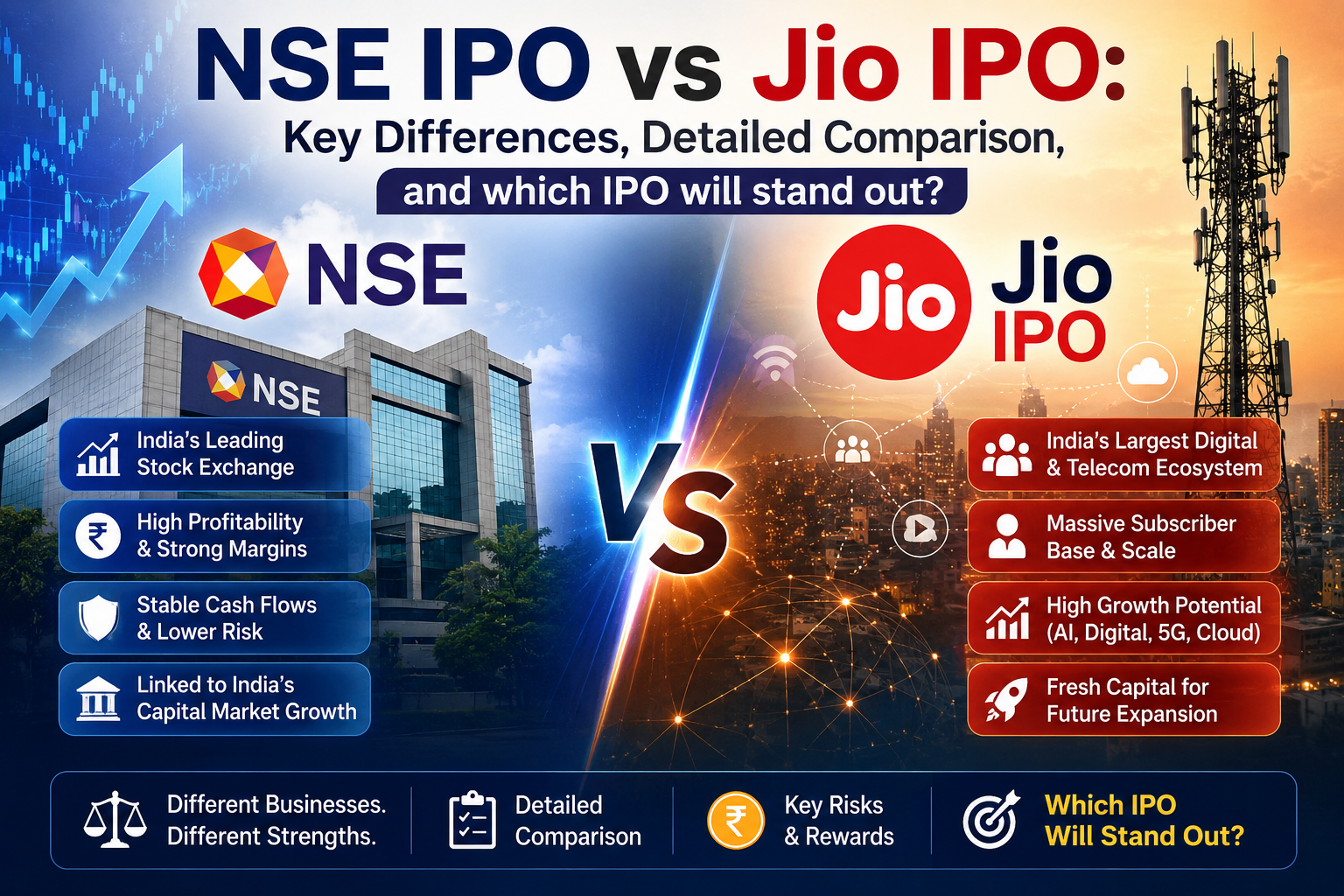
India’s primary market is preparing for two of the most eagerly awaited IPOs in recent years—the expected public listings of the National Stock Exchange (NSE) and Jio Platforms. As leaders in their respective industries, both companies are likely to generate strong investor interest once they debut on Dalal Street.
While NSE plays a pivotal role in India’s stock market infrastructure, Jio has revolutionized the country’s telecom and digital landscape. These IPOs offer investors exposure to two distinct business models, growth trajectories, and investment propositions.
In this Blog, we take a detailed look at the NSE IPO and Jio IPO, comparing their business models, growth potential, and investment appeal to assess which listing could emerge as the more attractive opportunity for investors.
Why Are Investors Excited About the NSE and Jio IPOs?
The NSE IPO has been one of the most anticipated listings in India, with its launch delayed for several years due to regulatory challenges. In 2026, the exchange moved a step closer to going public after securing regulatory approvals and completing key filing requirements. Market experts estimate its valuation at around ₹5–6 lakh crore.
On the other hand, Jio Platforms has officially initiated its IPO journey and is expected to bring one of the largest public offerings ever seen in India. Analysts value the company between ₹12 lakh crore and ₹14 lakh crore, which could place it among the country’s most valuable listed firms.
NSE IPO vs Jio IPO: Detailed Comparison
| Parameter | NSE IPO | Jio IPO |
| Business Model | Operates a stock exchange | Provides telecom and digital services |
| Sector | Financial Market Infrastructure | Telecom, Technology & Digital Services |
| Estimated Valuation | ₹5–6 lakh crore | ₹12–14 lakh crore |
| IPO Structure | Mostly an Offer for Sale (OFS) | Expected to be largely a Fresh Issue |
| Primary Revenue Sources | Trading fees, listing charges, and data services | Mobile services, broadband, digital platforms, and enterprise solutions |
| Growth Potential | Stable and predictable growth | Higher growth potential with greater competition |
| Market Position | India’s leading stock exchange | India’s largest telecom operator |
| Key Risks | Regulatory changes and market activity fluctuations | Competition, tariff regulations, and execution risks |
| Investor Appeal | Strong cash flows and earnings stability | Long-term growth and digital expansion opportunities |
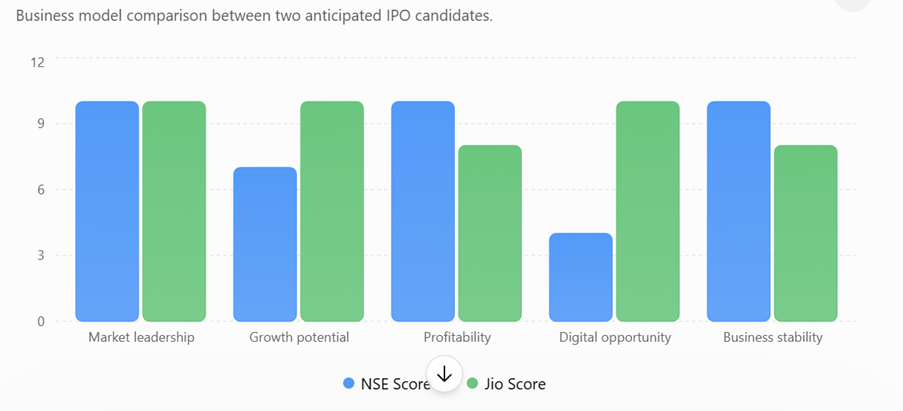
NSE IPO: Key Investment Highlights
1. Strong Market Leadership
NSE accounts for the bulk of equity derivatives trading in India and continues to be the country’s largest stock exchange by trading volume. Its dominant position provides a significant competitive edge and steady revenue generation.
2. Robust Profitability
Stock exchanges typically operate with high margins. Once the core infrastructure is in place, rising trading activity can boost profits without a proportionate increase in costs.
3. Reputed Shareholder Base
The IPO is expected to see participation from well-known institutional investors such as LIC, SBI, Temasek, and other major stakeholders through stake sales.
4. Potential Risks
- Revenue is closely linked to market activity and trading volumes.
- Regulatory oversight remains a key consideration.
- Growth prospects may be more moderate than those of technology-focused businesses.
Jio IPO: Key Investment Highlights
1. Extensive Digital Ecosystem
Jio has expanded beyond traditional telecom services to build a diversified digital ecosystem that includes broadband, enterprise solutions, cloud services, AI initiatives, digital content, and connected technologies.
2. Large Customer Base
With hundreds of millions of subscribers, Jio ranks among the world’s largest telecom operators, providing substantial opportunities for revenue growth and monetisation.
3. AI and Technology-Driven Growth
Artificial intelligence, digital services expansion, and increasing Average Revenue Per User (ARPU) are widely viewed as major drivers of Jio’s future growth.
4. Capital for Future Expansion
A significant portion of the IPO proceeds is expected to be used for strengthening the company’s financial position and supporting long-term growth plans.
5. Potential Risks
- The telecom industry remains intensely competitive.
- Future growth depends heavily on improving ARPU.
- Valuation expectations are already very high.
- Changes in telecom regulations or tariff policies could impact profitability.
Which IPO Is More Likely to Deliver Strong Listing Gains?
Forecasting listing gains is challenging because an IPO’s debut performance depends on much more than the company’s brand strength or financial performance. Several factors can influence how a stock performs on its first day of trading.
1. Valuation and Issue Pricing
The valuation at which an IPO is offered is one of the biggest determinants of listing gains. If the issue is priced too high, the scope for immediate upside may be limited, even for a high-quality company. On the other hand, a fairly priced IPO tends to attract stronger demand and may offer better listing-day returns.
2. Market Mood During the IPO
Investor sentiment plays a major role in IPO performance. During a strong bull market, investors are generally more willing to participate in new offerings, often leading to higher listing premiums. In contrast, weak or volatile markets can reduce enthusiasm and affect listing gains.
3. Interest from Institutional Investors
Participation from large investors such as mutual funds, insurance companies, pension funds, and foreign institutions is often seen as a positive signal. Robust institutional demand can increase confidence among other investors and support a successful market debut.
4. Overall Subscription Levels
The extent of demand from retail investors, high-net-worth individuals (HNIs), and institutional investors can provide clues about listing performance. IPOs that receive heavy oversubscription typically generate stronger market interest and may witness better listing-day momentum.
5. Economic and Global Market Environment
Broader factors such as interest rates, liquidity conditions, economic growth prospects, geopolitical events, and global market trends can also influence investor appetite for IPOs. A supportive economic environment generally improves the chances of healthy listing gains.
What Does This Mean for NSE and Jio?
Both NSE and Jio are highly anticipated IPOs with strong brand recognition and leadership positions in their respective industries. If either company comes to the market at an attractive valuation, it could witness substantial investor demand and strong oversubscription.
However, the eventual listing performance will largely depend on pricing, investor sentiment, and prevailing market conditions at the time of launch. While both IPOs have the potential to create significant buzz, attractive valuations and favourable market conditions will be the key drivers of listing-day gains.
Conclusion
NSE and Jio offer different investment stories. NSE stands out for stability and consistent profitability, while Jio offers higher growth potential through its digital and telecom businesses. The better IPO will depend on valuation, market conditions, and investor preference. Either way, both are expected to be landmark listings in the Indian stock market.