




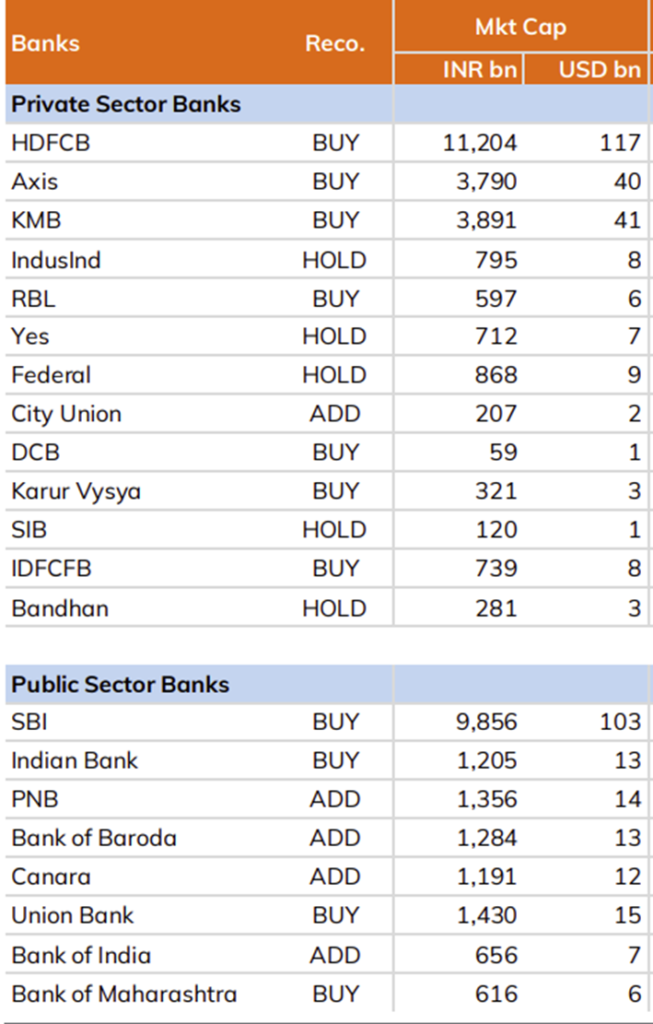
There is good news for investors interested in private bank stocks, but it is important to keep a close watch on their performance at regular intervals. For investors tracking the August 2026 stock market, these banking recommendations can offer useful insights. ICICI Securities has issued a fresh set of recommendations, retaining its positive outlook on the banking sector. The brokerage continues to prefer select large private-sector banks over certain mid-sized lenders.
ICICI Securities has assigned Buy ratings to HDFC Bank stocks, Kotak Mahindra Bank and Axis Bank, while maintaining Hold ratings on YES Bank, Federal Bank and Bandhan Bank. The brokerage has also issued Buy calls on private-sector lenders including RBL Bank, DCB Bank, Karur Vysya Bank and IDFC First Bank. These recommendations are particularly relevant for investors evaluating August 2026 stock picks.
The recommendations come amid ICICI Securities’ expectation of a recovery in banking-sector earnings, driven by stronger net interest income (NII) growth and improving asset quality. So in this Blog we will tell you which stocks to hold and which to buy in August 2026 and how these calls could influence the August 2026 stock outlook.
Why ICICI Securities Remains Positive on the Banking Sector
- ICICI Securities expects healthy NII and EPS growth in FY27, with the FCNR(B) segment providing additional support
- Banking-sector NII growth has already entered double digits, and the brokerage expects the momentum to improve further
- Asset quality has also strengthened, with gross slippages declining to around 1.2% sequentially, compared with 1.4% a year ago
- The Special Mention Account (SMA) pool has shown positive trends, particularly in microfinance and unsecured loans, indicating that potential stress in these portfolios may be easing
PSB (Public Sector Bank) Slippages Less Than Half of Private Banks
The banking sector’s asset quality remained better than expected, despite challenges such as currency fluctuations, higher crude oil prices, and weather-related pressures.
Gross slippages increased slightly to around 1.2% sequentially, mainly due to seasonal weakness associated with the agricultural cycle. However, the figure remained below the 1.4% recorded a year earlier, indicating an overall improvement in credit quality.
The Special Mention Account (SMA) pool also showed positive signs. Stress levels in segments such as microfinance (MFI) and unsecured lending appear to be easing, suggesting that asset-quality concerns in these areas are gradually reducing.
Public sector banks (PSBs) continued to show stronger asset-quality performance. Their slippages remained broadly stable at around 0.7%, even with the seasonal rise in credit stress. This was significantly lower than the levels reported by private-sector banks.
Private banks also saw their slippages improve compared with the same period last year. However, their asset quality remained relatively weaker, with slippages at around 1.7%, more than twice the level reported by PSBs.
Overall, the latest data suggest that the banking sector continues to maintain resilient asset quality. Lower year-on-year slippages and a declining SMA pool provide some comfort to investors, even as banks continue to face macroeconomic and seasonal challenges.
PSBs Continue to Lead Private Banks in Loan Growth
The improvement in asset quality has been accompanied by strong loan growth across the banking sector. Public sector banks (PSBs) continued to record higher year-on-year loan growth than private banks, although the difference has reduced. In Q1 FY27, PSBs recorded 18.3% loan growth, compared with 17% for private banks.
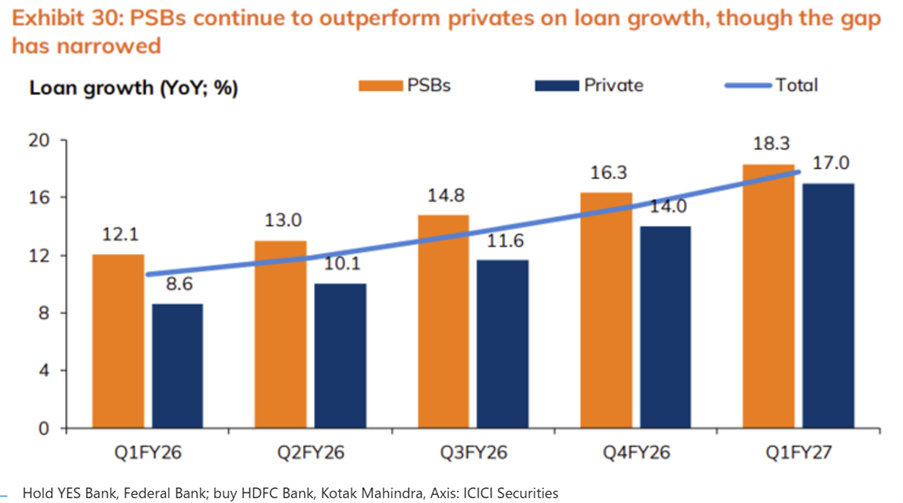
The chart highlights that PSBs have maintained their lead over private banks in loan growth since Q1 FY26. PSB loan growth rose from 12.1% in Q1 FY26 to 18.3% in Q1 FY27, while private banks’ loan growth rose from 8.6% to 17% over the same period.
Bank NII (Net Interest Income) Growth Reaches a New High
1. Banking sector NII growth climbed to a multi-quarter high of 11% YoY, supported by stronger core interest income
2. NIM performance differed across lender categories, with some banks facing greater margin pressure than others
3. Large private banks witnessed a double-digit sequential decline in their NIMs
4. Mid- and small-sized private banks delivered better margin performance, with NIMs remaining stable or improving sequentially
5. Growth in gold loans and SME lending helped support margins for mid- and small-sized private banks
6. PSBs reported mixed NIM trends, largely influenced by their approach to bulk term deposits and wholesale lending
7. Banks with higher exposure to bulk deposits and wholesale lending experienced varying degrees of margin pressure
8. Axis Bank, HDFC Bank and Kotak Mahindra Bank recorded relatively slower NII growth among large private-sector lenders
9. Their NII increased by around 1% sequentially and 7–9% YoY, significantly below the growth recorded by the broader private-bank sector
10. Mid- and small-sized private banks reported stronger NII growth, ranging between 15% and 30% YoY
11. PSBs also recorded a notable improvement, with aggregate NII growth reaching around 12% YoY
Overall, banking sector NII growth reached its strongest level in several quarters, while differences in NIM performance reflected the impact of deposit costs, loan mix, and funding strategies across lender categories
YES Bank and Federal Bank: Hold
ICICI Securities has maintained a Hold rating on YES Bank and Federal Bank, instead of recommending investors buy these stocks.
The Hold call does not mean the brokerage expects the two stocks to decline. Rather, it suggests that their risk-reward profile appears less attractive compared with the large private banks that remain ICICI Securities’ preferred picks.
Following the Q1 FY27 results, ICICI Securities continued with its Hold view on both banks. A research compilation published in July cited target prices of ₹24 for YES Bank and ₹360 for Federal Bank from the brokerage.
What Investors Should Know
- The latest ICICI Securities recommendations show a preference for large private-sector banks, with HDFC Bank stocks, Kotak Mahindra Bank and Axis Bank among its preferred picks, while YES Bank and Federal Bank continue to carry a Hold rating.
- Investors should note that brokerage recommendations reflect analysts’ views at a specific point in time, based on factors such as earnings outlook, valuations, asset quality and growth potential. Actual stock performance can differ due to market movements, interest rates, economic conditions and company-specific developments.
- Funding conditions in the banking sector are also evolving. Reuters reported that private banks, including Kotak Mahindra Bank, YES Bank and Federal Bank, were speeding up overseas fundraising plans ahead of the RBI’s planned early closure of its foreign-exchange swap facility on August 31.
FAQs
Q1: Does YES Bank have a future growth opportunity?
Ans: Yes, YES Bank has a viable future, with improved profitability, better asset quality, and stronger institutional support. However, competition and valuation concerns could limit near-term upside.
Q2: Has SBI sold its stake in YES Bank?
Ans: Yes. State Bank of India sold a 13.18% stake in YES Bank to Japan’s SMBC for ₹8,889 crore, while retaining around 10.8% in the bank.
Q3: What is the YES Bank share price target for 2026?
Ans: Analyst estimates for YES Bank in 2026 range from around ₹21 to ₹30 per share, reflecting cautious expectations for the bank’s recovery. This makes the August 2026 stock discussion especially relevant for investors monitoring YES Bank and other private-bank stocks.
Sources: business today