



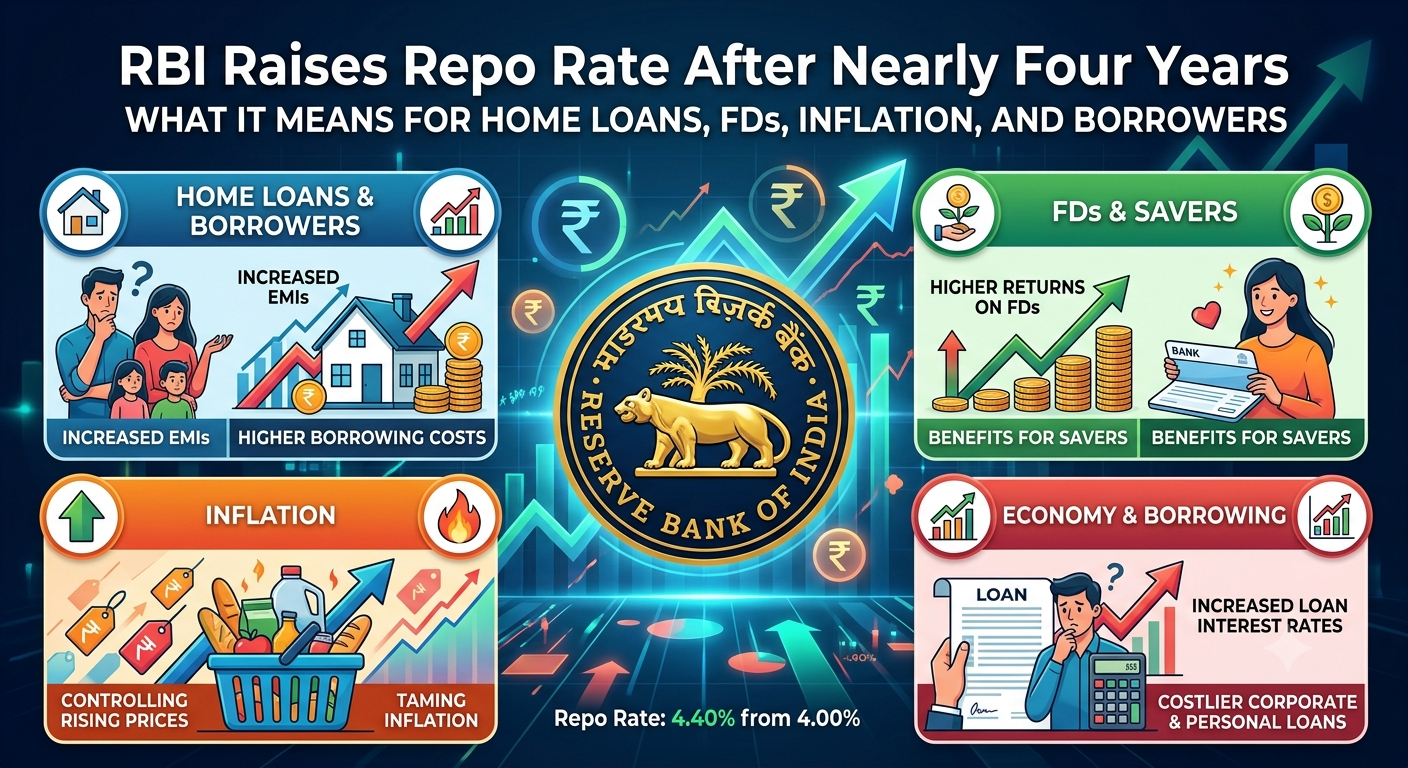
The Reserve Bank of India (RBI) has increased its benchmark interest rate for the first time in nearly four years, indicating a shift towards a tighter monetary policy as inflationary pressures rise.
At its Monetary Policy Committee (MPC) meeting held from October 5 to 7, 2026, the RBI raised the repo rate by 25 basis points (bps) to 5.50%, from 5.25%. All MPC members supported the decision. The RBI noted that the inflation outlook was less favourable compared with last year. It estimated CPI inflation at 5.2% for 2026-27 and projected real GDP growth at 7.1% for the same period.
What are the Changes in the RBI Repo rate?
| Policy Rate | Earlier | New Rate |
| Repo Rate | 5.25% | 5.50% |
| Standing Deposit Facility (SDF) | 5.00% | 5.25% |
| Marginal Standing Facility (MSF) | 5.50% | 5.75% |
| Bank Rate | 5.50% | 5.75% |
The RBI’s official data shows that the repo rate is now 5.50%, while the SDF rate stands at 5.25% and the MSF and Bank Rate at 5.75%.
The RBI also indicated that rate cuts are unlikely in the near term. Future policy action could involve another hike or a pause, depending on how inflation and economic growth evolve.
Why Did the RBI Raise Interest Rates?
The RBI raised interest rates mainly because of higher inflation risks, rising crude oil prices, and strong economic growth. The key factors behind the decision are:
1. Rising Inflation
India’s CPI inflation rose to 4.8% in August 2026 from 4.5% in July. Higher food and fuel prices contributed to the increase, while core inflation also climbed to 4.2%. The RBI expects inflation to remain under pressure in the coming quarters. It has projected CPI inflation at 5.2% for 2026-27, with inflation estimated at 4.9% in Q2, 6.0% in Q3, and 5.7% in Q4.
2. Higher Crude Oil Prices
Global crude oil prices have risen due to geopolitical tensions. The RBI said India’s average crude oil price increased to around US$116.1 per barrel in September 2026, compared with US$90.2 in August and US$82 in July.
3. Monsoon and Food Price Risks
The RBI also highlighted concerns over a weak southwest monsoon and strong El Niño conditions. These factors could affect farm output and rural demand, while also putting pressure on food prices.
4. Strong Economic Growth
India’s economy remains strong despite these inflation risks. Real GDP grew 7.8% in Q1 of FY2026-27, supported by private consumption and investment. The RBI has also increased its FY2026-27 GDP growth forecast by 40 basis points to 7.1%.
With economic growth remaining healthy, the RBI has more scope to focus on controlling inflation rather than providing additional support through lower interest rates.
Will Home Loan EMIs Increase?
A rise in interest rates can lead to a higher EMI, a longer loan tenure, or both, depending on how the lender adjusts the loan.
For instance, if you have a floating-rate home loan and your lender increases the interest rate after the RBI’s repo rate hike, your EMI may go up if the loan tenure stays the same.
However, a 25-bps increase in the RBI repo rate does not mean that every home loan EMI will automatically increase by the same amount. Banks and housing finance companies may pass on the rate hike differently based on their benchmark rates, spreads, funding costs, and individual loan terms.
Borrowers should check with their lender about the revised interest rate, EMI and loan reset terms, as the full repo rate hike may not be passed on to them directly.
What Should Existing Home Loan Borrowers Do?
Existing borrowers can take a few steps to manage the impact of higher interest rates:
- Check the new interest rate: Confirm whether your lender has revised the interest rate on your home loan.
- Understand the reset period: Check how often your floating-rate loan is reviewed and repriced.
- Compare other loan options: If your current rate is no longer competitive, consider a loan balance transfer after comparing the potential savings with processing and other charges.
- Consider part-prepayment: If you have extra funds, you may consider paying off a portion of the loan, depending on the loan terms and applicable charges.
- Review the loan tenure: If your EMI increases, check whether extending the tenure could raise the total interest you pay over the life of the loan.
What Does the RBI Rate Hike Mean for FD Interest Rates?
The RBI’s repo rate hike can also influence fixed deposit (FD) interest rates, although the impact may not be immediate or equal across banks. Banks may revise FD rates based on their funding needs, liquidity position, deposit growth, and market competition.
As of October 7, 2026, RBI data showed term deposit rates for deposits above one year in the range of 6.00% to 6.75%, although actual rates vary by bank, tenure and depositor category. FD investors should therefore make decisions based on their financial goals and liquidity needs rather than relying only on the RBI rate hike. Those expecting rates to rise further may consider shorter or staggered FD tenures, while investors seeking stable returns may choose to lock in a suitable rate for a longer period. An FD laddering strategy can also help by spreading investments across different maturity dates instead of investing the entire amount at one rate.
Impact of RBI Rate Hike on Inflation
One of the main reasons for the latest RBI rate hike is to help control inflation.
With the rise in interest rates, borrowing becomes very expensive. This can reduce demand for loans and spending, which may gradually ease inflationary pressure.
However, higher interest rates cannot address all causes of inflation. For instance, when prices rise because of food shortages, supply disruptions, or higher crude oil prices, monetary policy may take longer to have an effect.
The RBI has also pointed out that monetary policy mainly helps limit second-round effects of inflation, such as rising inflation expectations and businesses increasing prices, rather than directly solving supply-side problems.
Impact on Borrowers
The RBI rate hike may affect borrowers differently depending on their loan type, interest-rate structure, and lender.
| Borrower | Possible Impact |
| Home loan borrowers | Floating-rate loan EMIs or tenure may increase |
| Personal loan borrowers | New loans may become more expensive |
| Vehicle loan borrowers | Borrowing costs may increase depending on the lender’s interest rate. |
| Business borrowers | Higher interest costs may affect expansion and investment plans |
| New borrowers | May have to pay higher lending rates |
| Existing fixed-rate borrowers | Usually see little or no impact while the interest rate remains fixed. |
Impact on Savers and Depositors
The RBI’s rate hike could benefit savers if banks increase their deposit rates in response. Higher FD interest rates may help investors earn more predictable returns. However, before investing, depositors should compare the post-tax returns, tenure, premature withdrawal rules, and interest payout options. Senior citizens should also check whether the bank provides an additional interest rate for them.
What Does the Rate Hike Mean for the Economy?
The RBI is trying to maintain a balance between controlling inflation and supporting steady economic growth.
The central bank’s latest assessment suggests that India’s economy remains strong, although inflation risks have increased. The RBI has projected GDP growth of 7.1% for FY2026-27, while CPI inflation is expected to be 5.2%.
The shift to a calibrated tightening stance is significant as it shows that the RBI is willing to take further action if inflation remains high. However, the central bank has not indicated a fixed path of future rate hikes. Any further action will depend on how inflation and economic growth develop in the coming months.
FAQs
Q1. Why Did the RBI Raises the Repo Rate in October 2026?
Ans. The RBI increased the repo rate due to rising inflation risks, higher crude oil prices, food-price pressures, and strong economic growth. Along with the rate hike, the central bank shifted its policy stance from neutral to calibrated tightening, signalling a stronger focus on keeping inflation under control.
Q2. Will FD Interest Rates Increase After the RBI Repo Rate Hike?
Ans. FD interest rates could rise if banks increase their deposit rates in response to changing interest-rate conditions. However, an RBI repo rate hike does not necessarily lead to an immediate or equal increase in FD rates.
Sources: msn.com