



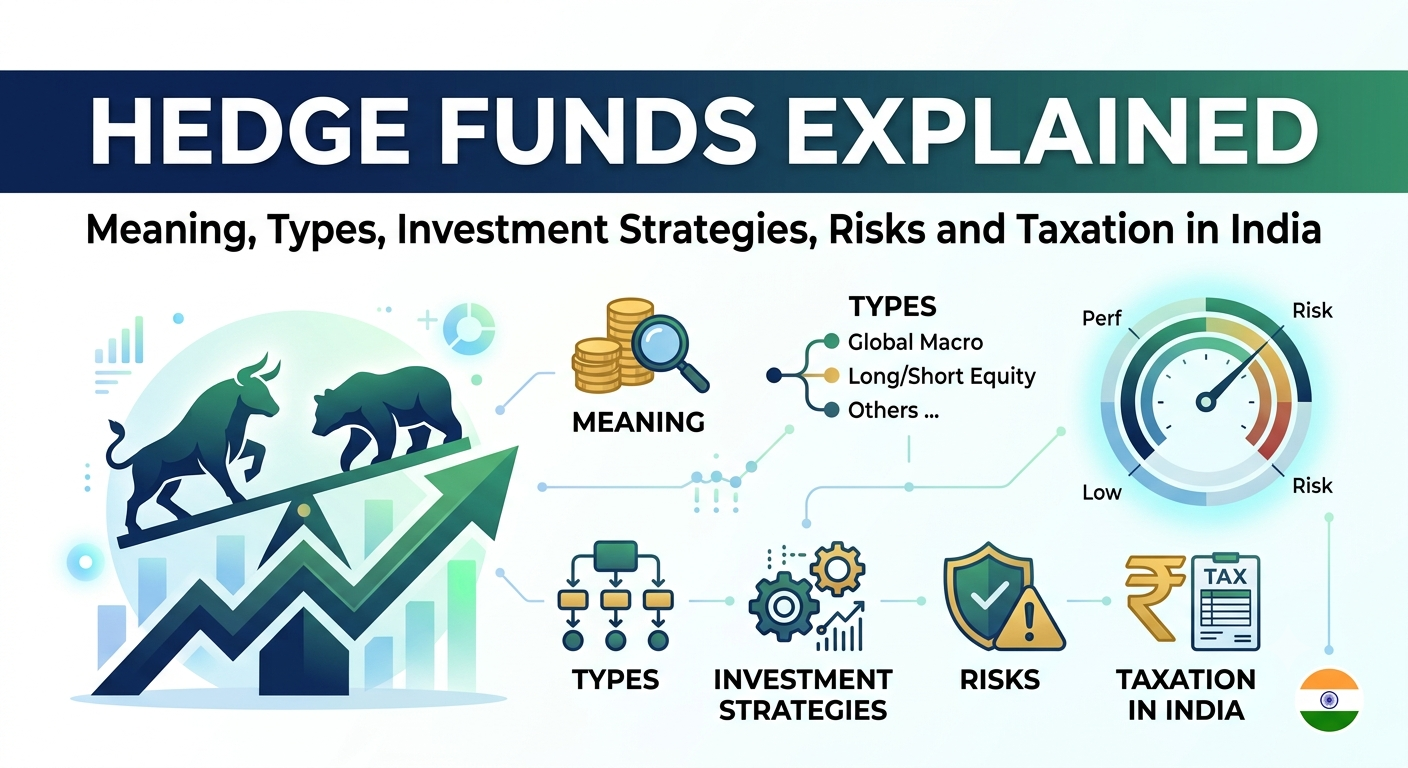
Unlike traditional mutual funds, which usually operate within specific investment rules, hedge funds have greater flexibility in their investment approach. Hedge funds use strategies such as short selling, derivatives, leverage, and arbitrage to achieve their investment objectives.
In India, hedge funds generally come under the Securities and Exchange Board of India (SEBI) regulations for Alternative Investment Funds (AIFs). Most hedge fund-like investment strategies are covered under Category III AIFs, which are allowed to use complex trading strategies and invest in both listed and unlisted securities. In this blog, we will explore the meaning of hedge funds, their types, investment strategies, benefits, risks, and taxation in India.
What Are Hedge Funds?
A hedge fund is a privately managed investment fund that collects money from multiple investors and invests it using different strategies to generate returns. Hedge fund managers select investment strategies based on their market expectations, financial goals, and risk management plans.
For example, a hedge fund manager may buy shares expected to rise in value while taking short positions in stocks that may fall. This strategy aims to earn returns from both rising and falling stock prices.
They may invest in various financial instruments, such as:
- Stocks and bonds
- Commodities
- Currencies
- Derivatives
- Futures and options
- Other financial assets
List of Top 10 Hedge Funds in India
| Name | Qualifies as a Hedge Fund | 2026 context |
| Avendus Capital | ⚠️ Needs qualification | Better described as an alternative-investment/asset-management firm rather than simply a hedge fund. |
| AlphaGrep Securities | ⚠️ Needs qualification | Known for quantitative/systematic investing, but don’t automatically label the firm itself a hedge fund. |
| Alchemy Capital | ✅ Category III AIF | Its own website confirms that it currently offers Category III AIFs and that its AIF is SEBI-registered. |
| Avenue Capital | Remove unless specifically verified | The name is too broad and should not be presented as an Indian hedge-fund example without identifying the specific Indian fund/entity. |
| True Beacon | With qualification | True Beacon confirms that its True Beacon AIF is a Category III AIF, with SEBI registration IN/AIF3/19-20/0701. |
| Unifi Capital | Needs qualification | It has investment-management/alternative investment activities, but should not automatically be called a hedge fund. |
| White Oak Capital | Needs qualification | White Oak has multiple investment vehicles. Identify its activities by the specific AIF/fund rather than calling the entire firm a hedge fund. |
| Equentis Wealth Advisory | Needs qualification | Better to verify the specific Category III AIF before including it in a hedge-fund list. |
| PGIM India | Needs qualification | It has broader asset-management activities; calling the firm a hedge fund would be too broad. |
| IIFL Asset Management | Needs qualification | The business has operated alternative investment products, but you should name the specific current fund rather than treating the entire firm as a hedge fund. |
What Are the Different Types of Hedge Funds in the Market?
Hedge funds follow different investment approaches depending on their objectives and market outlook. Some of the major types of hedge funds are explained below:
1. Global Macro Hedge Funds
These hedge funds use economic trends and global financial factors, such as inflation, interest rates, and currency movements, to identify investment opportunities and earn returns from market fluctuations.
2. Relative Value Hedge Funds
These funds aim to generate returns by identifying price differences between related financial assets and taking advantage of those differences through suitable investment strategies.
3. Activist Hedge Funds
Activist hedge funds invest in companies and seek changes in their business operations or management to improve shareholder value. These changes may include reducing costs, restructuring assets, or making other strategic decisions.
4. Equity Hedge Funds
Equity Hedge funds are likely to invest in national and international stocks and most probably use strategies like buying underpriced shares and short-selling overpriced stocks. Some also take short positions in stock indices to manage exposure to falling equity markets.
How Do Hedge Funds Work?
1. Equities
Hedge funds may invest in shares of listed companies after analysing their financial performance, industries, and market conditions. A fund may buy shares it expects to gain in value or use short-selling strategies when it expects a stock price to decline. This gives hedge funds the potential to benefit from both rising and falling stock prices, although these strategies can also lead to losses if the market moves against their positions.
2. Debt instruments
Hedge funds may invest in debt instruments such as bonds and other fixed-income securities to earn interest income or benefit from changes in bond prices and interest rates. Fund managers may adjust these investments based on interest rate and credit conditions. The risk depends on factors such as the issuer’s credit quality, interest rates, and the type of debt instrument.
3. Derivatives
Hedge funds may use derivatives such as futures and options to manage risk, gain exposure to assets, or implement specific investment strategies. They may use these instruments to hedge existing investments or take positions based on expected market movements. However, derivatives can be complex and may increase losses, particularly when used with leverage.
A Hedge fund pools money from investors and uses different investment instruments and trading strategies to generate returns while managing risk. However, returns are not guaranteed, and strategies involving leverage, short selling, and derivatives can increase potential losses.
Hedge Fund Investment Strategies
1. Long-Short Equity Strategy
Fund managers buy stocks they expect to rise and short-sell those they believe may decline, aiming to benefit from differences in their performance.
2. Short Selling
This strategy involves selling borrowed securities with the expectation of buying them back at a lower price to earn a profit.
3. Arbitrage Strategy
Fund managers identify price differences between related securities or markets and aim to earn returns when these differences narrow.
4. Leverage Strategy
Hedge funds use borrowed money or financial instruments to increase their investment exposure, which can magnify both returns and losses.
5. Derivatives-Based Strategy
Funds use derivatives such as futures, options, and swaps to manage market exposure or benefit from expected price movements.
6. Global Macro Strategy
Fund managers make investment decisions based on global economic trends, such as inflation, interest rates, and economic growth, by investing in currencies, bonds, and commodities.
Hedge Funds in India: SEBI Regulations and Category III AIFs
In India, hedge funds are generally covered under the Securities and Exchange Board of India (SEBI) framework for Alternative Investment Funds (AIFs).
As per the SEBI (Alternative Investment Funds) Regulations, 2012, AIFs are classified into three categories based on their investment objectives and strategies.
| AIF Category | Meaning | Investment Approach |
| Category I AIF | Funds that invest in sectors considered economically or socially beneficial, such as start-ups and infrastructure. | Venture capital funds, angel funds and other eligible investments. |
| Category II AIF | Funds that do not fall under Category I or III and generally do not use leverage, except for permitted operational needs. | Private equity, debt and other eligible strategies. |
| Category III AIF | Funds that use diverse or complex trading strategies and may employ leverage, including through derivatives. | Hedge fund-like, long-short and other trading strategies. |
Benefits and Risks of Hedge Funds
| Aspect | Benefits | Risks |
| Diversification | May invest across equities, debt, derivatives and other assets, helping spread investments across different opportunities. | Exposure to multiple asset classes and complex strategies can make the portfolio harder to understand and monitor. |
| Market opportunities | Can use long and short positions to potentially benefit from both rising and falling markets. | Short selling can lead to losses if prices move against the fund’s position. |
| Investment strategies | Fund managers can use different strategies based on market conditions and investment objectives. | Complex strategies may involve higher risks and may not perform as expected. |
| Derivatives | Futures and options can be used to hedge investments or gain exposure to specific assets and market movements. | Derivatives can increase losses, particularly when leverage is involved. |
| Debt investments | Bonds and other fixed-income securities may provide interest income and opportunities from changes in bond prices or interest rates. | Returns can be affected by interest-rate changes, credit quality, and the type of debt instrument. |
| Leverage | Borrowed funds can increase exposure to investment opportunities and potentially amplify returns. | Leverage can also magnify losses when investments move in the opposite direction. |
| Return potential | A combination of investment instruments and trading strategies may provide opportunities to seek returns in different market conditions. | Returns are not guaranteed, and aggressive strategies can result in significant losses. |
How Are Hedge Funds Taxed?
Hedge funds in India are generally structured as Category III AIFs and are taxed under the applicable tax rules for this category. Unlike certain other AIFs, Category III AIFs are generally not treated as pass-through vehicles, meaning the tax liability typically arises at the fund level rather than being directly passed on to individual investors.
In simple terms, the fund pays applicable taxes on its income or gains, and the remaining amount is distributed to investors. As a result, the tax paid by the fund can affect the post-tax returns received by investors.
FAQs
Q1. What is the difference between hedge funds and mutual funds?
Ans. Hedge funds can use advanced strategies such as leverage, short selling, and derivatives, while mutual funds generally invest according to their stated objectives and mandates. The two also differ in terms of investor accessibility, liquidity, fees, and regulatory requirements.
Q2. Can retail investors invest in hedge funds in India?
Ans. Retail investor access to hedge funds depends on regulatory requirements, eligibility criteria and the terms of the specific fund. Category III AIFs generally have higher minimum investment requirements than regular mutual funds, which can limit their accessibility.
Sources: investopedia