



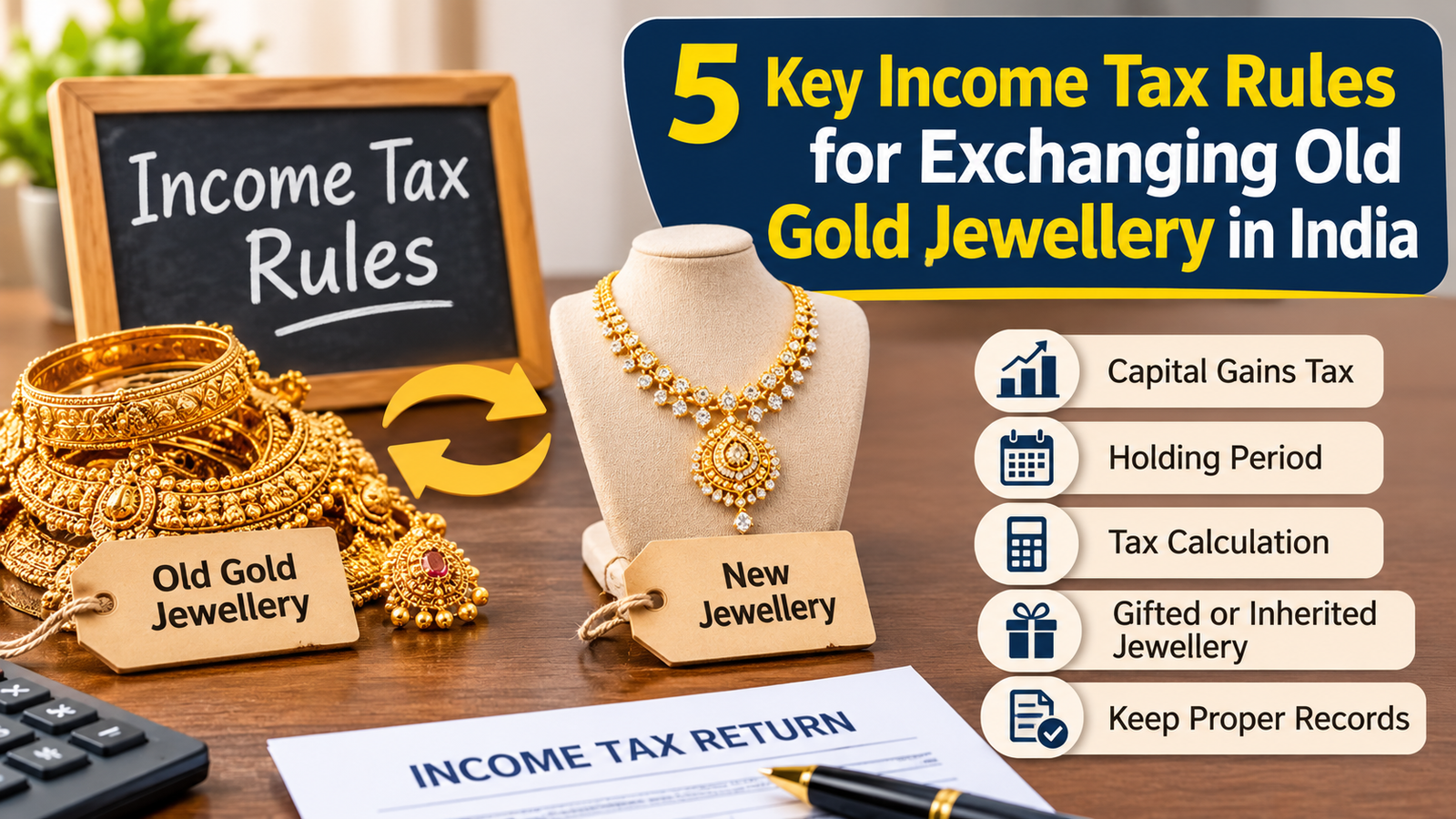
Exchanging old gold jewellery for new ornaments is a common tradition in India, particularly during weddings, festivals, and other special occasions. However, before making an exchange, it is essential to understand the income tax rules for exchanging old gold jewellery.
Many people believe that exchanging old jewellery for new ornaments does not attract income tax because no cash is received. However, under Indian income tax laws, such an exchange may be considered a transfer of a capital asset and could attract capital gains tax.
Tax liability depends on several factors, including the original purchase cost of the jewellery, its exchange value, the ownership period, and the applicable income tax provisions. In this blog, we’ll cover five key income tax rules you should know before exchanging old gold jewellery in India.
1. Old Gold jewellery exchange can imply Capital Gains Tax
- Gold jewellery is considered a capital asset: Under India’s income tax laws, gold jewellery is generally classified as a capital asset. Selling or exchanging it may result in a capital gain or loss, depending on its purchase cost and transfer value.
- Exchanging jewellery may count as a transfer: When you exchange old gold jewellery for new ornaments, the jeweller typically evaluates the old gold and adjusts its value against the price of the new jewellery.
- An exchange is not automatically tax-free: Even if you do not receive cash, exchanging old gold jewellery for new ornaments may attract capital gains tax under the applicable income tax provisions.
- Example: Suppose you purchased gold jewellery for ₹2 lakh several years ago. If a jeweller values it at ₹3.5 lakh and adjusts that amount against your new jewellery purchase, the difference may represent a capital gain before considering eligible costs and applicable tax rules.
- Capital gains calculation: The taxable gain depends on the applicable rules, including the acquisition cost, the value of the jewellery transferred, any eligible expenses, and the relevant capital gains provisions.
2. The holding period determines short-term or long-term gains
- Holding period of 24 months or less: If you exchange gold jewellery after owning it for 24 months or less, the resulting profit is generally treated as a short-term capital gain (STCG) and taxed according to your applicable income tax slab.
- Holding period of more than 24 months: If you have held the jewellery for more than 24 months before exchanging it, the profit is generally classified as a long-term capital gain (LTCG) and taxed at 12.5% without indexation, subject to the applicable tax provisions.
- Additional taxes may apply: The final tax liability may include surcharge and cess, depending on your circumstances.
| Holding Period | Type of Capital Gain | General Tax Treatment |
| 24 months or less | Short-term capital gain (STCG) | Taxed at the applicable income tax slab rates |
| More than 24 months | Long-term capital gain (LTCG) | Generally taxed at 12.5% without indexation |
Example: If you exchange gold jewellery that you have owned for more than two years, the resulting gain may qualify as a long-term capital gain. However, if you have owned it for two years or less, the gain would generally be treated as a short-term capital gain.
3. Capital Gains Are Based on the Value of Old Jewellery, Not the New Purchase Cost
Under the income tax rules for exchanging old gold jewellery, capital gains are generally calculated using the value received for the old jewellery, after deducting its eligible purchase cost and allowable expenses.
Formula:
Capital Gain = Value of Old Jewellery − Eligible Acquisition Cost − Allowable Expenses
- The value credited by the jeweller for your old jewellery is generally considered the sale consideration.
- The additional amount paid for purchasing new ornaments does not automatically reduce the capital gain.
Example:
| Particulars | Amount |
| Original purchase cost | ₹2,00,000 |
| Exchange value credited by jeweller | ₹3,50,000 |
| Illustrative capital gain | ₹1,50,000 |
In this example, the capital gain is ₹1.5 lakh before eligible adjustments. If it qualifies as a long-term capital gain taxed at 12.5%, the illustrative tax would be ₹18,750, excluding applicable surcharge and cess.
4. Gifted or Inherited Gold Jewellery Follows Special Tax Rules
Many people in India own gold jewellery received as wedding gifts, inherited from family members, or gifted by relatives. Exchanging such jewellery may involve special capital gains tax rules.
- Previous owner’s purchase cost: If you receive gold jewellery through a gift or inheritance, the original purchase cost paid by the previous owner is generally considered when calculating capital gains, subject to applicable provisions.
- Holding period: The previous owner’s holding period may also be included to determine whether the gain qualifies as short-term or long-term.
- Missing purchase invoice: Not having an original purchase bill in your name does not automatically make the entire exchange value taxable. You may need other supporting documents to establish the jewellery’s acquisition cost and ownership history.
5. Keep Exchange Bills and Report Capital Gains Correctly
Always maintain proper records when exchanging old gold jewellery and report any taxable capital gains in your income tax return.
- Get an itemised bill: Ask the jeweller for an exchange invoice that separately mentions the old jewellery exchanged and the new ornaments purchased.
- Maintain transaction details: Keep records of the following:
- Old gold jewellery weight and purity.
- Exchange value credited by the jeweller.
- Details and cost of the new jewellery.
- Additional amount paid, if any.
- Applicable charges, deductions, and adjustments.
- Date of the exchange.
Report taxable gains: Use these documents to calculate the capital gains correctly and disclose any taxable amount in your income tax return, as applicable.
Documents to Keep for Gifted or Inherited Gold Jewellery
Maintain the following documents, wherever available, to support the ownership and acquisition cost of gifted or inherited jewellery:
- Original purchase invoice of the gold jewellery.
- Gift deed or other proof of receiving the jewellery as a gift.
- Inheritance or succession-related documents.
- Jewellery valuation reports, if available.
- Exchange receipt from the jeweller mentioning the value credited for the old jewellery.
Is Exchanging Old Gold Jewellery Tax-Free?
- Understand the tax implications: Exchanging gold jewellery may result in taxable capital gains.
- Check the holding period: The duration of ownership determines whether the gain is short-term or long-term.
- Calculate capital gains accurately: Consider the exchange value, eligible acquisition cost, and allowable expenses.
- Keep supporting documents: Preserve purchase invoices, exchange bills, and gift or inheritance records.
- Report gains correctly: Disclose taxable capital gains in your income tax return, wherever applicable.
For more information, refer to the Income-tax Act, 2025, Section 2, which defines capital assets and transfers, and Section 72, which explains the computation of capital gains.
FAQs
Q1. Does exchanging gold jewellery mean you have to pay income tax immediately?
Ans. Not always. Your tax liability depends on whether the exchange generates a taxable capital gain and the applicable income tax provisions. If the transaction results in a taxable gain, you must report it under the relevant capital gains section of your income tax return and pay the applicable tax.
Q2. Does exchanging old gold jewellery for new ornaments count as a sale?
Ans. Yes. Under Indian income tax laws, exchanging old jewellery may be treated as a transfer of a capital asset. As a result, it may attract capital gains tax even if you do not receive any cash.
Q3. Does exchanging gifted or inherited gold jewellery attract capital gains tax?
Ans. Yes. Exchanging gifted or inherited gold jewellery may result in capital gains tax. However, special rules apply to the purchase cost and holding period, so the previous owner’s acquisition details matter when calculating tax liability.
Sources: msn.com