



In India, many individuals prefer keeping a certain amount of cash at home for emergencies, daily expenses, or simply for convenience. However, one common question often arises: Is there any legal limit on how much cash a person can keep at home?
This concern becomes even more relevant when news about Income Tax raids frequently makes headlines. In such cases, officials recover huge amounts of cash and valuables from homes and business premises. Such reports naturally leave people wondering whether keeping large amounts of cash at home is illegal. Furthermore, people wonder what income tax rules apply in such situations.
There are also several misconceptions surrounding this topic, with many assuming that the law sets a fixed limit on cash holdings at home. In reality, the rules are a bit more detailed. Let’s understand what Indian law actually says. Moreover, you should be aware of the important tax regulations discussed in this Blog.
Is There Any Legal Limit on Cash at Home?
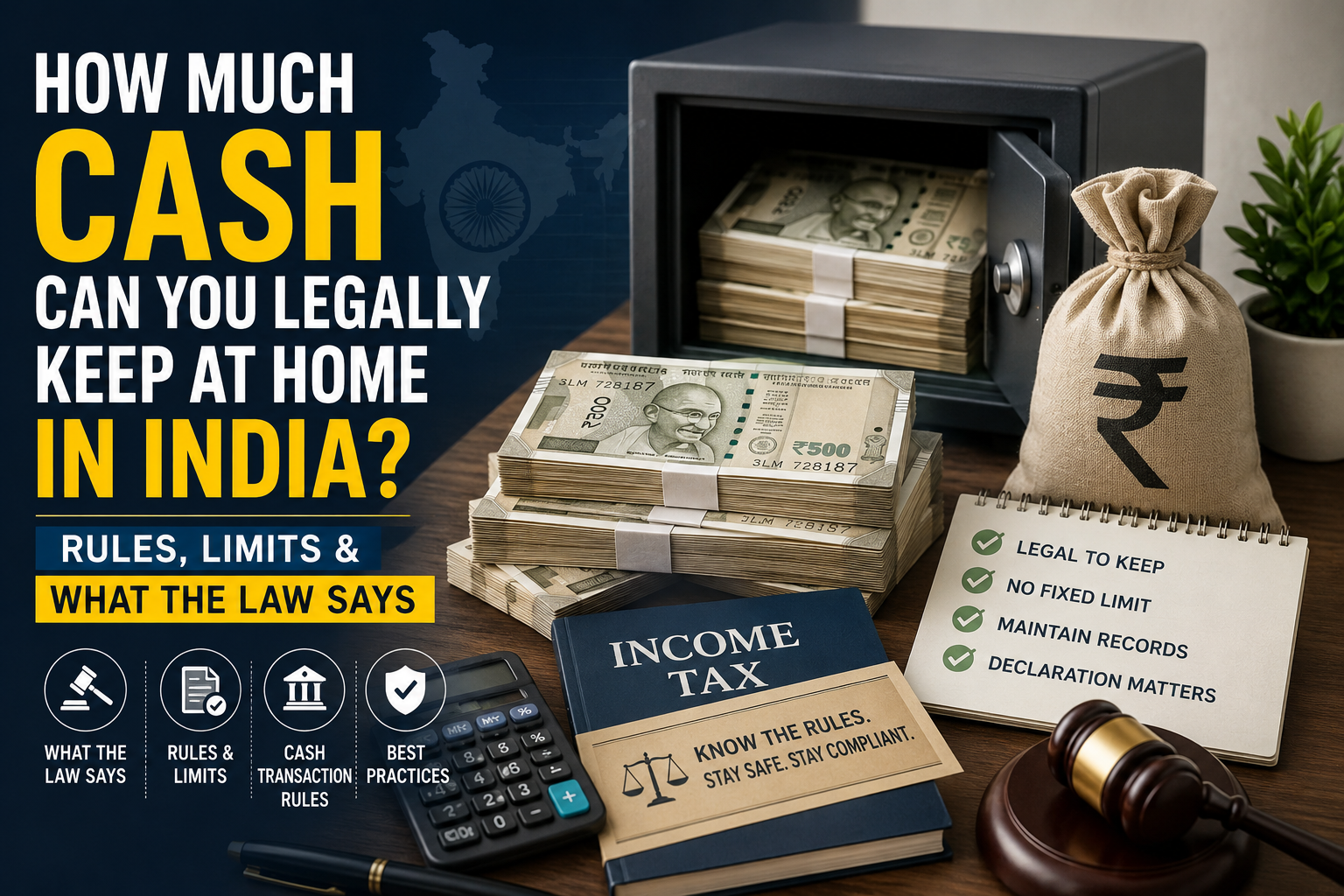
Contrary to what many people believe, Indian law does not prescribe any specific limit on the amount of cash you can keep at home. The Income Tax Department has not set a maximum cap on cash holdings. This means a person can legally store any amount of money at their residence.
The important factor, however, is the legitimacy of the source. The cash should be backed by proper records or a valid explanation. Ideally, the income should be disclosed in your Income Tax Return (ITR). If tax authorities ever question the cash holdings, you must be able to clearly explain and prove where the money came from.
Why the Source of Cash Matters?
- Indian law does not prescribe any maximum limit on the amount of cash a person can keep at home. However, the individual should be able to justify the source of the money whenever required by tax authorities.
- The Income Tax Act includes stringent rules regarding unaccounted cash and unexplained assets.
- As per Section 68, any cash amount lacking a proper and genuine source can be considered undisclosed income and may attract taxation.
- Sections 69 to 69B cover unexplained cash, investments, jewellery, and other valuables identified during income tax searches or raids.
- If adequate documents or evidence are not provided for the cash held, the Income Tax Department may levy substantial taxes and penalties.
- In some cases, the combined tax and penalty burden can rise to nearly 78% of the unexplained amount.
- Hence, keeping proper documentation such as bank records, proof of income, transaction receipts, and filed ITRs is essential. This is particularly important for individuals holding large sums of cash at home.
What are the Tax and Penalty on Unexplained Cash?
Under the provisions of the Income Tax Act, 1961, unexplained cash or income can attract heavy taxation and strict penalties. Below are the important points you should know:
- If a person is unable to explain the source of cash found during an inquiry or raid, the amount may be treated as undisclosed income by the Income Tax Department.
- Such unexplained cash can be taxed at very high rates, which may go up to around 60% or even more under applicable tax provisions.
- Apart from the basic tax, additional surcharge and penalties may also be imposed, substantially increasing the overall financial burden on the individual.
- In certain cases, the combined tax, surcharge, and penalty amount can become extremely high. This may even exceed a major portion of the cash amount discovered.
- Authorities may also conduct further scrutiny if large cash holdings are not backed by valid financial records or disclosed income sources.
Important Cash Transaction Rules You Should Know
- Even though there is no restriction on keeping cash at home in India, certain cash transactions are strictly regulated under the Income Tax Act.
- Under Section 269ST, a person cannot receive ₹2 lakh or more in cash:
- From a single person in one day
- For a single transaction
- For one event or occasion
- If this rule is violated, the penalty can be equal to 100% of the cash amount received.
- The law also restricts cash loans and deposits above ₹20,000.
- Such transactions should ideally be carried out through banking channels like bank transfers, cheques, or digital payment methods.
- These provisions were introduced to curb black money and unaccounted cash transactions in the economy.
- The rules also aim to promote digital payments and improve financial transparency across the country.
Best Practices to Avoid Legal and Tax Issues
- Maintain proper financial records and ensure that your Income Tax Returns (ITRs) are filed regularly and accurately.
- Keep supporting documents such as bank statements, cash withdrawal slips, invoices, bills, receipts, and transaction records safely stored.
- Proper documentation becomes especially important when holding or using large amounts of cash.
- Avoid high-value cash transactions whenever possible, as large cash dealings may attract the attention of tax authorities.
- Prefer using banking channels such as UPI, net banking, cheques, debit cards, or other digital payment methods for better transparency and security.
- Keeping a reasonable amount of emergency cash at home is generally acceptable, but the source of the money should always be legally justifiable.
- Ensure that large cash holdings are backed by valid income records and proper financial proof to avoid future legal or tax-related complications.
Final Thoughts
In India, keeping cash at home is not illegal. There is also no fixed legal limit on the amount you can store. The most important factor is being able to account for the money properly. To stay compliant, individuals should maintain financial transparency and proper documentation. Accurate record-keeping also helps avoid issues with the Income Tax Department. Instead of worrying about the amount of cash kept at home, focus on maintaining proper proof. Always be ready to explain and verify the source of the money when required by authorities.