




The upcoming 8th Pay Commission in India is among the most anticipated reforms for nearly 50 lakh central government employees and pensioners. It is expected to be implemented around 2026. The key question on everyone’s mind is: how much of a salary increase can one really expect?
The 8th Pay Commission is currently evaluating the extent of salary increases for government employees and pensioners. Central government staff is eagerly awaiting clarity on the expected hike. This situation makes an understanding of the fitment factor especially important in this context. The fitment factor is a multiplier used by the new Central Pay Commission (CPC) to determine the revised basic pay. Furthermore, the 8th Pay Commission will consider multiple factors—such as inflation—while deciding this fitment factor.
Understanding the 8th Pay Commission 2026
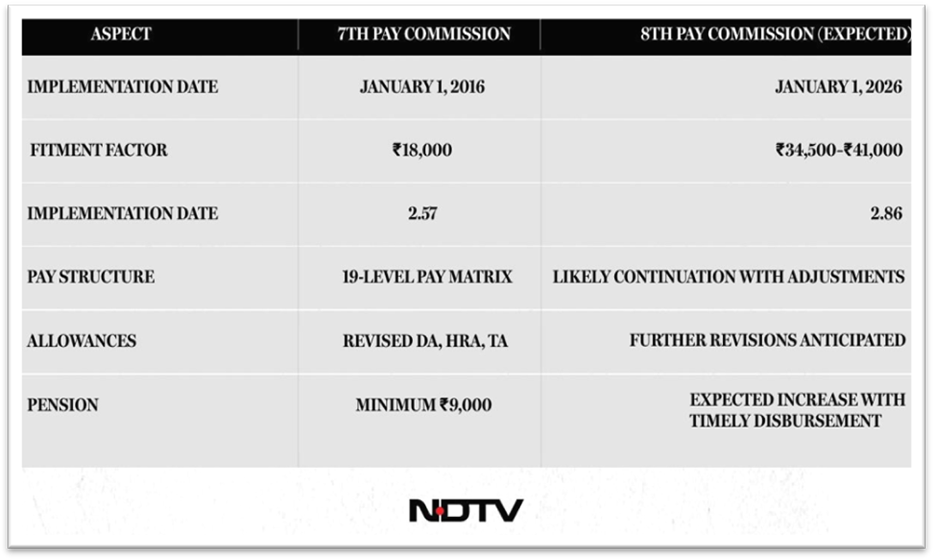
The 8th Pay Commission (2026) is a proposed panel likely to be established by the Government of India to evaluate and revise the pay structure, allowances, and pensions of central government employees and retirees. It comes after the 7th Pay Commission, implemented in 2016. This is part of the usual 10-year revision cycle.
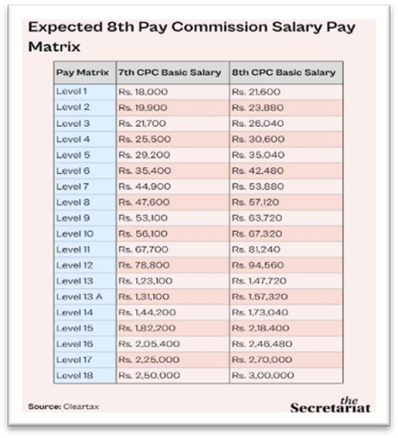
Its primary aim is to align salaries with current economic realities, including inflation, living costs, and broader financial conditions. A crucial component of this revision is the fitment factor, which helps determine the new basic pay. The 7th Pay Commission had set this factor at 2.57. Meanwhile, the 8th Pay Commission is expected to suggest a higher multiplier, although the final figure is yet to be confirmed.
The rollout is anticipated around 2026. It is likely to benefit around 50 lakh central government employees, along with more than 60 lakh pensioners. Overall, the commission holds significant importance as it affects salaries, pensions, and government spending. Additionally, it contributes to economic growth through higher disposable income.
What is Fitment Factor?
The fitment factor is a key element used by every pay commission to update the salaries of government employees. Simply put, it is a standard multiplier applied to an employee’s current basic pay to determine the revised basic salary under the new pay structure.
Rather than recalculating pay for millions of employees individually, the commission uses this uniform multiplier to maintain a consistent and transparent revision process across all levels. This approach simplifies implementation. Additionally, it promotes fairness.
The fitment factor does not just affect the basic salary—it also influences several other salary components, including:
- Dearness Allowance (DA)
- House Rent Allowance (HRA)
- Travel and other allowances
- Pension benefits for retirees
The fitment factor is a multiplier applied to your existing basic salary to calculate the revised pay under a new pay commission.
Fitment Factor Formula:
New Basic Pay = Current Basic Pay × Fitment Factor
Explanation:
- Current Basic Pay → Your present salary before any revision
- Fitment Factor → The multiplier set by the pay commission
- New Basic Pay → The updated salary after applying the multiplier
Example:
If your current basic pay is ₹20,000 and the fitment factor is 2.57, then:
New Basic Pay = 20,000 × 2.57 = ₹51,400
This formula serves as the basic method for determining salary increases under any pay commission.
What is the Expected Salary Hike in the 8th Pay Commission 2026?
According to expert estimates and various reports:
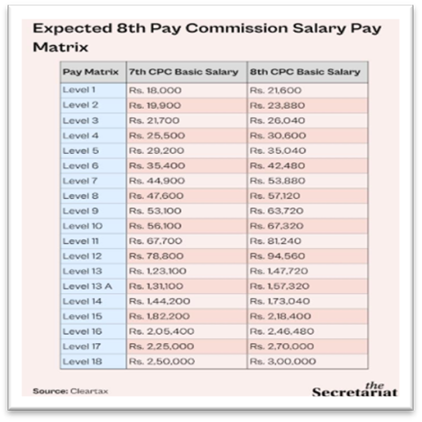
- The salary increase is likely to be in the range of 30% to 34% under a base scenario
- Some projections indicate a 34% or higher hike, assuming a fitment factor of around 2.28
- Employee unions are pushing for a higher fitment factor of 3.0 to 3.25 to secure a more substantial salary increase
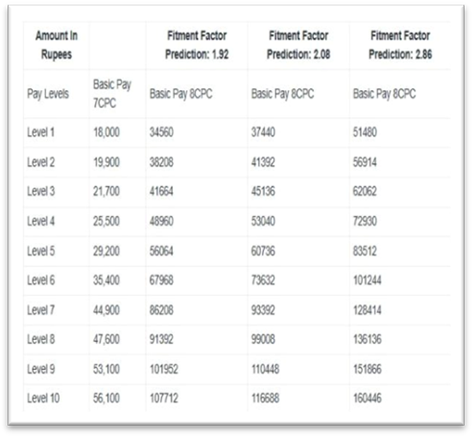
Salary Calculation Using 3 Fitment Factors
Let’s understand this with a simple example:
Example: Current Basic Pay = ₹22,400
1. Conservative Scenario (Fitment Factor: 1.92)
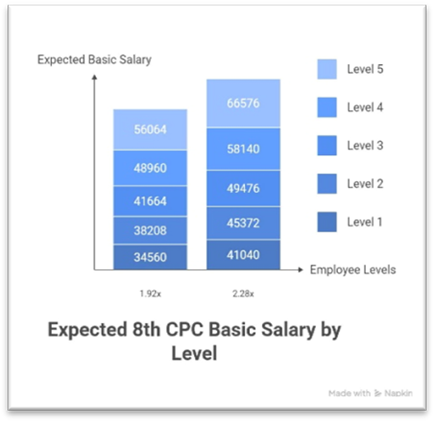
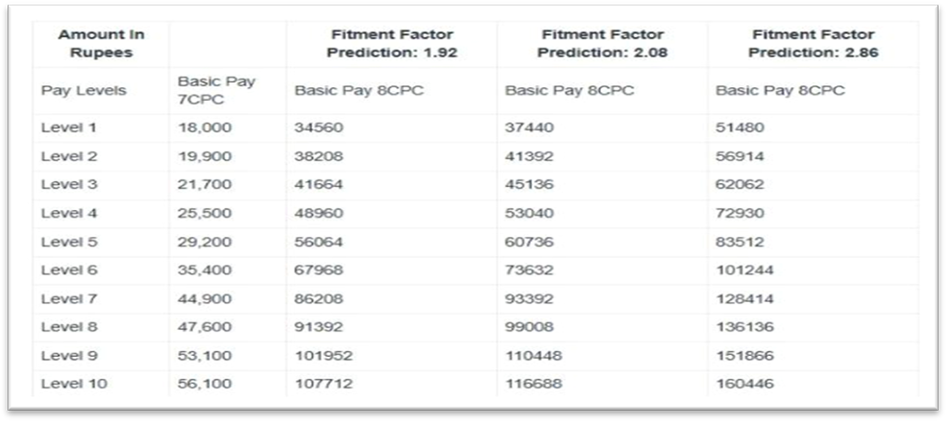
New Basic Pay = ₹22,400 × 1.92
₹43,008
<> Moderate increase
<> Considered a likely minimum benchmark
2. Realistic Scenario (Fitment Factor: 2.28)
New Basic Pay = ₹22,400 × 2.28
₹51,072
<> Most discussed estimate
<> Around 34%+ hike expected
3. Optimistic Scenario (Fitment Factor: 2.86)
New Basic Pay = ₹22,400 × 2.86
₹64,064
<> Strong salary growth
<> Aligns closely with employee union expectations
What Other Changes Can You Expect in Salary?
In addition to the increase in basic pay, several important salary components are also likely to be revised under the new pay commission:
- Dearness Allowance (DA) – It is expected to be reset to zero at the time of implementation. Then it will be increased periodically based on inflation. Since DA is directly linked to the cost of living, it will continue to rise over time after the reset.
- House Rent Allowance (HRA) – HRA will be recalculated on the updated basic pay. With a higher basic salary, the HRA amount will also increase. This will be particularly true for employees in metro cities where HRA rates are comparatively higher.
- Travel Allowance (TA) – The new pay levels may modify the travel allowance structure. This change aims to provide improved support for official travel and commuting expenses.
Overall Impact:
While basic pay gets the most attention, the real advantage comes from the combined revision of all these components. Since many allowances are linked to basic pay, the revision will likely increase the overall gross salary significantly. This change will result in a higher take-home income.
8th Pay Commission 2026 Salary Details
Several components make up a government employee’s salary, including basic pay, dearness allowance (DA), house rent allowance (HRA), and transport allowance. Typically, basic pay contributes around 51.5% of the total salary. DA follows at about 30.9%. Additionally, HRA is nearly 15.4%, and transport allowance stands at roughly 2.2%.
How Much Salary Increase Can You Expect?
<> Minimum hike: Around 30%
<> Likely increase: Between 30% and 40%
<> Best-case scenario: 50% or more (if a higher fitment factor is approved)
Final Thoughts
Experts expect the 8th Pay Commission to deliver a notable salary increase for government employees in 2026, although authorities are still finalizing the exact figures. Current estimates suggest a clear upward revision in pay levels, with a moderate fitment factor leading to steady growth. On the other hand, a higher factor could result in a substantial jump in salaries. Until authorities announce the official recommendations, employees should keep track of updates. Accordingly, they can use these projections to gauge their expected future pay.