



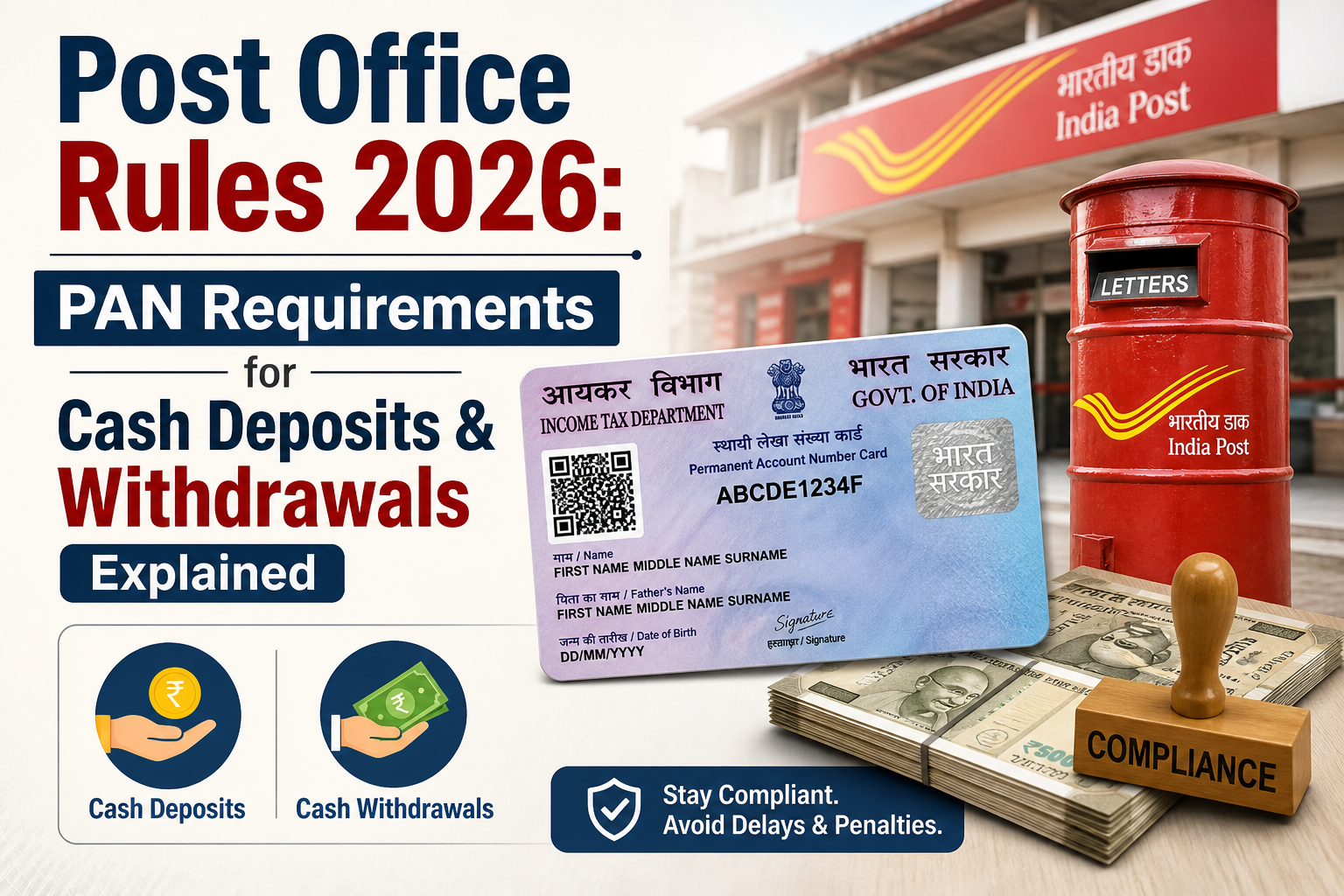
India’s postal banking network, managed by India Post, remains a vital channel for delivering financial services to millions, especially in semi-urban and rural areas. With increasing focus on transparency and digital tracking of financial transactions, the rules introduced in 2026 have become stricter. In particular, they are stricter for cash deposits and withdrawals. Moreover, they place greater emphasis on PAN compliance.
Under the revised Income-tax Rules, 2026, the government has made it mandatory to link high-value financial transactions at post offices with PAN (Permanent Account Number). This move aims to align post office operations with standard banking practices. Furthermore, it strengthens tax reporting.
Overall, these changes are part of a broader effort to integrate small savings instruments into the formal financial system. Additionally, they improve accountability and ensure better tracking of high-value transactions.
Why PAN is Important in Post Office Transactions?
Under the revised Income-tax Rules, 2026, the Income Tax Department has made it mandatory to quote PAN (Permanent Account Number) for specified high-value transactions at post offices. This requirement—linked to provisions such as Rules 159, 160, 161, 211, and 237—covers activities like opening accounts, making deposits, withdrawals, and investing in time deposit schemes. In addition, it is part of a broader compliance framework aimed at integrating post office transactions into the formal tax system.
Important reasons behind this move include:
- Tracking large cash movements to ensure better monitoring of financial flows
- Preventing tax evasion by linking transactions with verified identities
- Improving financial transparency across small savings and postal banking operations
For millions of small savers who depend on post office schemes, this effectively means that quoting PAN is no longer optional. This applies even for routine financial transactions.
PAN Requirement for Cash Deposits & Withdrawals under Post Office Rules 2026
| Category | Condition for PAN Requirement | Applicable To | Important Notes |
| Cash Deposits | PAN is mandatory if cash deposits exceed ₹50,000 in a single day | Savings Accounts, Recurring Deposits, Time Deposits | Limits are monitored cumulatively across accounts |
| PAN is required if total deposits exceed ₹10 lakh in a financial year | Savings instruments at post offices | Splitting transactions does not avoid reporting rules | |
| Cash Withdrawals | PAN must be quoted if total cash withdrawals exceed ₹10 lakh in a financial year | Post Offices, Banks, Cooperative Institutions | Institutions are responsible for PAN verification |
| Higher thresholds (e.g., ₹20 lakh) may apply under stricter monitoring provisions | Financial institutions (as per draft norms) | Rules may vary based on final regulatory updates |
What Happens If you don’t have a PAN Card?
• Submission of Form 97 as a mandatory declaration in the absence of PAN
If an individual does not have a PAN, submitting Form 97 becomes compulsory to carry out specified financial transactions at post offices. This form acts as a formal declaration to the authorities, ensuring that the transaction is recorded even without PAN linkage. As a result, it helps bring such transactions under the regulatory framework and prevents them from going unreported.
• Providing personal details such as full name and residential address
The form requires accurate personal information, including your full name and current residential address. These details are essential for identity tracking and help authorities establish a clear record of who is conducting the transaction. In some cases, any mismatch or incomplete information may lead to delays or rejection of the transaction.
• Disclosing transaction information, including the nature and amount of the transaction
You must clearly mention the type of transaction—whether it is a cash deposit, withdrawal, or investment—along with the exact amount involved. This ensures transparency and allows authorities to monitor high-value or suspicious transactions more effectively under the tax compliance system.
• Attaching supporting documents to verify identity and validate the transaction
To support the declaration, valid documents such as an Aadhaar card, voter ID, passport, or other officially accepted ID proofs must be submitted. These documents help verify the identity of the individual and confirm the authenticity of the transaction. Therefore, this reduces the chances of misuse or fraudulent activities.
New Forms and Compliance Updates after the new Post Office Rules 2026
The Income-tax Rules, 2026, introduce a redesigned documentation and reporting system aimed at improving transparency, standardisation, and traceability of financial transactions. While the updated framework simplifies procedures by replacing multiple legacy forms, it also imposes stricter compliance obligations on both individuals and financial institutions.
Here’s an overview of the key forms under the new system:
1. Form 97 – For individuals without PAN
This form is compulsory for individuals who do not have a PAN but wish to carry out specified financial transactions. It replaces earlier self-declaration formats and ensures that transactions without PAN are still properly recorded, verified, and brought under the tax monitoring framework.
2. Form 98 – Reporting to tax authorities
Form 98 is meant for institutions such as post offices, banks, and cooperative entities to report high-value or specified transactions to tax authorities within defined timelines. As a result, this strengthens oversight and helps in tracking large or potentially suspicious financial activities more effectively.
3. Form 121 → Replaces Forms 15G & 15H for TDS exemption
Form 121 substitutes the earlier Forms 15G and 15H, which were used to claim exemption from TDS (Tax Deducted at Source). The new form aims to standardise declarations, minimise misuse, and improve the verification process. Therefore, only eligible individuals can avail of TDS benefits.
Consequences of Non-Compliance
Under the updated rules, providing PAN (Permanent Account Number) or the required declaration forms is no longer optional for specified transactions. Failing to comply can lead to several practical and legal issues.
What can happen if you don’t provide PAN or the required documents:
- Transaction may be rejected or delayed
If you do not submit PAN or the necessary forms (like Form 97), the post office may refuse to process your transaction. In some cases, the transaction could be kept on hold until proper documents are provided, causing inconvenience and delays. - Accounts may come under closer scrutiny
Transactions without proper documentation may raise red flags in the system. This can lead to increased monitoring of your account activity by authorities, especially if the transactions involve large amounts. - Risk of penalties under income tax laws
Non-compliance with PAN requirements or incorrect declarations can attract penalties as per income tax regulations. This may include fines or further action if the transactions are found to violate reporting rules.
Why did the Government introduce these rules?
The new rules have been introduced by the Income Tax Department as part of a broader effort to strengthen financial discipline and improve transparency across the system. With increasing use of digital tools and data tracking, the government aims to ensure that all significant financial activities are properly recorded and monitored.
Key objectives behind these reforms include:
- Tracking high-value cash transactions
The rules help authorities monitor large cash deposits and withdrawals more effectively. By linking such transactions with PAN and proper documentation, it becomes easier to identify unusual or suspicious financial activity. - Preventing tax evasion and black money
One of the main goals is to curb tax evasion and reduce the circulation of unaccounted money. When transactions are properly recorded and linked to individuals, it becomes difficult to hide income or avoid taxes. - Standardizing reporting across banks and post offices
Earlier, post offices and banks followed slightly different documentation and reporting practices. These reforms bring uniformity, ensuring that both systems follow similar compliance standards and reporting formats. - Promoting a transparent and digital financial ecosystem
The government is pushing towards a more transparent and digitally tracked financial system. These rules encourage proper record-keeping, reduce cash-based opacity, and support the shift towards a more accountable financial environment.
Final Thoughts
The Post Office Rules 2026 signal a significant move toward tighter financial compliance. By making PAN mandatory for deposits and withdrawals, the government aims to bring even small savings channels under a more structured tax monitoring system. As a result, this ensures better transparency and accountability across all financial transactions.