



Estimated reading time: 7 minutes
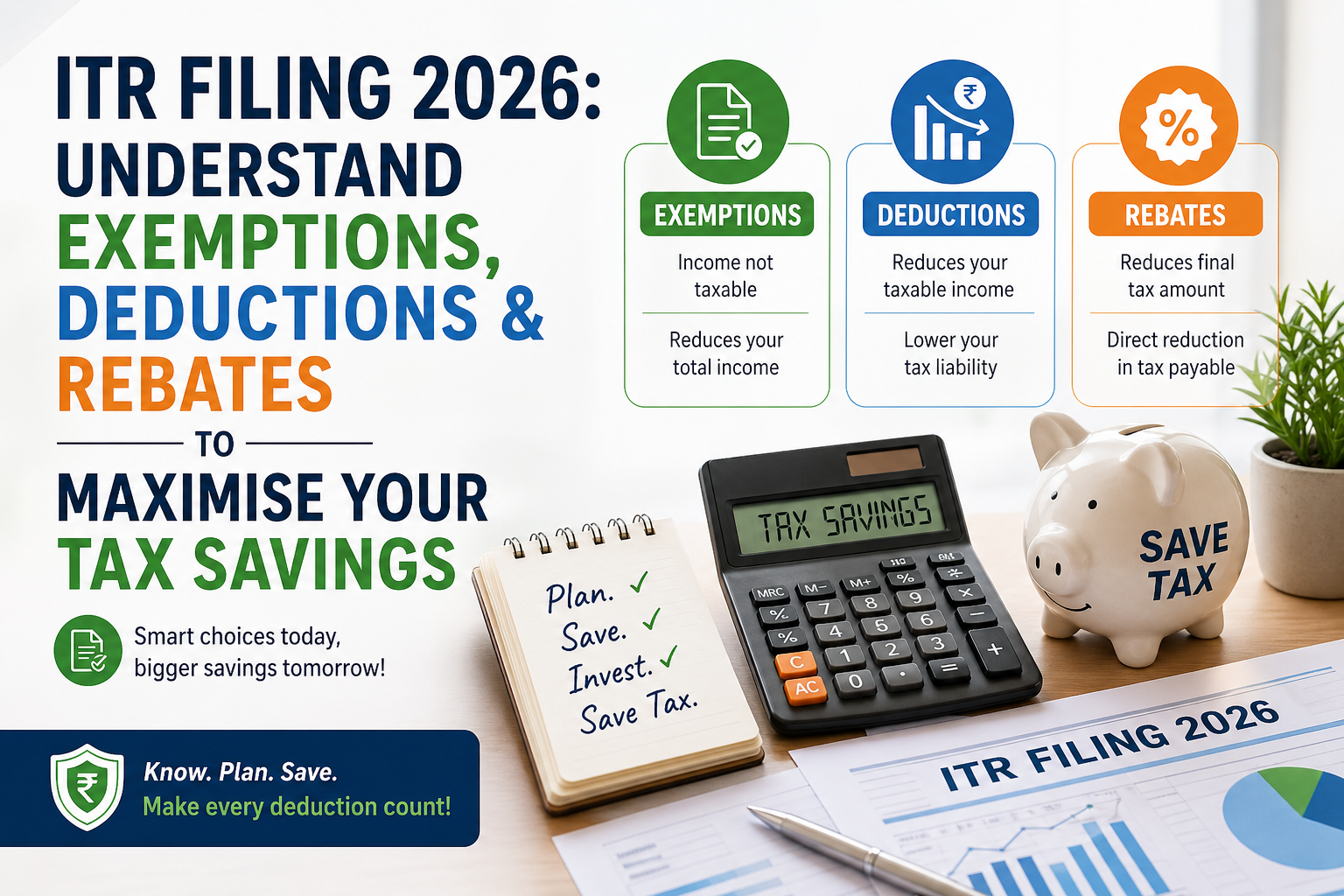
Filing your Income Tax Return (ITR) in 2026 is not just about meeting a legal requirement—it’s a smart way to reduce your tax burden within the law. With updated tax rules and evolving provisions, it is important to understand key concepts like exemptions, deductions, and rebates. This is essential to maximise your savings.
However, for first-time taxpayers, the process can feel overwhelming—especially when these terms come into play. Many individuals miss out on legitimate tax-saving opportunities simply because they don’t fully understand how these concepts work.
If you want to reduce your tax liability legally and file your ITR with confidence, it’s important to clearly understand these three terms. Here’s a simple breakdown. This will help you avoid confusion and make the most of your tax savings.
What’s New in ITR Filing 2026?
- The ITR filing process for 2026 has been updated to make it simpler. However, it now requires more detailed reporting from taxpayers.
- A major change is the implementation of the new tax system under the Income Tax Act 2025, effective from April 2026. This aims to modernise tax rules and improve clarity.
- The updated Income Tax Rules 2026 have introduced revised limits for exemptions and allowances. This may affect your overall tax savings.
- ITR forms now require more detailed disclosures, including additional information about income sources, investments, and financial transactions to enhance transparency.
- Taxpayers still have the option to choose between the old and new tax regimes. This depends on which one offers better tax benefits for their situation.
It is important to select the correct ITR form (ITR-1 to ITR-7) based on your income type and eligibility. This ensures accurate filing and helps you avoid delays or notices.
Understanding Tax Exemptions
Tax exemptions play a key role in reducing your overall tax liability by directly lowering your taxable income. These benefits are typically linked to specific components of your salary or certain types of income that are either fully or partially excluded from taxation. With the latest updates, several exemption rules have been refined. Therefore, it is important to understand what qualifies and how to claim them effectively.
Common Tax Exemptions
- House Rent Allowance (HRA):
HRA is one of the most widely used exemptions for salaried individuals living in rented accommodation. Under the revised rules, its applicability has been extended to cover more cities. This allows a larger group of taxpayers to benefit depending on rent paid, salary structure, and location. - Leave Travel Allowance (LTA):
LTA provides tax relief on travel expenses incurred during domestic trips. It can be claimed for travel costs (not accommodation or food) within India, subject to specific conditions such as frequency and employer policies. - Standard Deduction:
This is a fixed deduction available to salaried individuals and pensioners, which reduces taxable income without requiring any bills or proofs. It continues to be a simple and widely applicable benefit under the current tax rules. - Allowances (Meal, Education, Gifts):
Various allowances provided by employers—such as meal coupons, children’s education allowance, and gifts—offer partial tax exemptions. Under the updated rules, the exemption limits for these allowances have been revised. Therefore, it’s important to check the latest thresholds to maximise benefits.
Key Deductions to Save Tax in ITR Filing 2026
Tax deductions are one of the most effective ways to lower your taxable income. Unlike exemptions, which are linked to specific income components, deductions arise from eligible investments and expenses that you can claim under different provisions of the Income Tax Act 1961. By planning these wisely, you can significantly reduce your tax outgo. You will also build long-term financial security.
Popular Deduction Sections
- Section 80C – Investment-Based Deductions:
This is the most commonly used section for tax savings. It allows deductions of up to ₹1.5 lakh in a financial year for investments in instruments such as Public Provident Fund (PPF), Equity Linked Savings Scheme (ELSS), and Life Insurance premiums. These options help in saving tax. In addition, they encourage disciplined savings and wealth creation. - Section 80D – Health Insurance Premium:
Premiums paid towards health insurance policies for yourself, your family, and your parents are eligible for deduction under this section. The limit varies based on age and coverage. This makes it an important provision for both tax planning and financial protection against medical emergencies. - Section 80E – Education Loan Interest:
Interest paid on education loans taken for higher studies can be claimed as a deduction under Section 80E. There is no upper limit on the amount that can be claimed. However, the benefit is available for a specified number of years. Therefore, it is especially useful for students and young professionals. - Section 80DDB – Treatment of Specified Diseases:
Expenses incurred for the treatment of certain specified illnesses, such as critical or chronic diseases, qualify for deductions under this section. The deduction amount depends on the patient’s age and the type of illness. It offers relief during financially demanding medical situations.
Can You Pay Zero Tax up to ₹12 Lakh in ITR Filing 2026?
One of the most attractive relief measures for individual taxpayers in recent years is the rebate available under Section 87A of the Income Tax Act. This provision is designed to reduce the tax burden for individuals in the lower and middle-income brackets. In some cases, it can even bring the total tax liability down to zero.
Key Highlights of the Rebate
- Eligibility:
The rebate is available only to resident individual taxpayers. Non-residents and other entities are not eligible to claim this benefit. - Applicable Under the New Tax Regime:
Under the revised tax structure, the rebate has been made more beneficial, especially for those opting for the new tax regime with lower tax rates and fewer deductions. - Rebate Amount:
Eligible taxpayers can claim a rebate of up to ₹60,000, which directly reduces the tax payable (not just taxable income). - Income Threshold:
This benefit applies if your total taxable income does not exceed ₹12 lakh. If your income stays within this limit, the rebate can effectively eliminate your entire tax liability.
Key Difference Between Exemption, Deduction, and Rebate
| Term | When It Is Applied | Effect on Tax Calculation |
| Exemption | Before calculating the total tax | Eliminates a part of income from tax |
| Deduction | Before calculating the total tax | Reduces the overall taxable income |
| Rebate | After calculating the total tax | Decreases the final tax payable amount |
When used strategically, all three can help reduce your overall tax burden:
- Use exemptions to keep eligible portions of your income tax-free
- Claim deductions by reporting qualifying investments and expenses
- Take advantage of rebates to lower your final tax payable amount
Essential Documents for ITR Filing
Make sure you have the following documents in place before you begin filing your return:
- Form 16 – Provides details of your salary and TDS deducted by your employer
- Form 26AS / AIS – Contains a consolidated record of your tax credits and financial transactions
- Investment proofs – Required to claim eligible deductions under various sections
- Bank statements – Help verify income, interest earned, and transactions
- Capital gains statements (if applicable) – Needed if you’ve earned profits from investments like stocks, mutual funds, or property
FAQs
Q1. What is a tax exemption?
A tax exemption refers to a portion of income that is completely tax-free and not included in your taxable income. Examples include agricultural income, House Rent Allowance (HRA) under specific conditions, and certain allowances or benefits provided by employers.
Q2. What is a tax deduction?
A tax deduction lets you reduce your taxable income by claiming eligible investments or expenses. Popular deductions include Section 80C (LIC, PPF, ELSS up to ₹1.5 lakh), Section 80D (health insurance premium), and Section 24 (home loan interest).
Q3. What is a tax rebate?
A tax rebate is a benefit that directly reduces the amount of tax you need to pay after it has been calculated. Under Section 87A of the Income Tax Act, the new tax regime offers a rebate of up to ₹60,000 for income up to ₹12 lakh. Meanwhile, the old regime provides up to ₹12,500 for income up to ₹5 lakh.