




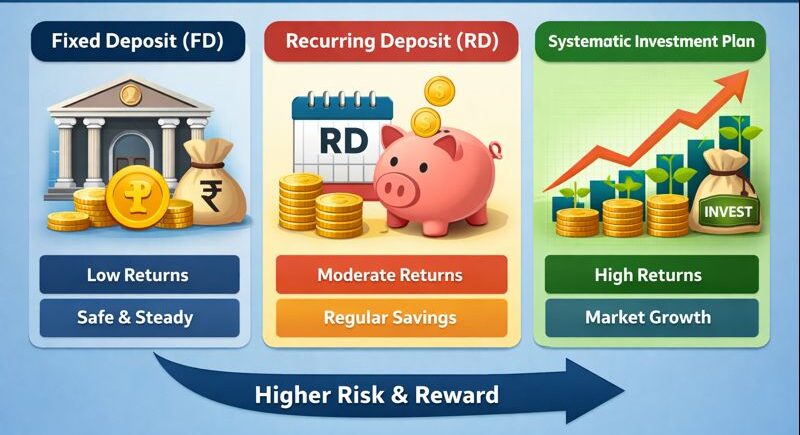
In today’s evolving financial landscape, setting money aside is no longer enough to secure long-term wealth. Investors are increasingly faced with an important choice: continue parking money in traditional monthly savings options such as savings accounts, fixed deposits, or recurring deposits, or take a disciplined investment route through Systematic Investment Plans (SIPs) in mutual funds.
In this Blog, we will understand that the difference between saving and investing is crucial, and exploring both approaches can help you decide which strategy aligns best with your financial goals.
Understanding Monthly Savings
Monthly savings means regularly setting aside a specific amount of money—typically every month—through traditional, low-risk financial products. This method is commonly chosen by conservative investors and individuals who are new to managing their finances, as it prioritises safety and predictability.
Popular monthly savings options include:
- Savings accounts: These allow consistent deposits while keeping funds readily available. Money can be withdrawn whenever needed, making savings accounts suitable for emergencies and short-term goals. However, the returns are relatively low and often fail to keep pace with inflation.
- Recurring deposits (RDs): RDs require investing a fixed amount each month for a defined period. The interest rate is locked in at the time of opening, ensuring stable and guaranteed returns. They work well for planned savings goals but offer limited flexibility.
- Fixed deposits (FDs): FDs involve parking a lump sum for a specified tenure at a predetermined interest rate. While they provide security and assured returns, the funds remain locked until maturity, and early withdrawals may lead to penalties.
Understanding Systematic Investment Plan (SIP)
A Systematic Investment Plan (SIP) enables you to invest a set amount at regular intervals—most often monthly—into mutual funds. Unlike traditional savings products that offer fixed returns, SIPs channel your money into market-linked assets like equity or debt, offering greater growth potential over the long run.
Through rupee cost averaging and the power of compounding, SIPs help smooth out market volatility while gradually growing your investment. Maintaining consistency and a long-term approach makes SIPs a practical tool for meeting goals such as retirement planning, funding education, or building lasting wealth.
How SIP Works?
1. Consistent monthly investing: A SIP involves investing a fixed sum in a selected mutual fund at regular intervals, typically every month. This encourages disciplined investing and eliminates the pressure of trying to predict market movements.
2. Units allotted at current NAV: Each instalment is used to purchase mutual fund units at the prevailing Net Asset Value (NAV), which fluctuates with market conditions.
3. Advantage in falling markets: When market prices drop, and NAVs are lower, the same investment amount buys more units, helping you accumulate a higher quantity at reduced prices.
4. Limited exposure at market highs: During rising markets, higher NAVs result in fewer units being purchased, reducing the risk of investing heavily at peak levels.
5. Cost averaging over time: Investing across different market cycles helps balance the average purchase cost, thereby softening the impact of short-term market volatility.
6. Compounding at work: Returns generated by the investment are reinvested, allowing earnings to generate further earnings over time.
7. Accelerated long-term growth: This compounding effect gains momentum over longer periods, making SIPs an effective strategy for achieving long-term financial objectives.
Key Differences Monthly Savings & SIP
| Aspect | Monthly Savings (Savings Account, RD, FD) | SIP (Mutual Funds) |
| Return Potential | Generally low to moderate (savings ~3–6%, RD/FD ~6–8%) | Historically higher over the long term (equity SIPs ~10–15% or more) |
| Risk Profile | Low risk with capital protection | Market-linked; investment value fluctuates |
| Liquidity | High for savings accounts; moderate for RD and FD | Relatively high; units can be redeemed anytime (some tax-saving funds have lock-in periods) |
| Inflation Protection | Often insufficient to beat inflation | Structured to outperform inflation over the long term |
| Investment Discipline | Depends on individual saving habits | Built-in discipline through automated periodic investments |
| Tax Treatment | Interest income is taxed every year | Tax applied at redemption; long-term gains are often taxed at lower rates |
When Savings Might Be the Right Choice?
Traditional monthly savings options, such as savings accounts or recurring deposits, may be more suitable if:
- Preserving your capital is a priority
- You are saving for short-term goals (for example, a holiday planned in the near future)
- Easy and immediate access to funds is essential, such as for emergency needs
- You are uncomfortable with market volatility and prefer stable returns
Banks and financial institutions also point out that while RDs encourage regular saving and financial discipline, their returns often struggle to keep up with inflation. As a result, the real value or purchasing power of your money may gradually decline over time.
Why SIPs Tend to Be More Effective for Long-Term Wealth Building?
SIPs are widely regarded as a powerful long-term investment approach due to the following benefits:
1. Stronger Return Potential
Equity-based mutual fund SIPs have, over time, delivered returns that are notably higher than traditional savings options like FDs and RDs. When investments are held for longer periods—often 7 to 15 years—the effect of compounding significantly widens this return gap, leading to a larger accumulated corpus.
2. Rupee Cost Averaging Advantage
By investing a fixed amount at regular intervals, SIPs naturally spread investments across different market phases. This results in purchasing more units when markets are down and fewer when they are high, helping investors manage volatility and avoid poor market-timing decisions.
3. Compounding at Work
SIP investments reinvest earnings back into the fund, allowing returns to generate further returns. Over time, this creates exponential growth, unlike savings accounts or RDs, where interest accumulation is largely linear.
4. Better Inflation Hedge
Because SIPs invest in market-linked assets—particularly equities—they are better equipped to outperform inflation over the long term. This helps safeguard and enhance your purchasing power, something fixed-return instruments often struggle to achieve.
5. Greater Flexibility
SIPs provide considerable flexibility, allowing investors to modify, pause, or stop contributions whenever needed, usually without penalties. Most mutual fund SIPs also do not impose strict lock-in periods, unlike many traditional savings products.
6. Easy to Start
SIPs can be started with a small monthly amount, making them accessible to beginners and salaried investors while still offering exposure to long-term market growth.
7. Aligned with Financial Goals
SIPs work well for long-term objectives such as retirement, funding education, or buying a home, as they combine consistent investing, growth potential, and adaptability.
Final Thoughts
If your primary objective is long-term wealth growth, SIPs typically deliver better results than basic monthly savings, thanks to the combined impact of compounding, rupee cost averaging, and exposure to market growth. That said, traditional savings options continue to be useful when capital safety and short-term needs take priority. Ultimately, the best approach is one that matches your financial goals, risk appetite, and investment timeframe.