



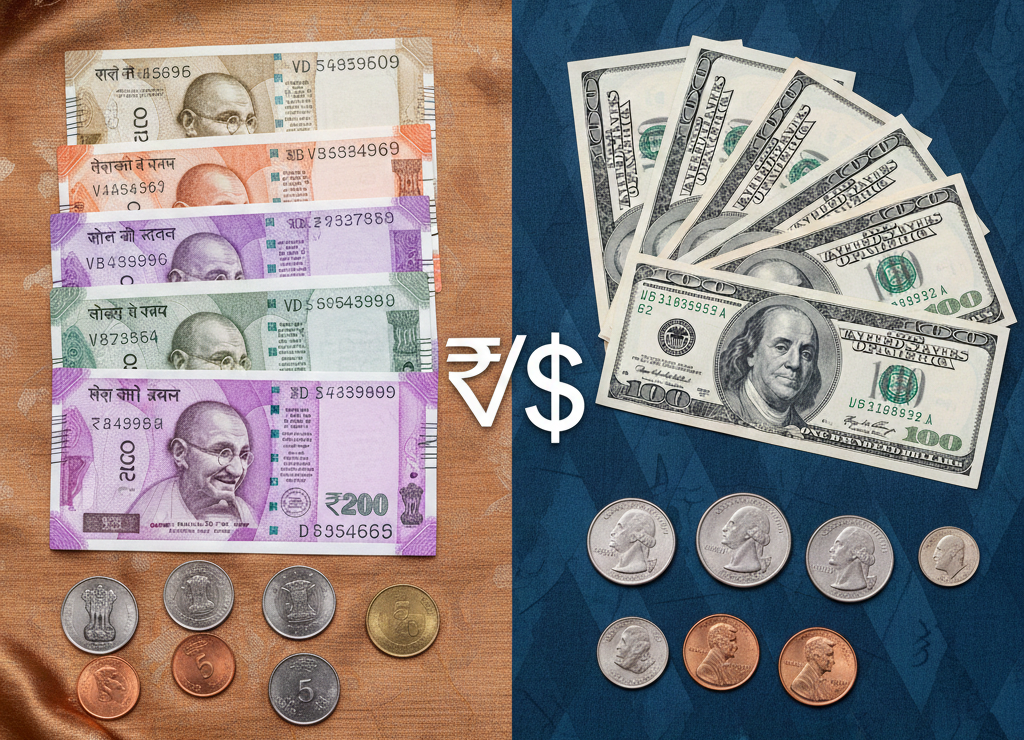
On December 17, 2025, the Indian rupee made a strong comeback in the foreign exchange market, gaining more than 1% against the US dollar. This marked a clear turnaround after several days of weakness, during which the rupee had steadily lost ground.
The sharp recovery was largely driven by the Reserve Bank of India’s intervention in the currency market. By stepping in to support the rupee, the central bank helped curb excessive volatility and restore confidence among market participants. At the same time, traders who had earlier been betting on a stronger US dollar began cutting back those positions. As dollar buying eased, demand for the rupee improved, adding to the upward momentum.
Together, RBI’s action and the shift in trading sentiment helped the rupee reverse its recent decline and register one of its strongest single-day gains in recent months, signalling temporary relief for the currency after a challenging period.
Current Scenario of the Indian Rupee against the U.S Dollar
The Indian rupee has been under sustained pressure against the US dollar, recently touching record lows close to ₹91 per dollar before recovering slightly. Market reports attribute this weakness to ongoing foreign investment outflows, a stronger global dollar, and uncertainty surrounding the India–US trade agreement. The sharp rebound on December 17, 2025, was largely seen as the result of RBI intervention, which helped check speculative selling and bring some stability to the currency. Even so, analysts note that the rupee remains volatile within the ₹90–₹91 band, with its near-term movement hinging on global market sentiment, capital flows, and central bank actions.
What Experts Have to Say About the Recent Jump in the Indian Rupee?
Jateen Trivedi, Vice President and Research Analyst for Commodities and Currency at LKP Securities, noted that the rupee is expected to trade in the 90.50–91.25 range in the near term. He pointed out that the currency has been under pressure due to delays in the India–US trade deal, continued foreign portfolio outflows, and limited RBI intervention. Additionally, higher gold and silver prices have increased India’s import costs, further straining the rupee.
Market observers highlighted that the recent sharp depreciation of the rupee was largely driven by these persistent capital outflows and unresolved trade negotiations with the US. As the rupee approached resistance near ₹91 per dollar and dollar demand eased, the currency stabilised.
Ponmudi R, CEO of Enrich Money, a SEBI-registered online trading and wealth-tech firm, explained that the recent movement toward the 90–91 range aligns with historical trends and does not indicate any structural shift. He said that USD/INR has historically respected its upper and lower boundaries within this range across market cycles. Each significant correction has found support near the lower band, after which the broader uptrend resumed. According to him, the long-term structure remains intact as long as the currency stays above the lower boundary of the ascending channel, and pullbacks should be viewed as temporary corrections rather than trend reversals. Overall, the prevailing chart patterns suggest a gradual and sustained upward trajectory for the rupee over time.
Why Did the Indian Rupee Fall Against the Dollar Recently?
1. Ongoing Foreign Capital Outflows
Foreign investors were selling Indian shares and bonds, moving their money out of the country.
This created a need to convert rupees into US dollars, increasing demand for the dollar and putting pressure on the rupee.
2. Uncertainty Over Trade Deals and External Pressures
Questions around a trade agreement between India and the US, along with high US tariffs on Indian goods, weakened investor confidence and made foreign funds cautious about investing in India.
3. Importers’ Dollar Demand and Hedging
Businesses and importers were buying dollars aggressively to protect themselves against further rupee depreciation, which added more pressure on the rupee.
4. Historic Lows and Market Momentum
The rupee fell to record lows, trading below ₹90 per US dollar in recent sessions. This reflects sustained downward pressure from multiple factors rather than a sudden shock.
5. Global Market Sentiment
Analysts noted a “risk-off” trend globally, where investors prefer safer currencies like the US dollar. Ongoing volatility in global markets typically weakens the currencies of emerging markets, including the rupee.
Key Figures of USD/INR Before and After RBI Intervention
| Metric | Reported Value / Range | Source |
| Intraday USD/INR high before the sharp move | Around ₹91.56 per dollar | FXStreet / market reports |
| USD/INR level after RBI intervention | Close to ₹90.00 per dollar | FXStreet / Business Today |
| Estimated percentage change (₹91.56 to ₹90.00) | Approximately 1.7% movement | Calculated using reported market levels |
| Alternate intraday range reported | Roughly ₹91.00 to ₹89.75, a move of about 1.37% | ET Markets (The Economic Times) |
| RBI’s cumulative use of forward contracts this fiscal year | Over $60 billion in reported intervention | The New Indian Express |
These numbers show how sharply the rupee bounced back during the day after RBI stepped in, with USD/INR retreating from record levels. They also highlight the central bank’s proactive efforts to contain volatility, evident from its significant use of forward market interventions this financial year. Although intraday quotes differed across trading platforms, the broader trend suggests firm resistance around ₹91 and relatively better stability near the ₹90-per-dollar mark.
Why Did the Indian Rupee Rebound Sharply After Hitting Record Lows?
1.The Indian rupee rebounded sharply after the Reserve Bank of India stepped in at a crucial moment, as the currency was nearing multi-session and record-low levels.
2. When the rupee approached ₹91 per dollar, fears grew that continued weakness could trigger panic-driven trading and high volatility in the forex market.
3. To stabilise the situation, state-run banks, acting on behalf of the RBI, sold US dollars in both the spot and forward markets, increasing dollar supply.
4. This action reduced the demand-supply imbalance, provided immediate support to the rupee, and stopped the one-way fall in the currency.
5. The intervention also forced traders who were heavily betting on a stronger dollar to cut back their positions, adding to the rupee’s recovery.
6. Importantly, the RBI was not trying to defend a specific exchange rate, but aimed to control excessive volatility and curb speculative pressure.
7. Such moves are typically used when currency movements become too sharp or disorderly, especially during periods of foreign fund outflows or global risk aversion.
8. By acting decisively, the RBI signalled its readiness to intervene when needed, which helped restore market confidence and reduce speculative dollar buying.
9. Overall, the episode highlighted the RBI’s role as a key stabilising force, ensuring that rupee movements remain guided by fundamentals rather than panic or unchecked speculation.
What This Signals for the Markets
1. Stabilisation
The RBI’s intervention did not reverse the rupee’s broader weakening trend, but it delivered a quick corrective bounce. This helped calm the market, restore confidence, and prevent panic-led selling.
2. Impact on Trader Behaviour and FX Flows
The nearly 1% rally highlights how central bank actions can swiftly shift market sentiment, especially when traders unwind aggressive dollar-buying positions.
3. Continued Pressure on the Rupee
Even after the rebound, the rupee remains exposed to structural challenges such as trade-related uncertainty, foreign capital movements, and a strong US dollar. As a result, RBI interventions are viewed as tools to manage volatility, not to permanently fix or dictate exchange rate levels.
FAQs
Q1: Is the RBI likely to reduce interest rates?
Ans: According to a Reuters survey conducted on November 27, most economists expect the Reserve Bank of India to cut its key policy rate by 25 basis points to 5.25% on December 5. The poll also suggests that the central bank is likely to keep rates unchanged at this level through 2026.
Q2. Which are the stocks that will be benefitted from RBI rate Cut?
Ans. The stocks of the banking sector, real estate and auto stocks probably rise since they benefit from lower interest rates.