



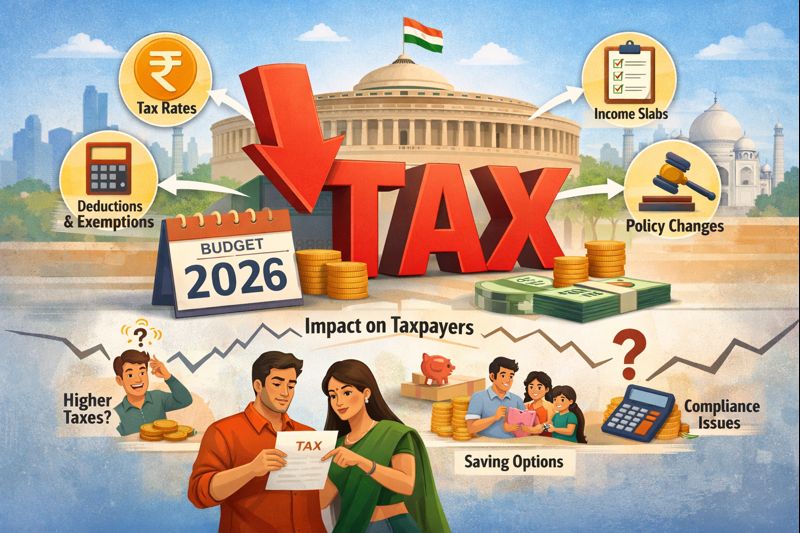
As Budget 2026 approaches, income tax changes are back in the spotlight. Many taxpayers are closely watching what may happen to the old tax regime, which offers various exemptions and deductions. Any changes could influence how people plan their taxes, savings, and investments.
While Budget 2026 is unlikely to abolish the old tax regime immediately, the government’s direction is clear. The focus remains on simplifying and promoting the new tax regime, with gradual adjustments expected. Taxpayers should keep an eye on tax slabs, standard deductions, and evolving exemption rules to plan their taxes effectively.
In this blog, we explain the expected tax changes and why they are being considered. Additionally, we discuss how they may affect taxpayers’ savings and tax planning.
Understanding Old and New Tax Regime
- Old Tax Regime: Allows taxpayers to reduce their taxable income through various exemptions (such as HRA and LTA) and deductions (including Sections 80C and 80D). However, it applies higher income tax slab rates.
- New Tax Regime (introduced in 2020): Offers lower tax rates with minimal exemptions and deductions. Taxpayers are free to choose the regime that results in lower tax liability.
In recent years, more taxpayers have been shifting to the new tax regime. This has prompted discussions about whether the old regime will continue to remain relevant in the future.
Why the Old Tax Regime is Being Reconsidered?
- Complex Structure: The wide range of exemptions and deductions makes the old regime difficult to understand. Furthermore, it is cumbersome to comply with for many taxpayers.
- Fairness Issues: Tax benefits tend to favour higher-income individuals who have the capacity to invest in tax-saving options. Meanwhile, many salaried taxpayers may not be able to take full advantage of these provisions.
- Uncertain Revenue Flow: A simpler tax system can help expand the tax base and enhance transparency. Moreover, it can limit revenue loss for the government.
- Higher Administrative Load: Verifying multiple exemptions increases the compliance burden for tax authorities. In addition, it raises the chances of errors or misuse.
- Evolving Income Patterns: The growth of gig work and streamlined salary structures has reduced the relevance of a deduction-heavy tax framework.
- Policy Consistency: Moving toward a simplified regime supports the government’s broader objective of easier compliance. As a result, it improves the ease of doing business.
Will Budget 2026 Set an End Date for the Old Tax Regime?
1. No Immediate Phase-Out Likely: According to Chartered Accountant Suresh Surana, announcing a fixed end date for the old tax regime may look administratively efficient. But, it cannot be done abruptly.
2. Need for Transition Safeguards: Any move to sunset the old regime would require proper transition measures. This is to avoid disrupting taxpayers who rely on exemptions and long-term tax-saving investments.
3. Gradual Policy Approach So Far: The government has consistently followed a phased strategy. It has steadily made the new tax regime more attractive, rather than forcing a sudden shift.
4. Focus on Incentivising Choice: Instead of eliminating the old regime outright, policymakers appear to be encouraging taxpayers to voluntarily move to the new regime. They do this through lower rates and simplified rules.
5. Budget 2026 Direction: If changes are announced, they are more likely to involve further incentives or tweaks to the new regime. It is less likely that a clear deadline for ending the old one will be set.
What changes are expected in Budget 2026?
- Budget 2026 is likely to prioritise fine-tuning the current income tax framework rather than introducing sweeping reforms.
- The government is expected to continue nudging taxpayers toward the new tax regime through small, targeted adjustments.
- Major changes to tax slabs or exemption limits may be limited. This signals a phase of consolidation after the significant revisions in Budget 2025.
- Several proposals are being discussed to enhance the appeal of the new tax regime. However, none have been officially confirmed so far.
- One key suggestion is to raise the income level at which the 30% tax rate applies, possibly beyond ₹24 lakh. This would offer relief to upper-middle-income groups.
- There are also demands to increase the standard deduction under the new regime from ₹75,000 to around ₹1 lakh for salaried taxpayers.
- Industry bodies have recommended introducing an intermediate tax slab of 20% or 25% for incomes ranging between ₹30 lakh and ₹50 lakh.
- Any upward revision in slab thresholds or deductions could result in higher take-home pay for salaried and middle-class taxpayers.
- Taxpayers opting for the old tax regime can continue to benefit from deductions such as Sections 80C and 80D, HRA, and home loan interest as long as the regime remains in place.
- If the government signals a phased withdrawal of the old regime, taxpayers may need to reassess long-term tax-saving and investment strategies.
- High-income earners are particularly watchful of surcharge-related announcements amid concerns over rising effective tax rates.
- On Budget Day, taxpayers should closely track updates on the future of the old tax regime, changes in slabs, standard deductions, rebates, and any surcharge revisions.
Is Maintaining Two Tax Regimes Still Practical for India?
Experts argue that the coexistence of two income tax regimes has added to taxpayer confusion rather than simplifying compliance. Garg points out that while the idea behind offering two options was to provide flexibility and choice, it has instead forced taxpayers to repeatedly calculate and compare tax liabilities every year to determine the more beneficial regime. This ongoing reassessment has increased complexity rather than reducing it.
Looking ahead, Garg suggests that India should take a balanced path by gradually positioning the new tax regime as the main system. At the same time, taxpayers should be encouraged to channel their savings into instruments that are recognised under the new regime. A phased move toward a single, simplified tax framework would reduce compliance burdens and improve transparency. This approach would also boost taxpayer confidence, and lead to fewer disputes and a more efficient tax system.
Strategies to Lower Your Taxes Easily
1. Plan taxes year-round:
Estimate your tax bracket early and review it again at year-end to identify strategies—such as higher pre-tax contributions—that can help lower your taxable income.
2. Maximize retirement contributions:
Investing in 401(k)s or IRAs can reduce taxes now through pre-tax or deductible contributions. Alternatively, it can offer long-term tax-free growth in the case of Roth IRAs.
3. Use an HSA for tax savings:
If eligible, contributing to an HSA lowers taxable income, allows tax-deferred growth, and offers tax-free withdrawals for qualified medical expenses.
4. Consider a QCD if you’re 70.5+:
Donating directly from your IRA to a charity can reduce your AGI, satisfy RMDs, and provide tax benefits whether you itemise or take the standard deduction.
5. Maximise itemised deductions:
If itemising makes sense, plan ahead to fully use deductions such as charitable donations, eligible medical expenses, and mortgage interest to lower taxable income.
6. Take advantage of tax credits:
Review available tax credits each year, as they directly reduce your tax bill and new or updated credits may offer additional savings.
7. Use tax-loss harvesting:
Selling investments at a loss can help offset capital gains and reduce taxes. Nevertheless, the strategy should be used carefully with professional guidance.
8. Consider tax-gains harvesting:
Strategically selling appreciated assets in years with lower income can help pay taxes at a more favourable rate. However, seek professional guidance as it’s a complex strategy.
FAQs
Q1. Will income tax slabs change in 2026?
Ans: A major revision of tax slab rates is unlikely in 2026. At best, only minor or minimal adjustments to the existing slabs may be introduced.
Q2. What is the standard deduction for 2026?
Ans: For the 2026 tax year, the standard deduction has been raised to $32,200 for married couples filing jointly. Single taxpayers and married individuals filing separately will be eligible for a standard deduction of $16,100.