



Aadhaar, India’s foundational digital identity system, is set for one of its most important upgrades in recent years. As new regulations and timelines come into effect from late 2025 through 2026, it becomes essential for every Aadhaar holder to stay informed. Overlooking these changes may lead to interruptions in critical services such as banking, financial transactions, tax-related processes, and access to government welfare schemes.
In this Blog, we will explain how Aadhaar updates function in real life and highlight what truly matters when regulations are revised. It looks at the impact of recent Aadhaar rule changes on verification, updates, and day-to-day usage. This blog clarifies the practical meaning of the ten-year document update, QR-code–based authentication, and age-linked biometric requirements. It also identifies common issues people face when Aadhaar details are outdated or inconsistent.
What is an Aadhaar Card?
An Aadhaar card is basically a document that gives a unique digital identity to all residents regardless of citizenship. It carries a unique 12-digit identification number that functions as a nationwide proof of identity and address for people living in India. Aadhar Card is Issued by the UIDAI (Unique Identification Authority of India) under the Ministry of Electronics and Information Technology.
It securely stores essential personal and biometric details such as name, date of birth, gender, address, photograph, fingerprints, and iris scans. The primary aim is to offer a single, dependable identity that can be used consistently across the country.
Key features of the Aadhaar Card
1. Unique 12-digit identity number
Aadhaar assigns a permanent, one-of-a-kind number. This enables individuals to be uniquely identified across various services and platforms.
2. Issued by UIDAI
The card is administered by the Unique Identification Authority of India, ensuring uniform, government-authorised identity verification.
3. Biometric-based verification
Aadhaar relies on fingerprints, iris scans, and facial recognition to provide reliable and secure authentication.
4. Core demographic information
It has important personal details such as the person’s name, DOB, gender, and address for identity confirmation.
5. Accepted nationwide
Aadhaar is valid throughout India, allowing seamless use irrespective of state or region.
6. Online and offline authentication
It supports multiple verification methods, including OTP, biometric checks, and QR-code–based validation, both digitally and offline.
7. Multiple Aadhaar formats
Aadhaar can be accessed in physical and digital forms, such as e-Aadhaar, mAadhaar, and the PVC card for user convenience.
8. Easy integration with services
Aadhaar can be linked with bank accounts, PAN, mobile numbers, and government schemes. This streamlines KYC and service access.
9. Facilitates Direct Benefit Transfer (DBT)
It enables government subsidies and benefits to be transferred directly to beneficiaries, minimising delays and leakages.
10. Enhanced privacy safeguards
Options like Masked Aadhaar, Virtual ID, and limited KYC are designed to protect personal information from misuse.
What are the new rules for Aadhar Card in 2026?
1. Mandatory Aadhaar–PAN Linking by December 31, 2025
One of the most important changes is the compulsory linking of Aadhaar with PAN by 31 December 2025. If this requirement is not met, the PAN will become inactive from 1 January 2026. This will make it unusable for filing income tax returns, opening bank accounts, or carrying out most financial transactions. The rule also applies to new PAN applicants, who must complete Aadhaar verification at the time of application. In effect, missing this deadline can seriously disrupt everyday financial and compliance-related activities. This is because PAN remains a core financial identity in India.
2. Online Aadhaar Updates Made Simpler with a Digital-First Approach
UIDAI has significantly simplified the Aadhaar update process by allowing key demographic details—such as name, address, date of birth, and mobile number—to be updated online. These changes can now be submitted through the official UIDAI portal or app using OTP-based verification. This eliminates the need to visit an Aadhaar enrolment centre for routine corrections. Compared to the earlier system, which often required physical appointments even for minor edits, the new digital process is faster, more convenient, and paperwork-free.
3. Revised Aadhaar Fees and Update Charges
From 1 November 2025, UIDAI has revised the fee structure for Aadhaar-related services, which continues into 2026. Demographic updates done at enrolment centres now attract a charge of ₹75, while biometric updates cost ₹125. Online document uploads remain free until 14 June 2026, after which fees may apply. Other services include ₹40 for Aadhaar PVC reprints and ₹700 for home enrolment for the first person. Additionally, authorities have reduced charges for additional family members living at the same address. Notably, biometric updates for children in the 5–7 and 15–17 age brackets remain free. This ensures their records stay accurate as they grow.
4. Easier KYC for Banking and Financial Services
To streamline customer verification, banks and financial institutions can now use simplified Aadhaar-based KYC methods. These include OTP-based Aadhaar authentication, video KYC, and in-person verification where required. This shift towards digital verification reduces paperwork, speeds up account opening, and improves the overall onboarding experience for customers.
5. Stronger Digital Security with QR-Based Aadhaar Features
UIDAI has also strengthened digital identity protection by enabling QR code–based Aadhaar verification through its official app. This allows individuals to share only the necessary details for verification without disclosing their full Aadhaar number. The QR-based, consent-driven system enhances privacy and security while still enabling quick and reliable identity checks for various services.
What should you do now?
1. PAN Inactivation Risk: If you do not link Aadhaar with PAN by the deadline, your PAN may become inactive from 1 January 2026. This prevents its use for income tax filing, refunds, and most financial transactions.
2. Avoidable Update Charges: Delaying Aadhaar updates can lead to unnecessary fees, as services that are currently free—especially online updates—may become chargeable after the grace period ends.
3. Service Delays and Disruptions: Outdated Aadhaar details can cause issues with KYC verification, bank account changes, mobile SIM registration, and access to government subsidies or benefit schemes.
4. Limits on Financial Access: Inaccurate or inconsistent Aadhaar information can trigger temporary blocks or delays in banking transactions, loan processing, credit card approvals, and the functioning Issued by the Unique Identification Authority of India (UIDAI) under the Ministry of Electronics and Information Technology. 5. Deadline-Driven Hassles: Procrastinating until the last moment often leads to overcrowded enrolment centres, system slowdowns, and a greater likelihood of mistakes. This can further delay corrections and approvals.
FAQs
Q1. How would I know if my Aadhaar needs an update?
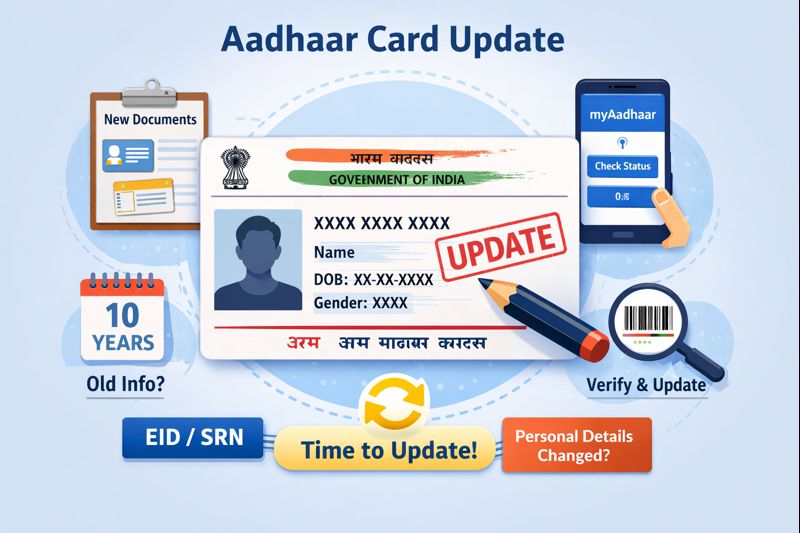
Ans. You need to update your Aadhaar if your personal details change or if you haven’t refreshed your documents in the past ten years. You can easily check the update status through the myAadhaar portal or the mAadhaar app using your EID or SRN.
Q2. Is it possible to download someone else’s Aadhaar?
Ans: No. You can download Aadhaar only after completing biometric verification or OTP authentication, which ensures that only the Aadhaar holder can access it.